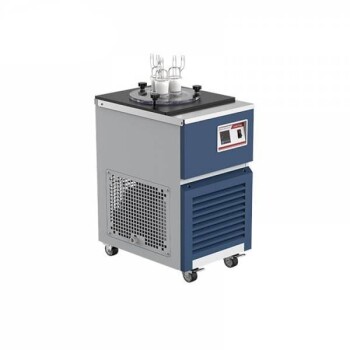
A liquid nitrogen cold trap serves as a critical purification stage within a vacuum system. Installed before the quadrupole mass spectrometer, it functions effectively as a cryopump, actively condensing residual gases and stray vapors. By removing these contaminants, the trap significantly lowers background noise, allowing the instrument to detect trace ion species evaporated from the sample with high precision.
The core value of a liquid nitrogen cold trap is its ability to drastically improve the signal-to-noise ratio. By freezing out background interference, it enables the detection of low-concentration species that would otherwise remain invisible.
How the Cold Trap Improves Vacuum Integrity
Functioning as a Localized Cryopump
The cold trap does not merely passively allow gas to pass; it actively alters the vacuum environment. The extreme low temperature of the liquid nitrogen causes gas molecules to lose thermal energy and bond to the trap's surface.
Condensing Residual Vapors
Even in high-quality vacuum systems, stray vapors and residual gases remain present. The cold trap condenses these unwanted elements before they can enter the quadrupole mass spectrometer. This prevents contaminants from interacting with the measurement electronics or the sample ions.
Enhancing Mass Spectrometer Performance
Reducing Background Signal Noise
The primary operational benefit of removing these stray vapors is a significant reduction in background noise. When the vacuum is cleaner, the electronic baseline of the spectrometer drops. This clarifies the data, ensuring that the signals recorded are from the sample rather than system contamination.
Increasing Detection Sensitivity
With a lower noise floor, the spectrometer's sensitivity is effectively enhanced. This allows for the resolution of much weaker signals.
Identifying Trace Species
This increased sensitivity is particularly critical for identifying low-concentration species. Without the cold trap, complex or subtle formations, such as dimers or trimers, would likely be obscured by the background noise.
Operational Considerations and Trade-offs
Necessity of Continuous Cooling
For the trap to function as a cryopump, it requires a consistent supply of liquid nitrogen. If the coolant level drops, the trapping efficiency vanishes immediately.
Risk of Re-release (Desorption)
The trapped gases are held only by the low temperature. If the trap is allowed to warm up while the system is still under vacuum, the condensed vapors will vaporize and release back into the chamber, potentially contaminating the very measurement you are trying to protect.
Making the Right Choice for Your Experiment
To maximize the utility of your mass spectrometer, consider your specific analytical goals:
- If your primary focus is general vacuum hygiene: The cold trap acts as an effective insurance policy against stray vapors, ensuring a consistent baseline for standard measurements.
- If your primary focus is detecting trace elements: The cold trap is non-negotiable; it is the specific component that lowers the noise floor enough to reveal low-concentration species like dimers and trimers.
By effectively managing the vacuum environment, the cold trap transforms a standard measurement into a high-sensitivity analysis capable of revealing the finest details of your sample.
Summary Table:
| Feature | Function & Benefit |
|---|---|
| Core Mechanism | Functions as a localized cryopump by condensing residual gases |
| Primary Benefit | Drastically improves signal-to-noise ratio for mass spectrometers |
| Noise Reduction | Lowers the electronic baseline by freezing out background interference |
| Sensitivity | Enables resolution of trace species, including dimers and trimers |
| Vapor Control | Prevents stray vapors from interacting with measurement electronics |
| Requirement | Needs a continuous supply of liquid nitrogen for operational efficiency |
Elevate Your Analytical Precision with KINTEK
Don't let background noise obscure your critical data. KINTEK specializes in high-performance laboratory solutions, providing the advanced cooling tools—including liquid nitrogen cold traps, ULT freezers, and freeze dryers—necessary to maintain vacuum integrity and maximize mass spectrometer sensitivity.
Whether you are conducting battery research, processing advanced ceramics, or performing high-pressure thermal analysis, our comprehensive range of laboratory equipment and consumables is designed to meet the most demanding research standards. From high-temperature vacuum furnaces to precision crushing and milling systems, we empower your lab with the reliability it deserves.
Ready to achieve high-sensitivity analysis? Contact KINTEK today to discover how our expertise can optimize your experimental outcomes!
References
- Elisa Capelli, R.J.M. Konings. Determination of the thermodynamic activities of LiF and ThF<sub>4</sub>in the Li<sub>x</sub>Th<sub>1−x</sub>F<sub>4−3x</sub>liquid solution by Knudsen effusion mass spectrometry. DOI: 10.1039/c5cp04777c
This article is also based on technical information from Kintek Solution Knowledge Base .
Related Products
- Liquid Nitrogen Cryogenic Grinder Mill Cryomill Airflow Ultrafine Pulverizer
- Liquid Nitrogen Cryogenic Grinder Mill Cryomill with Screw Feeder
- lab cryogenic grinding use liquid-nitrogen for pulverizing plastic raw materials and heat sensitive materials
- Small Cryogenic Grinder Cryomill Cryogrinder with Liquid Nitrogen for Laboratory Use
- Vacuum Cold Trap Direct Cold Trap Chiller
People Also Ask
- What is cryogenic grinding of crumb rubber? Achieve Fine, High-Quality Rubber Powder
- What are the advantages of using a cryogenic grinder? Achieve Nanoscale Precision for All-Solid-State Battery Cathodes
- What is the role of a cryogenic grinder in PET recycling? Transform Waste into High-Reactive Micron Powders
- Why is a cryogenic grinder required for cured alkyd resin HRMAS NMR? Ensure Structural Integrity & Sample Precision
- What is the temperature of cryogenic grinding? Achieve Superior Particle Size & Preserve Heat-Sensitive Materials