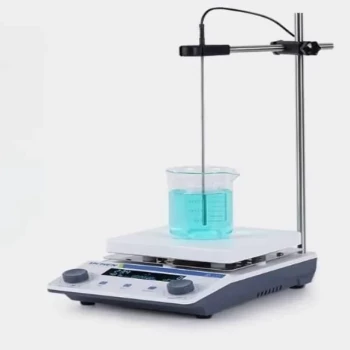
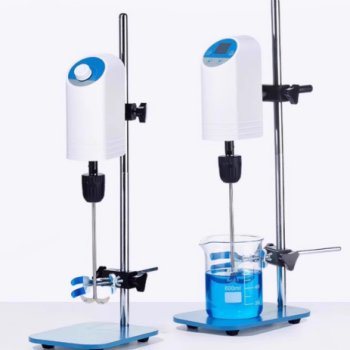
In the co-precipitation synthesis of doped zinc oxide nanoparticles, the magnetic stirrer functions as the primary driver of molecular-level homogeneity. It provides continuous, uniform mechanical power to mix precursor solutions—such as zinc chloride and doping metal salts—creating a state of forced convection throughout the reaction vessel.
Core Takeaway: The magnetic stirrer is not merely blending liquids; it is eliminating localized concentration gradients. This precise agitation is the defining factor in ensuring doping ions are incorporated evenly into the zinc oxide crystal lattice rather than segregating into impurities.
The Mechanics of Uniformity
Generating Forced Convection
The fundamental role of the magnetic stirrer is to convert electrical energy into mechanical power within the fluid.
By driving a stirring bar at controlled speeds, it generates continuous forced convection. This ensures that the entire volume of the liquid moves consistently, preventing stagnant zones where reactions might occur at different rates.
Achieving Molecular-Level Mixing
For doped nanoparticles, macroscopic mixing (simply swirling the liquid) is insufficient.
The stirrer ensures molecular-level mixing of the zinc precursors and the doping metal salts. This level of interaction is necessary so that the reactants meet chemically in the correct ratios at every point in the solution, rather than just physically occupying the same beaker.
Impact on Nanoparticle Quality
Ensuring Uniform Doping
The primary challenge in creating doped zinc oxide (e.g., with silver or manganese) is getting the foreign ions inside the crystal structure.
Thorough mixing driven by the stirrer guarantees that doping ions are evenly distributed around the zinc ions during the precipitation phase. This uniformity is what allows the dopant to successfully integrate into the zinc oxide crystal lattice.
Preventing Component Segregation
Without adequate stirring, different components of the solution may separate or react in isolation.
The magnetic stirrer prevents localized component segregation, where clusters of pure dopant or pure zinc oxide might form independently. By maintaining a homogenous solution, the device ensures the final product is a composite material with consistent properties, rather than a mixture of separated byproducts.
Understanding the Trade-offs
The Risk of Localized Gradients
If the stirring speed is insufficient or the magnetic coupling is weak, the solution will develop concentration gradients.
In these localized areas, the concentration of one reactant may spike relative to another. This leads to inconsistent nucleation sites, meaning some nanoparticles will grow larger than others, or some will lack the intended doping concentration entirely.
Balancing Shear and Stability
While high-intensity stirring is required for mixing, it must be balanced.
In broader chemical synthesis contexts, mechanical shear helps prevent agglomeration (clumping) of particles. However, the stirring must be stable to ensure that the chemical environment remains uniform over the entire duration of the reaction time, specifically to avoid separating the doping agents from the zinc precursors before precipitation occurs.
Making the Right Choice for Your Goal
## How to Apply This to Your Synthesis
- If your primary focus is Doping Efficiency: Ensure the stirrer provides vigorous, continuous agitation to force the doping ions into the crystal lattice and prevent segregation.
- If your primary focus is Particle Homogeneity: Verify that the stirring bar creates a full vortex without splashing to eliminate any "dead zones" where concentration gradients could ruin particle size distribution.
Uniform agitation is the invisible variable that determines whether you synthesize a high-performance nanomaterial or a segregated mixture of salts.
Summary Table:
| Feature | Function in Co-precipitation | Impact on ZnO Nanoparticles |
|---|---|---|
| Forced Convection | Converts mechanical power into fluid movement | Eliminates stagnant zones and dead spots |
| Molecular Mixing | Facilitates chemical interaction of ions | Ensures dopants integrate into the crystal lattice |
| Gradient Removal | Prevents localized concentration spikes | Maintains consistent particle size and distribution |
| Component Stability | Inhibits spontaneous segregation | Prevents formation of pure dopant clusters/impurities |
Elevate Your Nanomaterial Synthesis with KINTEK Precision
Achieving molecular-level homogeneity in doped zinc oxide synthesis requires more than just basic agitation—it requires reliable, controlled power. KINTEK specializes in high-performance laboratory equipment designed for the rigorous demands of advanced chemical research. From high-stability magnetic stirrers and homogenizers to crushing, milling, and sieving systems, we provide the tools necessary to ensure your nanoparticle production is consistent and impurity-free.
Whether you are working on battery research, advanced ceramics, or high-temperature reactions, our comprehensive portfolio—including muffle furnaces, high-pressure reactors, and specialized crucibles—is engineered to meet your exact specifications.
Ready to optimize your lab's efficiency and material quality? Contact KINTEK today to find the perfect solution for your research goals!
References
- Mengstu Etay Ashebir, Tesfakiros Woldu Gebreab. Structural, Optical, and Photocatalytic Activities of Ag-Doped and Mn-Doped ZnO Nanoparticles. DOI: 10.1155/2018/9425938
This article is also based on technical information from Kintek Solution Knowledge Base .
Related Products
- Laboratory Small Constant Temperature Heated Magnetic Stirrer Heater and Stirrer
- Custom PTFE Teflon Parts Manufacturer for Magnetic Stirring Bar
- Three-dimensional electromagnetic sieving instrument
- High Performance Laboratory Stirrers for Diverse Applications
- Custom PTFE Teflon Parts Manufacturer for PTFE Stirring Bar Recovery Rod
People Also Ask
- What role does a magnetic stirrer with heating play in ZnO nanoparticle synthesis? Precision Control for Quality Results
- What role does a constant temperature heating magnetic stirrer play in MFC-HAp synthesis? Achieve Material Homogeneity
- What is the function of a laboratory magnetic stirrer in Ni–Cr–P electrodeposition? Optimize Ion Transport & Coating
- Why is a laboratory magnetic stirrer required for benzoic acid esters? Boost Reaction Speed & Yield with High RPM
- What role does a laboratory magnetic stirrer play in TiO2 and TiO2-Ag sol preparation? Master Chemical Kinetics