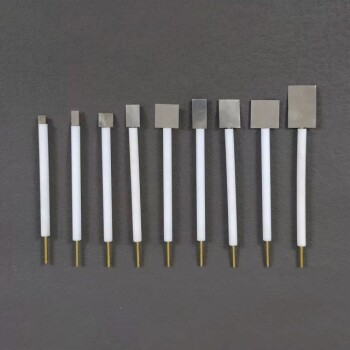
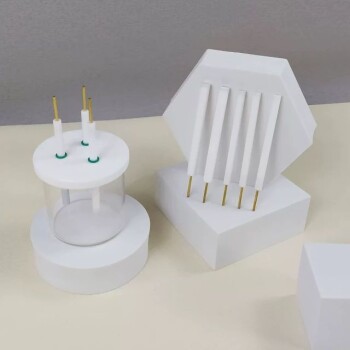
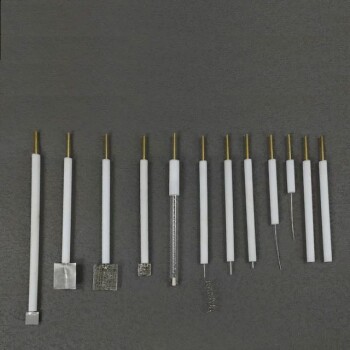
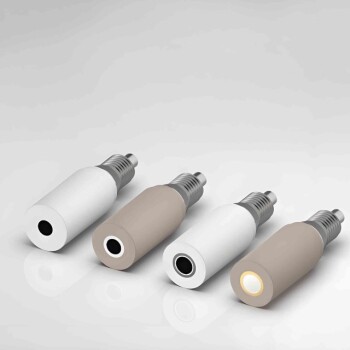
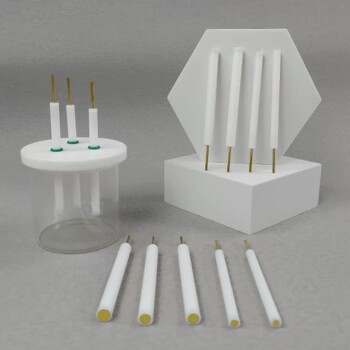
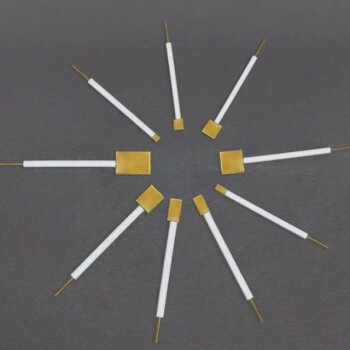
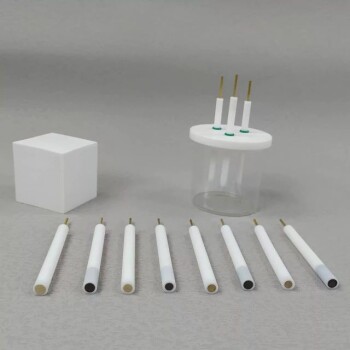
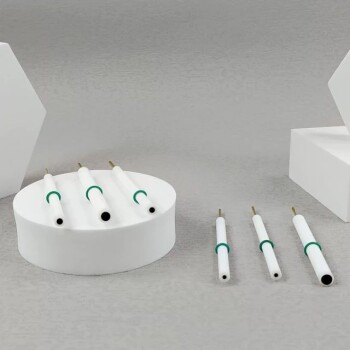
The platinum electrode serves as the counter (auxiliary) electrode. In a three-electrode system testing Ag@CuO@rGO materials, its primary role is to complete the electrical circuit and carry the current, ensuring that the measured signals accurately reflect the electrochemical properties of the working electrode.
The platinum electrode provides a stable, chemically inert surface for the balancing charge transfer reaction. By handling the current flow, it prevents the reference electrode from becoming polarized, thereby ensuring precise potential control and reliable data for the Ag@CuO@rGO material.
The Essential Functions of the Platinum Electrode
Completing the Electrical Circuit
In an electrochemical cell, current must flow through a complete loop to be measured. The platinum electrode acts as the "exit" or "entrance" for electrons, pairing with the Ag@CuO@rGO working electrode to facilitate this flow.
Preserving Measurement Integrity
Because platinum is chemically inert, it does not participate in the redox reactions of the Ag@CuO@rGO material. This ensures that the current signals recorded by the potentiostat are strictly the result of the working electrode's behavior, rather than side reactions from the counter electrode.
Balancing Charge Transfer
To maintain electroneutrality in the electrolyte, the counter electrode must perform an equal and opposite reaction to the working electrode. Platinum’s high catalytic activity allows it to support reactions like hydrogen or oxygen evolution with very low resistance.
Why Platinum is the Industry Standard
High Electrical Conductivity
Platinum's superior conductivity minimizes the ohmic drop (voltage loss) within the measurement circuit. This efficiency allows the system to capture fast charge-carrier dynamics, which is critical when analyzing high-performance materials like Ag@CuO@rGO.
Chemical Inertness and Purity
Platinum does not dissolve or corrode, even in the harsh acidic or alkaline electrolytes often used for testing metal oxides and carbon-based composites. This prevents the introduction of metallic impurities that could "poison" the Ag@CuO@rGO surface and skew results.
Protecting the Reference Electrode
In a two-electrode system, current flows through the reference electrode, causing it to lose its stable potential (polarization). The platinum electrode in a three-electrode setup carries the experimental current instead, allowing the reference electrode to maintain a constant baseline.
Understanding the Trade-offs
The Risk of Surface Area Imbalance
If the platinum electrode's surface area is too small relative to the working electrode, it can become a bottleneck for the current. This limitation can distort polarization curves and lead to inaccurate electrochemical impedance spectroscopy (EIS) data.
Cost and Material Management
Platinum is a precious metal, making high-purity electrodes an expensive component of the laboratory setup. While durable, these electrodes require regular cleaning (typically via flame or acid treatment) to maintain their catalytic activity and prevent cross-contamination between experiments.
Optimizing Your Electrochemical Setup
Practical Recommendations for Testing
When characterizing Ag@CuO@rGO or similar composite materials, the configuration of your counter electrode directly impacts your data quality.
- If your primary focus is Precise Kinetic Data: Ensure the platinum electrode has a surface area at least 10 times larger than your working electrode to prevent counter-electrode limitation.
- If your primary focus is Long-term Stability: Use high-purity platinum wire or mesh to avoid leaching trace metals that could catalyze unwanted side reactions on your sample.
- If your primary focus is Impedance Accuracy: Position the platinum electrode symmetrically relative to the working electrode to ensure a uniform primary current distribution.
By utilizing a platinum counter electrode, you isolate the unique redox characteristics of Ag@CuO@rGO, ensuring your findings are both reproducible and scientifically sound.
Summary Table:
| Key Feature | Role of Platinum Electrode | Benefit to Ag@CuO@rGO Analysis |
|---|---|---|
| Primary Role | Counter (Auxiliary) Electrode | Completes the electrical circuit without interference. |
| Chemical Property | High Inertness & Purity | Prevents contamination and unwanted side reactions. |
| Conductivity | High Electrical Conductivity | Minimizes voltage loss (ohmic drop) for fast kinetics. |
| System Stability | Polarisation Prevention | Protects the reference electrode to ensure precise potential control. |
| Catalytic Activity | High Surface Activity | Supports balancing charge transfer (H2/O2 evolution). |
Elevate Your Electrochemical Research with KINTEK
Precision in material characterization starts with superior hardware. KINTEK specializes in high-performance laboratory equipment designed to meet the rigorous demands of advanced research. Whether you are optimizing Ag@CuO@rGO composites or exploring new energy materials, we offer a comprehensive suite of tools to ensure your data is accurate and reproducible.
Our portfolio includes:
- High-Purity Electrolytic Cells and Electrodes: Platinum, glassy carbon, and reference electrodes for stable measurements.
- Battery Research Tools: Specialized consumables and tools for next-generation storage solutions.
- Thermal Processing: A wide range of muffle, tube, and vacuum furnaces for material synthesis.
- Precision Systems: Crushing, milling, and hydraulic presses (pellet, isostatic) for sample preparation.
Don't let equipment limitations bottleneck your scientific breakthroughs. Contact KINTEK today to discuss your specific testing requirements and discover how our high-quality laboratory solutions can enhance your research efficiency.
References
- Yuxin Zhang, Wei‐Zhong Han. Synthesis by adding CTAB and characterization of Ag@CuO@rGO nanocomposite with a novel core–shell crystal sugar structure and its application in supercapacitors. DOI: 10.1039/d3ra03025c
This article is also based on technical information from Kintek Solution Knowledge Base .
Related Products
- Platinum Sheet Electrode for Laboratory and Industrial Applications
- Platinum Sheet Electrode for Battery Lab Applications
- Rotating Platinum Disk Electrode for Electrochemical Applications
- Platinum Auxiliary Electrode for Laboratory Use
- RRDE rotating disk (ring disk) electrode / compatible with PINE, Japanese ALS, Swiss Metrohm glassy carbon platinum
People Also Ask
- What is a common use for a platinum sheet electrode? As a Reliable Counter Electrode in Electrochemical Cells
- What is the most critical guideline for immersing a platinum sheet electrode in an electrolyte? Ensure Accurate Electrochemical Measurements
- What is the purity of the platinum sheet in a platinum sheet electrode? The Key to Reliable Electrochemical Data
- What is the expected lifespan of a platinum sheet electrode? Maximize Your Electrode's Service Life
- What are the available specifications for platinum sheet electrodes? Find the Perfect Fit for Your Electrochemical Needs