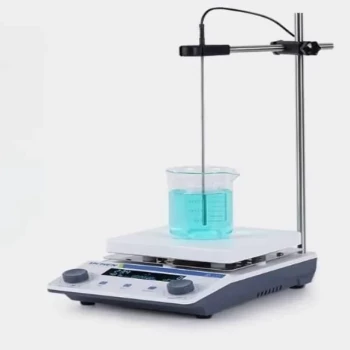
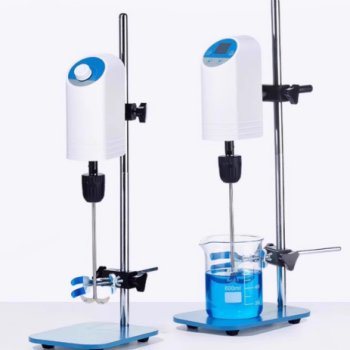
The primary function of a sealed reactor equipped with an impeller stirrer is to provide a controlled environment for the kinetic mixing of silicone enamel suspensions. This equipment applies necessary rotational shear force to disperse aluminum pigments, polyphenylsiloxane lacquer, and surfactants while simultaneously preventing the loss of volatile solvents.
Success in preparing silicone enamel suspensions relies on balancing mechanical dispersion with chemical stability. The sealed impeller system serves as a unified control unit, ensuring uniform pigment distribution through shear force while preserving exact formulation ratios by trapping volatile components.
The Mechanics of Kinetic Mixing
Applying Rotational Shear Force
The impeller stirrer functions as the mechanical driver of the process. It generates controlled rotational shear force, which is essential for interacting with the solid components of the suspension. This force breaks down agglomerates to ensure a smooth mixture.
Ensuring Component Integration
This mechanical energy drives the kinetic mixing of three specific elements: aluminum pigments, polyphenylsiloxane lacquer, and surfactants. The impeller ensures these distinct materials are forced into a cohesive blend rather than remaining as separate layers.
Achieving Uniform Dispersion
The ultimate goal of the impeller is homogeneity. By maintaining consistent motion, the stirrer ensures that the aluminum pigments achieve a uniform initial dispersion within the polymer matrix.
The Critical Role of the Sealed Design
Preventing Solvent Evaporation
The "sealed" nature of the reactor is a functional necessity, not just a safety feature. The formulation utilizes toluene, a highly volatile solvent. In an open vessel, this solvent would evaporate rapidly during the mixing process.
Maintaining Precise Ratios
Evaporation is the enemy of formulation accuracy. By sealing the reactor, you ensure that the precise formulation ratios are maintained from the start to the end of the mixing cycle.
Stabilizing the Polymer Matrix
If solvent is lost, the viscosity and chemistry of the suspension change. The sealed environment preserves the intended interaction between the solvent and the polymer matrix, ensuring the final enamel performs as designed.
Understanding Operational Constraints
Managing Shear Intensity
While shear force is required for mixing, it presents a trade-off regarding pigment integrity. Excessive shear can damage the structure of aluminum pigments. Operators must balance the need for dispersion with the need to preserve the physical properties of the pigment flakes.
The Risk of Seal Failure
Reliance on a sealed system creates a single critical point of failure. If the reactor seal is compromised, solvent loss is immediate and invisible. This can alter the solid-to-solvent ratio, leading to off-spec batches that are too viscous or chemically unbalanced.
Optimizing Your Preparation Process
To ensure high-quality silicone enamel suspensions, align your equipment settings with your specific production goals:
- If your primary focus is Dispersion Quality: Calibrate the impeller's rotational speed to maximize shear force just below the threshold where pigment damage occurs.
- If your primary focus is Batch Consistency: Implement rigorous pre-run checks on the reactor's seals to ensure zero loss of toluene, guaranteeing the viscosity remains stable.
Precise control over both mechanical shear and atmospheric containment is the key to producing superior silicone enamel suspensions.
Summary Table:
| Feature | Function in Silicone Enamel Preparation | Benefit |
|---|---|---|
| Impeller Stirrer | Generates rotational shear force | Ensures uniform dispersion of aluminum pigments and surfactants. |
| Sealed Design | Prevents evaporation of volatile solvents (toluene) | Maintains precise formulation ratios and suspension viscosity. |
| Kinetic Mixing | Drives integration of pigments, lacquer, and surfactants | Creates a cohesive, homogeneous polymer matrix blend. |
| Controlled Environment | Balances mechanical shear vs. chemical stability | Protects pigment integrity while ensuring batch consistency. |
Elevate Your Material Processing with KINTEK Precision
Achieving the perfect silicone enamel suspension requires a delicate balance of mechanical shear and atmospheric control. At KINTEK, we specialize in high-performance laboratory equipment designed to meet the rigorous demands of chemical research and industrial production.
Our comprehensive range of high-temperature high-pressure reactors and autoclaves, alongside our advanced crushing, milling, and stirring systems, provides the reliability you need for sensitive kinetic mixing tasks. Whether you are working with volatile solvents like toluene or require precise homogenization for battery research and ceramic materials, KINTEK delivers the tools to ensure batch consistency and product integrity.
Ready to optimize your lab's efficiency and formulation accuracy? Contact our technical experts today to find the ideal reactor or mixing solution tailored to your specific application.
References
- Vitaliy Tyukanko, Marianna Lezhneva. Optimization of the Composition of Silicone Enamel by the Taguchi Method Using Surfactants Obtained from Oil Refining Waste. DOI: 10.3390/polym13213619
This article is also based on technical information from Kintek Solution Knowledge Base .
Related Products
- Laboratory Small Constant Temperature Heated Magnetic Stirrer Heater and Stirrer
- High Performance Laboratory Stirrers for Diverse Applications
- Stainless High Pressure Autoclave Reactor Laboratory Pressure Reactor
- High Pressure Laboratory Autoclave Reactor for Hydrothermal Synthesis
- Customizable High Pressure Reactors for Advanced Scientific and Industrial Applications
People Also Ask
- What role does a magnetic stirrer with heating play in ZnO nanoparticle synthesis? Precision Control for Quality Results
- What role does a constant temperature heating magnetic stirrer play in MFC-HAp synthesis? Achieve Material Homogeneity
- What is the function of a laboratory magnetic stirrer in Ni–Cr–P electrodeposition? Optimize Ion Transport & Coating
- Why is a laboratory magnetic stirrer required for benzoic acid esters? Boost Reaction Speed & Yield with High RPM
- What role does a laboratory magnetic stirrer play in TiO2 and TiO2-Ag sol preparation? Master Chemical Kinetics