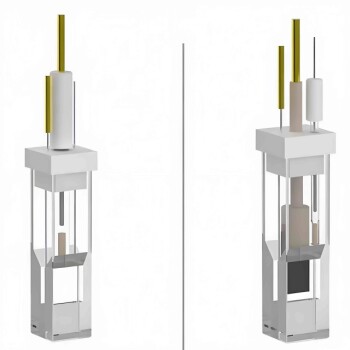
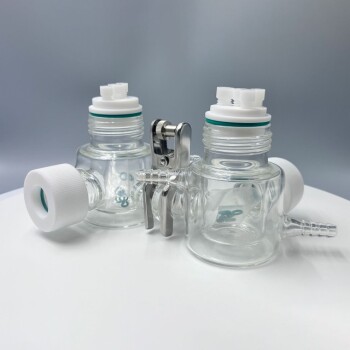
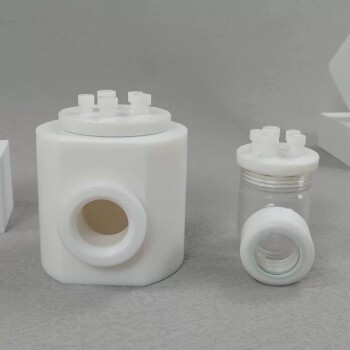
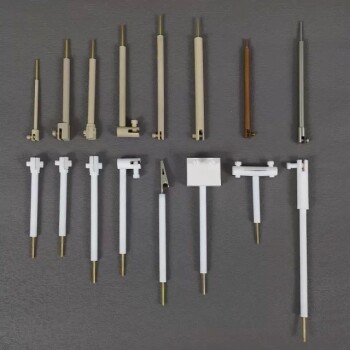
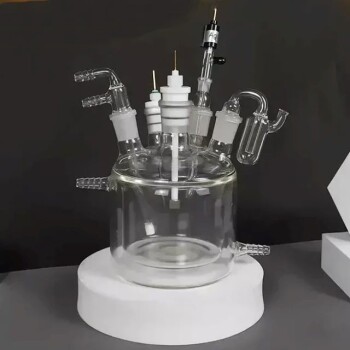
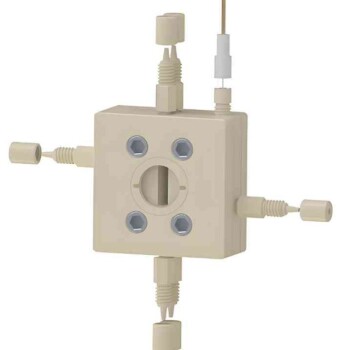
The primary function of a three-electrode electrochemical cell in ORR testing is to provide precise, independent control over the FeCo-N6-C catalyst's potential. By separating the current-carrying loop from the potential-sensing loop, this configuration allows researchers to accurately observe how pH-driven changes—such as the orientation of water molecules at the catalyst surface—affect catalytic activity without interference from voltage drops or counter-electrode limitations.
A three-electrode cell isolates the working electrode’s electrical potential from the system’s total current flow. This ensures that measurements of the FeCo-N6-C catalyst reflect its true intrinsic activity and the specific behavior of the double-layer microenvironment across varying pH levels.
Precision Control through Component Specialization
The Role of the Reference Electrode
In this setup, a reference electrode (such as Ag/AgCl or Mercury/Mercurous Sulfate) provides a stable, known potential that does not change regardless of the current. This allows the electrochemical workstation to maintain the FeCo-N6-C catalyst at an exact voltage, which is critical for identifying the onset of the Oxygen Reduction Reaction (ORR).
Separation of Current and Potential Loops
Unlike a two-electrode system, the three-electrode cell uses a counter electrode (typically a large-area platinum wire) to complete the circuit. This separation ensures that the potential measurement at the working electrode is not distorted by the Ohmic pressure drop (iR drop) caused by current passing through the electrolyte, leading to more accurate kinetic data.
Ensuring Stable Reactant Concentrations
To simulate ORR effectively, the system must maintain a stable environment for the oxygen reactants. The three-electrode configuration is typically paired with an electrolyte (like 0.1 M KOH or PBS) saturated with high-purity oxygen, ensuring that Linear Sweep Voltammetry (LSV) data reflects the catalyst's performance rather than fluctuations in oxygen availability.
Observing the Catalyst-Electrolyte Interface
pH-Dependent Water Structuring
The primary value of precise potential regulation is the ability to observe the double-layer microenvironment. In acidic conditions, researchers can detect an ordered O-down water configuration, while in alkaline conditions, a disordered water molecule arrangement typically occurs.
Identifying Intrinsic Activity Indicators
Because the counter electrode is designed with a large surface area, it ensures that the loop current is never a bottleneck. This allows the system to reflect the true intrinsic electrocatalytic activity of the FeCo-N6-C material, rather than being limited by the hardware's ability to move electrons.
Facilitating Kinetic Analysis
Precise control over the potential allows for the generation of clean Tafel plots and accurate kinetic current calculations. This is essential for understanding why the same FeCo-N6-C catalyst may exhibit different efficiency levels when moving from acidic to alkaline environments.
Understanding the Trade-offs and Pitfalls
The Challenge of Ohmic Compensation
Even with three electrodes, high-current density tests can still suffer from residual Ohmic resistance. Failure to manually or automatically compensate for this resistance in the software can lead to an underestimation of the catalyst's true performance.
Reference Electrode Stability across pH
Not all reference electrodes are suitable for all pH levels. Using a reference electrode that is unstable in highly acidic or highly alkaline electrolytes can introduce potential drift, leading to inconsistent data when comparing FeCo-N6-C performance across different environments.
How to Apply This to Your Research
Implementing the Three-Electrode Setup
- If your primary focus is mechanistic understanding: Use the three-electrode setup to isolate the specific potential where water molecules transition from disordered to ordered states to explain pH-dependent activity.
- If your primary focus is material benchmarking: Prioritize a large-area platinum counter electrode to ensure that the measured current densities reflect the FeCo-N6-C’s intrinsic limits rather than system limitations.
- If your primary focus is kinetic accuracy: Ensure you utilize an electrochemical workstation capable of real-time iR compensation to eliminate errors caused by electrolyte resistance.
By decoupling potential from current, the three-electrode cell transforms the electrochemical environment into a precise laboratory for observing the molecular-level interactions that define ORR efficiency.
Summary Table:
| Component | Role in ORR Testing | Key Benefit |
|---|---|---|
| Working Electrode | Hosts FeCo-N6-C catalyst | Measures intrinsic catalytic activity & microenvironment changes |
| Reference Electrode | Provides stable, known potential | Ensures precise voltage control without current interference |
| Counter Electrode | Completes the electrical circuit | Prevents system bottlenecks; supports high current densities |
| Electrolyte | Ion transport (e.g., KOH, PBS) | Allows testing across pH levels to observe water structuring |
Elevate Your Electrochemical Research with KINTEK
Precision is the backbone of groundbreaking material science. At KINTEK, we understand that simulating ORR for advanced catalysts like FeCo-N6-C requires uncompromising accuracy. Our high-performance electrolytic cells and electrodes are designed to provide the stable environment needed to isolate intrinsic activity from system noise.
Whether you are a researcher focused on pH-dependent water structuring or a lab manager looking for reliable battery research tools, KINTEK offers a comprehensive suite of solutions, including:
- Electrochemical Excellence: High-purity electrodes, electrolytic cells, and precision consumables.
- Thermal Processing: Muffle, tube, and vacuum furnaces for catalyst synthesis.
- Material Preparation: Hydraulic presses, crushing systems, and specialized ceramics/crucibles.
Ready to optimize your lab's performance? Contact our experts today to discuss how our specialized laboratory equipment can accelerate your next breakthrough.
References
- Peng Li, Shengli Chen. Revealing the role of double-layer microenvironments in pH-dependent oxygen reduction activity over metal-nitrogen-carbon catalysts. DOI: 10.1038/s41467-023-42749-7
This article is also based on technical information from Kintek Solution Knowledge Base .
Related Products
- H Type Electrolytic Cell Triple Electrochemical Cell
- PTFE Electrolytic Cell Electrochemical Cell Corrosion-Resistant Sealed and Non-Sealed
- Electrolytic Electrochemical Cell Gas Diffusion Liquid Flow Reaction Cell
- Electrolytic Electrochemical Cell with Five-Port
- Electrolytic Electrochemical Cell for Coating Evaluation
People Also Ask
- What is a H type cell? A Guide to Divided Electrochemical Cells for Accurate Experiments
- How should the electrolyte be prepared and added to the H-type electrolytic cell? Best Practices for Purity and Safety
- What is the technical necessity of using an H-type electrolytic cell for NO3RR tests? Protect Your Ammonia Yields
- How does the design of an H-type electrolytic cell benefit the neutral water electrolysis process for metal recovery?
- What is the primary function of an H-type electrolytic cell in NitRR? Ensure Accurate Product Yields