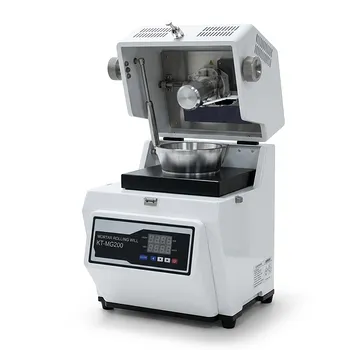
The primary function of a three-roll mill in this context is to apply high shear forces to thoroughly disperse nano-scale BSCF catalyst powders within a viscous medium. By processing the mixture through horizontally rotating rollers, the mill breaks down particle agglomerates and ensures a homogenous blend with binders and solvents, which is critical for subsequent screen printing.
Core Takeaway Achieving a high-quality catalyst layer requires more than simple mixing; it demands the de-agglomeration of nanoparticles. The three-roll mill uses mechanical shear to ensure the BSCF powder is uniformly distributed, resulting in a layer with consistent pore structure and mechanical strength.
The Mechanics of High-Shear Mixing
Generating Shear Force
The machine operates using three horizontally positioned rollers. These rollers rotate against one another, often at varying speeds, to create intense friction and pressure at the nip points (the spaces between rollers).
Breaking Down Agglomerates
The primary challenge with nano-scale powders like BSCF is their tendency to clump together. The high shear forces generated by the rollers physically pull these clusters apart. This ensures that the catalyst exists as individual particles rather than inconsistent lumps within the slurry.
The Role of Formulation Components
Integrating the Binder
The milling process is essential for incorporating binders, such as ethyl cellulose. The mill forces the binder to coat the dispersed particles evenly, which is necessary to hold the catalyst layer together after drying.
Distributing the Solvent
Solvents like terpineol provide the liquid medium for the slurry. The three-roll mill ensures the solvent is fully integrated with the powder and binder, creating a paste with the correct rheology (flow properties) for application.
Understanding the Trade-offs
Process Intensity vs. Material Integrity
While high shear is necessary for dispersion, it is an aggressive process. The friction generates heat, which must be managed to prevent the solvent from evaporating prematurely or the binder from degrading.
Efficiency Considerations
Three-roll milling is generally slower than simple impeller mixing. It is a precision step intended for high-viscosity pastes where quality and uniformity take precedence over rapid throughput.
Optimizing for Screen Printing
The ultimate goal of using a three-roll mill is to prepare a slurry suitable for screen printing. A poorly mixed slurry will clog screens or result in a patchy catalyst layer.
- If your primary focus is Uniform Porosity: The mill is critical because it eliminates agglomerates that would otherwise create dense spots or voids in the final layer.
- If your primary focus is Mechanical Strength: The mill ensures the binder is perfectly distributed, preventing the finished layer from cracking or delaminating during use.
The three-roll mill effectively transforms raw BSCF powder into a high-performance ink capable of delivering precise electrochemical results.
Summary Table:
| Feature | Function in BSCF Slurry Preparation | Impact on Final Catalyst Layer |
|---|---|---|
| High Shear Force | Breaks down nano-scale BSCF agglomerates | Ensures uniform pore structure and consistency |
| Differential Rolling | Homogenizes powder, binder, and solvent | Prevents clogging during screen printing |
| Binder Integration | Evenly coats particles with ethyl cellulose | Enhances mechanical strength and prevents cracking |
| Rheology Control | Optimizes viscosity and flow properties | Enables precise, high-quality layer deposition |
Elevate Your Materials Research with KINTEK Precision
Achieving the perfect catalyst ink requires professional-grade dispersion. KINTEK specializes in advanced laboratory equipment designed for the most demanding applications, including high-performance crushing and milling systems and homogenizers tailored for nanoparticle research.
Whether you are developing next-generation BSCF catalysts or scaling up battery research, our comprehensive range of high-temperature furnaces, hydraulic presses, and specialized consumables ensures your lab achieves repeatable, high-precision results.
Ready to optimize your slurry preparation? Contact our technical experts today to find the ideal milling and dispersion solution for your specific laboratory needs.
References
- Diana Marcano, José M. Serra. Controlling the stress state of La1−Sr Co Fe1−O3− oxygen transport membranes on porous metallic supports deposited by plasma spray–physical vapor process. DOI: 10.1016/j.memsci.2015.12.029
This article is also based on technical information from Kintek Solution Knowledge Base .
Related Products
People Also Ask
- What laboratory apparatus is used for grinding? Match the Right Mill to Your Sample Material
- What is the function of a laboratory grinding mill? Achieve Precise Sample Preparation for Accurate Results
- What is the purpose of using a laboratory grinder and standard sieves? Unlock Precise Rice Husk Pretreatment
- What is the role of laboratory-grade grinders and sieves in sample prep? Ensure High-Precision Corrosion Analysis
- What is the purpose of using a laboratory grinder with specific mesh sieves for oat straw? Optimize Pellet Quality