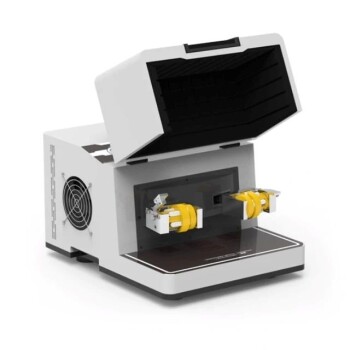
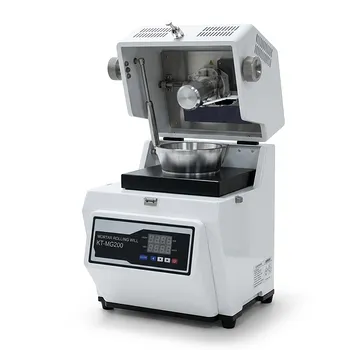
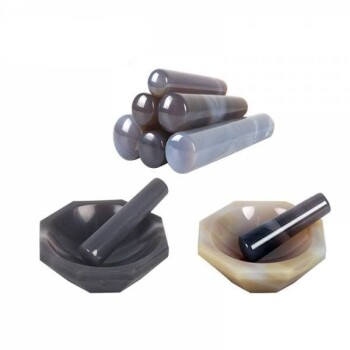
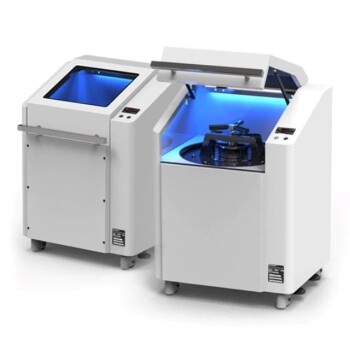
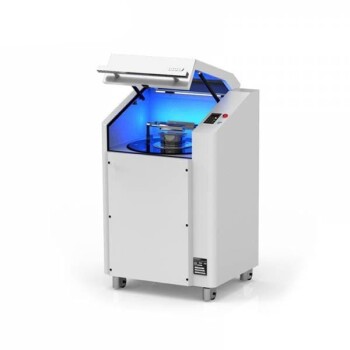
High-purity grinding equipment is the foundational tool for ensuring chemical homogeneity in the synthesis of Tl-1212 superconductors. During the initial solid-state reaction phase, equipment such as agate mortars is used to pulverize and blend raw materials like barium carbonate, strontium carbonate, calcium oxide, and copper oxide. This process ensures the mixture reaches micro-scale uniformity, which is a critical prerequisite for successful pre-calcination and the prevention of material defects.
Core Takeaway: High-purity grinding serves to eliminate localized compositional segregation by ensuring raw materials are mixed at the micro-scale. This uniformity facilitates the complete decomposition of carbonates and promotes rapid, even reactions across multi-component oxides during thermal processing.
The Role of Micro-Scale Uniformity
Achieving Physical Homogeneity
The primary function of grinding is to reduce the particle size of raw materials and distribute them evenly throughout the bulk mixture. By using high-purity tools like agate mortars, researchers can achieve a level of physical homogeneity that is impossible with manual mixing alone.
This micro-scale mixing ensures that every region of the precursor powder contains the correct stoichiometric ratio of barium, strontium, calcium, and copper. This precise distribution is necessary because the subsequent chemical reactions depend on the immediate proximity of these different atoms.
Facilitating Carbonate Decomposition
Tl-1212 precursors often rely on carbonate-based raw materials, which must be fully decomposed into oxides during the pre-calcination phase. High-purity grinding increases the surface area of these carbonates, allowing carbon dioxide to escape more efficiently.
Without thorough grinding, large clusters of carbonates may remain partially unreacted. This creates "dead zones" in the powder that can hinder the development of the superconducting phase later in the process.
Preventing Compositional Segregation
Avoiding Localized Imbalances
If the raw materials are not mixed with extreme precision, the precursor will suffer from localized compositional segregation. This occurs when certain areas of the powder have an excess of one element and a deficiency of another.
Segregation leads to the formation of secondary, non-superconducting phases that degrade the electrical properties of the final Tl-1212 material. Grinding acts as a preventative measure to ensure the chemical environment remains consistent throughout the entire sample.
Accelerating Multi-Component Reactions
The formation of Tl-1212 requires multiple metal oxides to react simultaneously during heating. Grinding ensures that these multi-component oxides are in direct contact at the micro-scale, significantly increasing the reaction rate.
Rapid, uniform reactions during pre-calcination result in a more stable precursor powder. This stability is essential for the final step where thallium is introduced, as it provides a consistent framework for the superconductor to form.
Understanding the Trade-offs
Contamination Risks
While grinding is necessary, it introduces the risk of mechanical contamination from the grinding media itself. Even high-purity materials like agate can shed trace amounts of silica into the precursor if the grinding duration is excessive.
These impurities can disrupt the delicate crystal lattice of the Tl-1212 superconductor. Engineers must balance the need for fine particle sizes against the potential for introducing foreign elements that could lower the transition temperature ($T_c$).
Energy vs. Uniformity
Increasing the grinding time generally improves uniformity but also generates heat, which can cause some materials to clump or undergo premature phase changes. Mechanical energy input must be carefully calibrated to ensure a free-flowing, fine powder rather than a compacted cake.
If the powder becomes too fine, it may also become hygroscopic, absorbing moisture from the air. This moisture can interfere with the pre-calcination process and lead to inconsistent results across different batches.
How to Apply This to Your Project
Selecting a Grinding Strategy
To ensure the highest quality Tl-1212 precursor, your grinding protocol must align with your specific material requirements and purity standards.
- If your primary focus is Phase Purity: Use high-purity agate mortars and limit grinding time to the minimum required for micro-scale uniformity to prevent silica contamination.
- If your primary focus is Reaction Kinetics: Prioritize high-energy ball milling or extended grinding sessions to maximize surface area, ensuring the sample is kept in a dry environment to prevent moisture absorption.
By mastering the grinding phase, you establish the chemical foundation necessary for high-performance superconducting materials.
Summary Table:
| Function | Impact on Tl-1212 Synthesis | Recommended Equipment |
|---|---|---|
| Micro-scale Homogeneity | Prevents stoichiometric imbalances and secondary phases | Agate Mortars / Milling Systems |
| Increased Surface Area | Accelerates carbonate decomposition and reaction rates | High-Purity Crushing Systems |
| Phase Stability | Ensures uniform reaction across multi-component oxides | Precision Grinding Tools |
| Contamination Control | Protects the crystal lattice from foreign impurities | High-Purity Ceramic Media |
Elevate Your Superconductor Research with KINTEK
Precision is paramount in the synthesis of high-performance materials like Tl-1212 superconductors. At KINTEK, we provide the specialized laboratory equipment necessary to achieve micro-scale uniformity and phase purity.
Our portfolio features advanced crushing and milling systems to ensure flawless precursor blending, alongside a comprehensive range of high-temperature furnaces (muffle, tube, vacuum, and atmosphere) for precise calcination and sintering. To support your entire workflow, we also offer high-temperature high-pressure reactors, pellet presses, and essential high-purity ceramic consumables that prevent mechanical contamination.
Ready to optimize your material synthesis? Contact our experts today to explore how KINTEK can enhance your lab's efficiency and results!
References
- J. Nur-Akasyah, Tet Vui Chong. Elemental Substitution at Tl Site of Tl1−xXx(Ba, Sr)CaCu2O7 Superconductor with X = Cr, Bi, Pb, Se, and Te. DOI: 10.3390/ma16114022
This article is also based on technical information from Kintek Solution Knowledge Base .
Related Products
- Laboratory High Throughput Tissue Grinding Mill Grinder
- High Energy Planetary Ball Mill Milling Machine for Laboratory
- High Purity Alumina Granulated Powder for Engineering Advanced Fine Ceramics
- Liquid Nitrogen Cryogenic Grinder Mill Cryomill Airflow Ultrafine Pulverizer
- High Energy Vibratory Laboratory Ball Mill Grinding Mill Single Tank Type
People Also Ask
- What is the purpose of using a laboratory grinder and standard sieves? Unlock Precise Rice Husk Pretreatment
- What is the purpose of using a laboratory grinder with specific mesh sieves for oat straw? Optimize Pellet Quality
- What is the role of laboratory-grade grinders and sieves in sample prep? Ensure High-Precision Corrosion Analysis
- How do laboratory grinders and standard sieving systems ensure the quality of feedstock for torrefaction?
- What does a grinder do in a laboratory? Achieve Homogeneous Sample Preparation for Accurate Analysis