Knowledge What is the role of laboratory-grade grinders and sieves in sample prep? Ensure High-Precision Corrosion Analysis
Author avatar

Tech Team · Kintek Solution

Updated 11 hours ago

What is the role of laboratory-grade grinders and sieves in sample prep? Ensure High-Precision Corrosion Analysis


Precision in sample preparation is the foundation of reliable corrosion data. The primary role of laboratory-grade grinders and electromagnetic vibrating sieves is to mechanically process raw coal and straw biomass into a highly specific particle size: 200 mesh, or approximately 75 microns. This precise reduction is the crucial first step in creating homogeneous ash samples for experimental testing.

The ultimate goal of using these tools is to guarantee physical uniformity. By ensuring all particles are 75 microns or smaller, you ensure that corrosion reactions occur evenly across the metal surface, which is a prerequisite for calculating accurate kinetic parameters.

The Mechanics of Sample Preparation

Achieving the 200-Mesh Standard

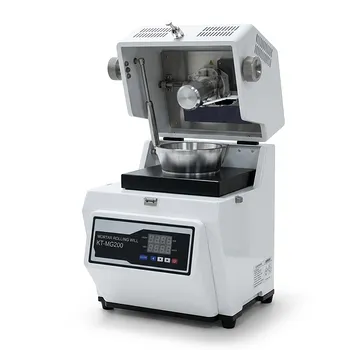
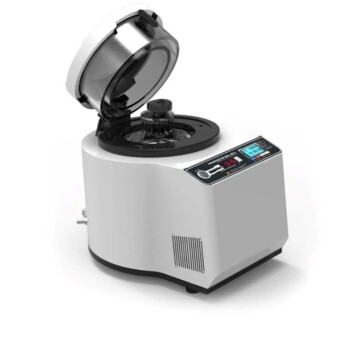
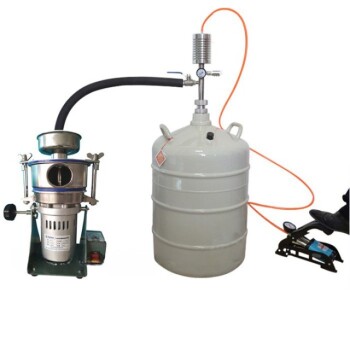
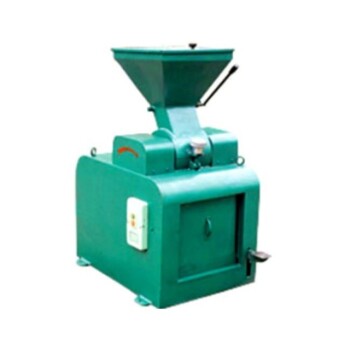
The laboratory-grade grinder is the workhorse of this process. Its function is to pulverize the rough structural integrity of raw coal and biomass.

However, grinding alone is rarely sufficient to achieve perfect uniformity.

The Function of the Electromagnetic Sieve

The electromagnetic vibrating sieve acts as the quality control filter. It processes the ground material to strictly separate particles.

Only material that passes through the 200-mesh screen (75 microns) is retained. This ensures that no oversized particles make it into the final test sample.

Why Homogeneity Drives Accuracy

Creating Uniform Corrosion Environments

In corrosion experiments, the ash sample must interact with the metal surface.

If the particle sizes vary, the contact points between the ash and the metal will vary.

A homogeneous sample ensures that the chemical reaction—the corrosion—occurs uniformly across the entire surface area of the metal.

The Link to Kinetic Parameters

The scientific value of these experiments lies in the data, specifically the calculation of kinetic parameters.

These calculations describe how fast the corrosion occurs and the energy involved.

If the physical sample is inconsistent, the reaction rates will be erratic. High-homogeneity samples significantly improve the accuracy and reliability of these mathematical models.

The Consequence of Inconsistency

The Risk of Variable Particle Sizes

Skipping the fine sieving process introduces a critical variable into the experiment.

Larger particles may create localized areas of intense reaction or, conversely, poor contact.

This leads to "noise" in the data, making it difficult to distinguish between actual chemical properties and artifacts caused by poor sample preparation.

Making the Right Choice for Your Goal

To ensure your corrosion experiments yield publishable, valid results, you must prioritize the physical state of your reactants.

  • If your primary focus is experimental reproducibility: Strictly enforce the 200-mesh (75 micron) limit using electromagnetic sieves to ensure every sample batch is physically identical.
  • If your primary focus is mathematical accuracy: Prioritize high-homogeneity samples to ensure the kinetic parameters you calculate reflect true chemical behavior rather than physical inconsistencies.

Precise physical preparation is the hidden variable that determines the chemical validity of your corrosion research.

Summary Table:

Equipment Type Primary Function Target Specification Impact on Research
Laboratory Grinder Mechanical Pulverization Raw material reduction Breaks down structural integrity of biomass/coal
Electromagnetic Sieve Quality Control & Filtering 200 Mesh (75 Microns) Ensures absolute physical uniformity of samples
Combined System Homogenization Uniform particle size Enables accurate calculation of kinetic parameters

Elevate Your Sample Preparation with KINTEK Precision

Don't let inconsistent particle sizes compromise your research data. KINTEK specializes in high-performance laboratory equipment designed for the most demanding material science applications. Whether you are preparing coal and biomass for corrosion studies or refining advanced materials, our comprehensive range of crushing and milling systems, electromagnetic vibrating sieves, and high-temperature furnaces ensures your samples meet the strictest standards for homogeneity.

Why choose KINTEK?

  • Precision Engineering: Achieve the exact mesh size required for reliable kinetic parameter modeling.
  • Comprehensive Solutions: From initial crushing to final ash analysis in our muffle or tube furnaces, we provide the full workflow.
  • Expert Support: Our team understands the critical link between physical sample state and chemical validity.

Ready to achieve publishable, reproducible results? Contact us today to find the perfect equipment for your lab!

References

  1. Yongzheng Wang, Yungang Li. Reaction Kinetics of Chlorine Corrosion to Heating Surfaces during Coal and Biomass Cofiring. DOI: 10.1155/2020/2175795

This article is also based on technical information from Kintek Solution Knowledge Base .

Related Products

People Also Ask

Related Products

Laboratory Test Sieves and Sieving Machines

Laboratory Test Sieves and Sieving Machines

Precision lab test sieves & sieving machines for accurate particle analysis. Stainless steel, ISO-compliant, 20μm-125mm range. Request specs now!

Laboratory Test Sieves and Vibratory Sieve Shaker Machine

Laboratory Test Sieves and Vibratory Sieve Shaker Machine

Efficiently process powders, granules, and small blocks with a high-frequency vibration sieve. Control vibration frequency, screen continuously or intermittently, and achieve accurate particle size determination, separation, and classification.

Vibratory Sieve Shaker Machine Dry Three-Dimensional Vibrating Sieve

Vibratory Sieve Shaker Machine Dry Three-Dimensional Vibrating Sieve

The KT-V200 product focuses on solving common sieving tasks in the laboratory. It is suitable for sieving 20g-3kg dry samples.

Laboratory Jaw Crusher

Laboratory Jaw Crusher

Discover the small jaw crusher for efficient, flexible, and affordable crushing in labs and small mines. Ideal for coal, ores, and rocks. Learn more now!

Laboratory Disc Rotary Mixer for Efficient Sample Mixing and Homogenization

Laboratory Disc Rotary Mixer for Efficient Sample Mixing and Homogenization

Efficient Laboratory Disc Rotary Mixer for Precise Sample Mixing, Versatile for Various Applications, DC Motor and Microcomputer Control, Adjustable Speed and Angle.

Laboratory Oscillating Orbital Shaker

Laboratory Oscillating Orbital Shaker

Mixer-OT orbital shaker uses brushless motor, which can run for a long time. It is suitable for vibration tasks of culture dishes, flasks and beakers.

Laboratory manual slicer

Laboratory manual slicer

Manual microtome is a high-precision cutting device designed for laboratories, industry and medical fields. It is suitable for the preparation of thin slices of various materials such as paraffin samples, biological tissues, battery materials, food, etc.

Metallographic Specimen Mounting Machine for Laboratory Materials and Analysis

Metallographic Specimen Mounting Machine for Laboratory Materials and Analysis

Precision metallographic mounting machines for labs—automated, versatile, and efficient. Ideal for sample prep in research and quality control. Contact KINTEK today!

Custom PTFE Teflon Parts Manufacturer for PTFE Mesh F4 Sieve

Custom PTFE Teflon Parts Manufacturer for PTFE Mesh F4 Sieve

PTFE mesh sieve is a specialized test sieve designed for particle analysis in various industries, featuring a non-metallic mesh woven from PTFE filament. This synthetic mesh is ideal for applications where metal contamination is a concern . PTFE sieves are crucial for maintaining the integrity of samples in sensitive environments, ensuring accurate and reliable results in particle size distribution analysis.

Automatic High Temperature Heated Hydraulic Press Machine with Heated Plates for Lab

Automatic High Temperature Heated Hydraulic Press Machine with Heated Plates for Lab

The High Temperature Hot Press is a machine specifically designed for pressing, sintering and processing materials in a high temperature environment. It is capable of operating in the range of hundreds of degrees Celsius to thousands of degrees Celsius for a variety of high temperature process requirements.

Automatic Heated Hydraulic Press Machine with Heated Plates for Laboratory Hot Press 25T 30T 50T

Automatic Heated Hydraulic Press Machine with Heated Plates for Laboratory Hot Press 25T 30T 50T

Efficiently prepare your samples with our Automatic Heated Lab Press. With a pressure range up to 50T and precise control, it's perfect for various industries.

Lab Blown Film Extrusion Three Layer Co-Extrusion Film Blowing Machine

Lab Blown Film Extrusion Three Layer Co-Extrusion Film Blowing Machine

Lab blown film extrusion is mainly used to detect the feasibility of film blowing of polymer materials and the colloid condition in the materials, as well as the dispersion of colored dispersions, controlled mixtures, and extrudates;

Filter Testing Machine FPV for Dispersion Properties of Polymers and Pigments

Filter Testing Machine FPV for Dispersion Properties of Polymers and Pigments

The filter testing machine (FPV) is suitable for testing the dispersion properties of polymers such as pigments, additives and masterbatches by extrusion and filtration.

Vacuum Hot Press Furnace Machine for Lamination and Heating

Vacuum Hot Press Furnace Machine for Lamination and Heating

Experience clean and precise lamination with Vacuum Lamination Press. Perfect for wafer bonding, thin-film transformations, and LCP lamination. Order now!

HFCVD Machine System Equipment for Drawing Die Nano-Diamond Coating

HFCVD Machine System Equipment for Drawing Die Nano-Diamond Coating

The nano-diamond composite coating drawing die uses cemented carbide (WC-Co) as the substrate, and uses the chemical vapor phase method ( CVD method for short ) to coat the conventional diamond and nano-diamond composite coating on the surface of the inner hole of the mold.

Custom PTFE Teflon Parts Manufacturer for Culture Dish and Evaporation Dish

Custom PTFE Teflon Parts Manufacturer for Culture Dish and Evaporation Dish

The PTFE culture dish evaporating dish is a versatile laboratory tool known for its chemical resistance and high-temperature stability. PTFE, a fluoropolymer, offers exceptional non-stick properties and durability, making it ideal for various applications in research and industry, including filtration, pyrolysis, and membrane technology.

Manual High Temperature Heated Hydraulic Press Machine with Heated Plates for Lab

Manual High Temperature Heated Hydraulic Press Machine with Heated Plates for Lab

The High Temperature Hot Press is a machine specifically designed for pressing, sintering and processing materials in a high temperature environment. It is capable of operating in the range of hundreds of degrees Celsius to thousands of degrees Celsius for a variety of high temperature process requirements.

Custom PTFE Teflon Parts Manufacturer for PTFE Measuring Cylinder 10/50/100ml

Custom PTFE Teflon Parts Manufacturer for PTFE Measuring Cylinder 10/50/100ml

PTFE measuring cylinder are a rugged alternative to traditional glass cylinders. They are chemically inert over a wide temperature range (up to 260º C), have excellent corrosion resistance and maintain a low coefficient of friction, ensuring ease of use and cleaning.

Super Sealed Electrolytic Electrochemical Cell

Super Sealed Electrolytic Electrochemical Cell

Super-sealed electrolytic cell offers enhanced sealing capabilities, making it ideal for experiments that require high airtightness.


Leave Your Message