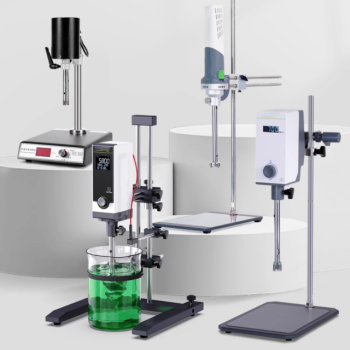
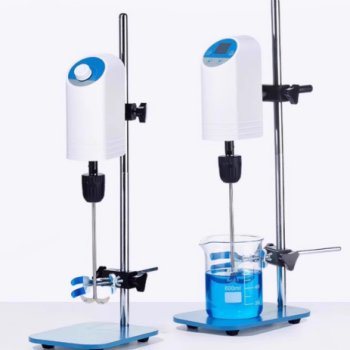
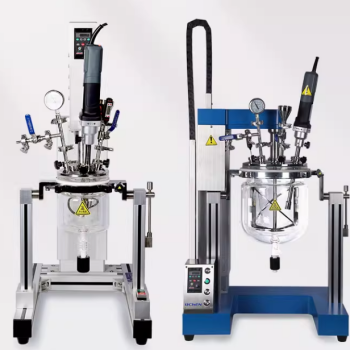
The primary function of high-shear or magnetic stirrers in the co-precipitation of composite metal oxides is to introduce intense mechanical energy during acid-base neutralization. This energy drives the instantaneous mixing of metal salts (such as titanium and aluminum) with the precipitant, ensuring microscopic uniformity throughout the solution.
Core Insight: Stirring in this context is not merely about blending ingredients; it is a critical process control tool. By preventing localized concentration gradients, high-shear mixing directly dictates the chemical consistency, specific surface area, and pore architecture of the final material.
The Mechanics of Homogeneity
Preventing Localized Gradients
When a precipitant is added to a solution of metal salts, reaction "hotspots" can form immediately at the point of contact.
Without sufficient energy, these hotspots create localized concentration gradients. High-shear stirring disrupts these zones, distributing the precipitant evenly before the reaction locks in a non-uniform structure.
Instantaneous Reaction Dynamics
The goal of using high-shear equipment is to ensure that the chemical reaction happens simultaneously across the entire volume.
This rapid, high-energy mixing forces the titanium and aluminum salts to co-precipitate at the same rate. This prevents one metal from precipitating out of solution before the other, which would lead to phase separation.
Determining Final Material Properties
Defining Chemical Composition
The mechanical energy applied during synthesis ensures that the resulting composite carrier has a uniform chemical composition.
Instead of having isolated islands of TiO2 and Al2O3, the intense mixing facilitates a true composite structure at the microscopic level.
Optimizing Surface Area and Pore Structure
The physical dynamics of the precipitation process heavily influence the morphology of the solid particles.
By controlling the mixing intensity, you ensure the formation of an ideal pore structure. This directly results in a high specific surface area, which is often the critical specification for catalytic applications.
Common Pitfalls to Avoid
The Risk of Low-Energy Mixing
A common mistake is assuming that standard, low-speed stirring is sufficient for co-precipitation.
If the mechanical energy is too low, the neutralization process becomes diffusion-controlled rather than kinetic-controlled. This leads to compositional deviations and unpredictable particle sizes, rendering the material less effective for its intended use.
Making the Right Choice for Your Goal
To ensure your composite metal oxides meet performance specifications, apply the following guidelines:
- If your primary focus is chemical uniformity: Prioritize high-shear equipment to prevent localized concentration gradients and ensure a homogeneous composite.
- If your primary focus is catalytic performance: Ensure the stirring intensity is sufficient to generate the high specific surface area and ideal pore structure required for active sites.
The quality of your mechanical mixing limits the potential quality of your final composite material.
Summary Table:
| Feature | High-Shear/Magnetic Stirrer Function | Impact on Material |
|---|---|---|
| Mixing Dynamics | Rapid neutralization & disruption of concentration gradients | Prevents localized reaction "hotspots" |
| Phase Control | Simultaneous precipitation of metal salts | Ensures microscopic chemical homogeneity |
| Morphology | Mechanical energy input during solid formation | Optimizes pore architecture & surface area |
| Process Type | Shifts reaction from diffusion to kinetic control | Consistent particle size & phase purity |
Elevate Your Material Synthesis with KINTEK Precision
Achieving the perfect TiO2-Al2O3 composite requires more than just chemistry—it requires precision mechanical control. At KINTEK, we specialize in high-performance laboratory equipment designed to meet the rigorous demands of material science.
Whether you are optimizing catalytic carriers or developing advanced metal oxides, our range of magnetic stirrers, high-speed homogenizers, and shakers provides the intense mechanical energy necessary for uniform co-precipitation. Beyond mixing, KINTEK offers a comprehensive suite of tools including:
- High-Temperature Furnaces (Muffle, Tube, Vacuum) for precise calcination.
- Crushing & Milling Systems for fine powder processing.
- High-Pressure Autoclaves & Reactors for hydrothermal synthesis.
- Essential Consumables like ceramics, crucibles, and PTFE products.
Ready to achieve superior chemical consistency and surface area in your lab? Contact our technical experts today to find the ideal equipment solution for your research goals.
References
- Xun Zhang, Rui Wang. Enabling Catalysts for Carbonyl Sulfide Hydrolysis. DOI: 10.3390/catal14120952
This article is also based on technical information from Kintek Solution Knowledge Base .
Related Products
- High Shear Homogenizer for Pharmaceutical and Cosmetic Applications
- High Performance Laboratory Stirrers for Diverse Applications
- High Performance Lab Homogenizer for Pharma Cosmetics and Food R&D
- Laboratory Small Constant Temperature Heated Magnetic Stirrer Heater and Stirrer
- Custom PTFE Teflon Parts Manufacturer for Magnetic Stirring Bar
People Also Ask
- Why Use a High Shear Homogenizer for Cathode Slurries? Optimize Double-Layer Solid-State Battery Production
- What is the function of high-shear dispersion equipment in corona-resistant nanocomposites? Elevate Your Insulation
- What is the necessity of using an industrial-grade high-shear homogenizer for biomass washing? Ensure Process Efficiency
- What are the advantages of using a high-shear homogenizer for BED/GMA coatings? Achieve Superior Nano-Dispersion
- What role does a high-shear homogenizer play in ODC catalyst suspensions? Unlock Superior Electrochemical Efficiency