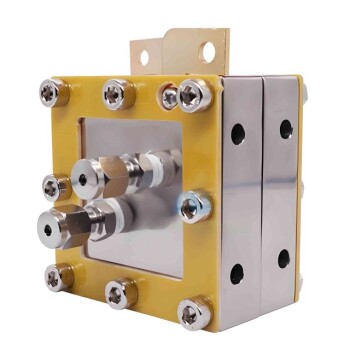
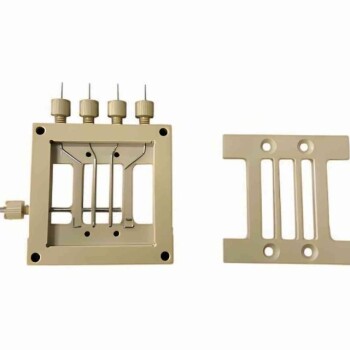
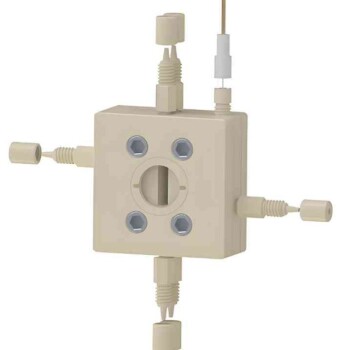
The electrolytic cell establishes a stable chemical environment for metal precursors, while the electrode system serves as the physical interface for charge transfer. Controlled by a power source like a potentiostat, this system drives the reduction of metal ions into atoms directly on a conductive substrate, enabling the in-situ growth of antimicrobial nanoparticles.
Core Takeaway The electrolytic system is not merely a containment vessel; it is a precision engineering tool. By manipulating electrical parameters and fluid dynamics within the cell, you can dictate the exact size, shape, and density of nanoparticles to meet specific antimicrobial performance goals.
The Role of the Electrolytic Cell
Providing Chemical Stability
The electrolytic cell acts as the foundation for the process. It holds the electrolyte solution containing the necessary silver salt precursors.
Ensuring Consistent Conditions
This vessel maintains a stable electrochemical environment. Stability is critical for preventing unwanted side reactions that could compromise the purity of the coating.
Managing Fluid Dynamics
The design of the cell influences how the electrolyte moves. Proper fluid dynamics ensure that ions are constantly replenished near the electrode surface for uniform deposition.
The Function of the Electrode System
Facilitating Charge Transfer
The electrode system acts as the medium where electricity converts into chemical change. It serves as the bridge between the external power source and the internal chemical reaction.
Driving Reduction Reactions
At the working electrode (the substrate being coated), a reduction reaction occurs. Metal ions floating in the solution gain electrons and are transformed into solid metal atoms.
Enabling In Situ Growth
This system allows for in situ generation. Rather than applying pre-made particles, the nanoparticles grow directly on the surface, ensuring better adhesion and integration.
Engineering Antimicrobial Properties
Controlling Particle Morphology
The system allows you to act as an architect on the nanoscale. By adjusting the current density, you can precisely control the size and shape (morphology) of the resulting silver nanoparticles.
Tuning Distribution Density
The electrode controls are used to determine how closely packed the particles are. Higher density often correlates with stronger antimicrobial activity but requires careful management to avoid agglomeration.
Precision via Instrumentation
A potentiostat or galvanostat regulates the voltage or current. This fine-tuned control is what separates high-performance engineered coatings from simple bulk plating.
Understanding the Trade-offs
Parameter Complexity
The flexibility of this system creates complexity. You must simultaneously balance current density, fluid flow, and chemical concentration; failure to align these variables results in uneven or ineffective coatings.
Substrate Conductivity Requirements
The process relies on the working electrode being conductive to accept electrons. This limits the ability to coat non-conductive materials (like certain plastics) without conductive pre-treatments.
Making the Right Choice for Your Goal
To leverage the electrolytic system effectively, align your operational parameters with your specific outcome.
- If your primary focus is maximum antimicrobial potency: Prioritize high control over current density to engineer smaller, high-surface-area nanoparticles.
- If your primary focus is coating uniformity: Focus on optimizing the fluid dynamics within the electrolytic cell to ensure an even supply of ions across the entire substrate.
By mastering the interplay between the cell environment and electrode controls, you transform standard deposition into a tunable manufacturing process for advanced protective surfaces.
Summary Table:
| Component | Primary Function | Impact on Antimicrobial Coating |
|---|---|---|
| Electrolytic Cell | Chemical containment & fluid dynamics | Ensures ion replenishment and uniform coating distribution. |
| Electrode System | Charge transfer interface | Facilitates in-situ reduction of metal ions into solid atoms. |
| Potentiostat | Electrical parameter control | Dictates nanoparticle size, morphology, and distribution density. |
| Electrolyte | Precursor carrier | Provides the silver salt ions necessary for antimicrobial activity. |
Elevate Your Surface Engineering with KINTEK
Unlock the full potential of electrochemical deposition with high-precision equipment from KINTEK. Whether you are developing next-generation antimicrobial surfaces or advanced battery technologies, our specialized electrolytic cells and electrodes provide the stability and control required for nanoscale architecture.
From high-temperature reactors to comprehensive battery research tools, KINTEK empowers laboratories with:
- High-Performance Electrolytic Cells: Designed for optimal fluid dynamics and chemical stability.
- Precision Electrodes: Engineered for superior charge transfer and durable in-situ growth.
- Complete Lab Solutions: Including crushing systems, cooling solutions, and premium ceramic consumables.
Ready to refine your deposition process? Contact KINTEK today to discover how our expertise can optimize your research and production outcomes.
References
- Edith Dube, Grace Emily Okuthe. Silver Nanoparticle-Based Antimicrobial Coatings: Sustainable Strategies for Microbial Contamination Control. DOI: 10.3390/microbiolres16060110
This article is also based on technical information from Kintek Solution Knowledge Base .
Related Products
- H Type Electrolytic Cell Triple Electrochemical Cell
- Electrolytic Electrochemical Cell Gas Diffusion Liquid Flow Reaction Cell
- Super Sealed Electrolytic Electrochemical Cell
- Electrolytic Electrochemical Cell with Five-Port
- PTFE Electrolytic Cell Electrochemical Cell Corrosion-Resistant Sealed and Non-Sealed
People Also Ask
- What is a H type cell? A Guide to Divided Electrochemical Cells for Accurate Experiments
- How should the electrolyte be prepared and added to the H-type electrolytic cell? Best Practices for Purity and Safety
- What is the technical necessity of using an H-type electrolytic cell for NO3RR tests? Protect Your Ammonia Yields
- How does the design of an H-type electrolytic cell benefit the neutral water electrolysis process for metal recovery?
- What is the primary function of an H-type electrolytic cell in NitRR? Ensure Accurate Product Yields