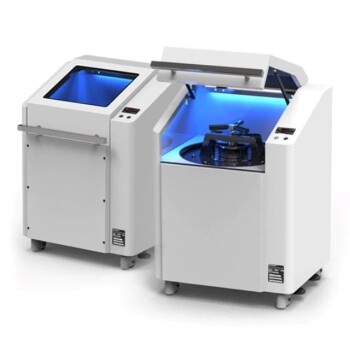
The primary function of a Disk Mill equipped with zirconia grinding media is to mechanically refine synthesized coarse Li2.2C0.8B0.2O3 powders down to an average particle size of approximately 1 micrometer. By leveraging the high hardness and wear resistance of zirconia, this process drastically increases the specific surface area of the powder, creating the essential physical conditions required to form high-density sintered bodies in subsequent processing steps.
The success of a solid electrolyte relies heavily on the density of the final sintered component. The Disk Mill step is not merely about size reduction; it is a critical preparation stage that transforms coarse raw material into a highly reactive powder capable of achieving maximum densification.
The Mechanics of Particle Refinement
Utilizing High-Hardness Media
The Disk Mill employs zirconia (ZrO2) grinding media specifically for its mechanical properties. Zirconia is characterized by exceptional hardness and wear resistance.
This durability allows the media to deliver high-energy mechanical impacts to the coarse Li2.2C0.8B0.2O3 powder without degrading rapidly.
Achieving the Micrometer Target
The specific objective of this milling process is to reduce the powder to an average particle size of 1 micrometer.
Reaching this specific size threshold is vital for the material's processing characteristics. Coarser particles would fail to pack efficiently, leading to structural weaknesses in the final product.
Why Surface Area Matters for Electrolytes
Increasing Specific Surface Area
As the Disk Mill pulverizes the material, the specific surface area of the powder increases significantly.
This increase in surface area exposes more material to the heat and pressure applied during sintering. It acts as the driving force for the densification process.
Enabling High-Density Sintered Bodies
The ultimate goal of using the Disk Mill is to prepare the powder for sintering.
A powder with a high specific surface area allows for the formation of a high-density sintered body. In solid electrolytes, high density is non-negotiable, as porosity leads to poor ionic conductivity and mechanical failure.
The Role of Material Purity
Chemical Inertness of Zirconia
While the Disk Mill focuses on size reduction, the choice of zirconia media provides a secondary, critical benefit: chemical inertness.
Supplementary data indicates that zirconia prevents the introduction of metallic impurities, such as iron or chromium, which are common when using steel media.
Preserving Electrochemical Performance
Maintaing purity is essential for solid electrolytes.
Metallic contamination can cause side reactions or internal short circuits. Zirconia media ensures the synthesized powder maintains the high purity required for stable electrochemical cycling.
Understanding the Trade-offs
The Necessity of Size Control
While the Disk Mill effectively reduces average particle size, it does not guarantee a perfectly uniform distribution on its own.
Oversized particles or "hard agglomerates" may persist. Relying solely on the mill without subsequent checks can lead to internal stress concentrations in the ceramic layer.
Processing Consistency vs. Agglomeration
Grinding the powder too fine can sometimes lead to re-agglomeration due to high surface energy.
The process requires a balance: the particles must be small enough to sinter well (around 1 micrometer) but not so fine that they clump together intractably before processing.
Making the Right Choice for Your Goal
To maximize the effectiveness of your powder preparation, consider the following specific objectives:
- If your primary focus is Sintered Density: Ensure your milling parameters are tuned to reliably hit the 1-micrometer average, as this is the threshold for effective densification.
- If your primary focus is Structural Homogeneity: Integrate a sieving step immediately after milling to remove any remaining agglomerates that could cause microscopic defects.
- If your primary focus is Electrochemical Purity: strict adherence to zirconia media is required to prevent metallic contamination that degrades ionic conductivity.
The Disk Mill with zirconia media serves as the bridge between raw synthesis and high-performance application, ensuring your material has the physical architecture necessary for a viable solid-state battery.
Summary Table:
| Feature | Specification/Detail | Impact on Solid Electrolyte |
|---|---|---|
| Target Particle Size | ~1 micrometer | Enhances packing density and sintering reactivity |
| Grinding Media | Zirconia (ZrO2) | Prevents metallic contamination and ensures purity |
| Key Mechanism | Mechanical Refinement | Increases specific surface area for densification |
| Primary Goal | High-Density Sintered Body | Maximizes ionic conductivity and structural integrity |
| Process Benefit | Chemical Inertness | Prevents internal short circuits from impurities |
Elevate Your Battery Research with KINTEK Precision Solutions
Precision in particle size reduction is the foundation of high-performance solid-state batteries. KINTEK specializes in advanced laboratory equipment designed to meet the rigorous demands of electrolyte synthesis. From high-durability Disk Mills and crushing and milling systems to zirconia grinding media and sieving equipment, we provide the tools necessary to achieve a perfect 1μm refinement without contamination.
Our comprehensive portfolio also includes high-temperature furnaces (muffle, vacuum, CVD) for sintering, hydraulic presses for pellet formation, and battery research tools to validate your results.
Ready to achieve maximum densification and electrochemical purity? Contact KINTEK today to find the ideal equipment for your laboratory's material processing needs.
Related Products
- Vibrating Disc Mill Small Laboratory Grinding Machine
- Laboratory Disc Cup Vibratory Mill for Sample Grinding
- Stainless Steel Laboratory Ball Mill for Dry Powder and Liquid with Ceramic Polyurethane Lining
People Also Ask
- What role do disc mills play in the wet or dry pretreatment of lignocellulosic waste? Scalable Biomass Solutions
- What is the function of a laboratory grinding mill? Achieve Precise Sample Preparation for Accurate Results
- What is the function of an industrial vibratory mill? Optimize Fe-Cr-Al Alloy Powder Production
- What laboratory apparatus is used for grinding? Match the Right Mill to Your Sample Material
- Why use stainless steel jars and balls for solid-state battery slurries? Maximize Dispersion and Conductivity