Knowledge What is the oven in a bio lab? The Key to Sterilization and Precise Sample Drying
Author avatar

Tech Team · Kintek Solution

Updated 1 week ago

What is the oven in a bio lab? The Key to Sterilization and Precise Sample Drying


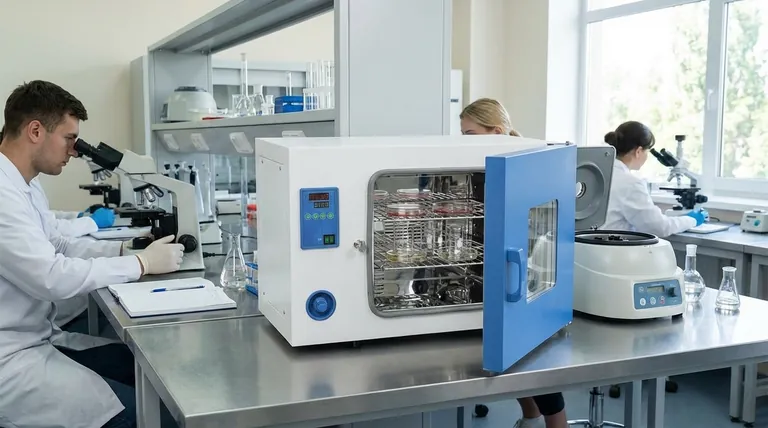
In a biology laboratory, an oven is a precision heating instrument used for high-temperature applications that require controlled and uniform thermal environments. Unlike a standard kitchen oven, a lab oven is engineered for specific scientific tasks such as sterilization, decontamination, and precisely drying biological or environmental samples.

A lab oven is not for cooking, but for creating a highly controlled, high-heat environment essential for sterilizing equipment and accurately removing moisture from scientific samples.
What is the oven in a bio lab? The Key to Sterilization and Precise Sample Drying

The Core Functions of a Laboratory Oven

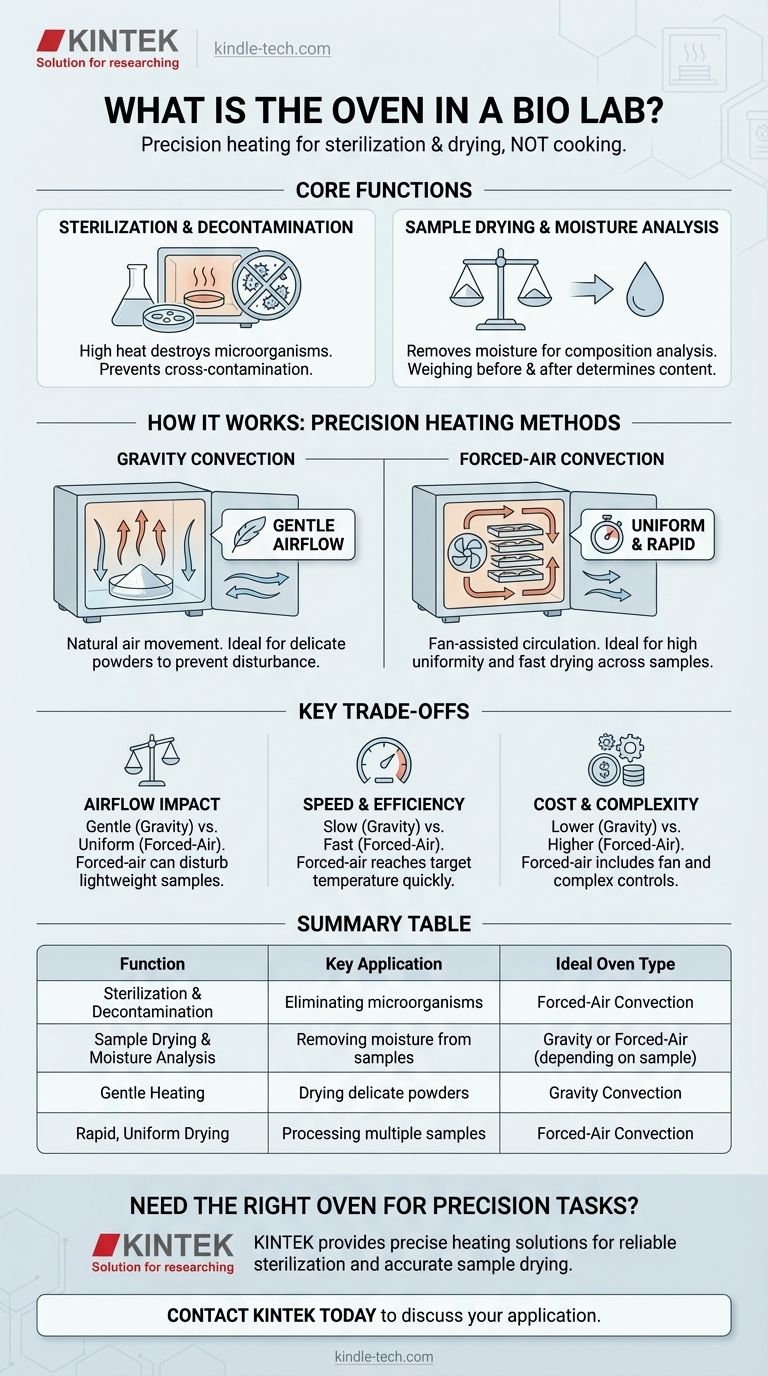
A lab oven’s value comes from its ability to maintain precise and consistent temperatures, which is critical for repeatable scientific outcomes. Its applications generally fall into two primary categories.

Sterilization and Decontamination

The high heat inside a lab oven is used to destroy microorganisms and remove biological contaminants. This is a fundamental step in ensuring that lab equipment and glassware are sterile before an experiment begins, preventing cross-contamination that could invalidate results.

Sample Drying and Moisture Analysis

In biological and environmental studies, determining the moisture content of a sample is often a critical data point. A lab oven is used to dry out samples, such as soil or biological tissue, at a controlled temperature until all moisture has evaporated.

By weighing the sample before and after the drying process, a researcher can accurately calculate its initial moisture content. This is essential for understanding material composition and properties.

How Lab Ovens Achieve Precision Heating

The method of heat circulation is the key differentiator among lab ovens and dictates their ideal use case. The two most common types are gravity convection and forced-air convection.

Gravity Convection Ovens

These ovens rely on the natural movement of air. As the air at the bottom of the chamber is heated, it becomes less dense and rises. As it cools near the top, it falls, creating a gentle, continuous airflow.

This method is simple and effective for applications where a forceful airflow could disturb the sample, such as when drying fine powders.

Forced-Air (Mechanical) Convection Ovens

These ovens incorporate a fan to actively circulate the hot air throughout the chamber. This forced circulation creates a highly uniform temperature distribution and speeds up the heating and drying processes significantly.

This makes them ideal for applications requiring tight temperature uniformity across multiple samples or when rapid drying is necessary.

Understanding the Key Trade-offs

Choosing between a gravity or forced-air oven depends entirely on the specific requirements of your experiment. Neither is universally superior.

The Problem of Airflow

The primary trade-off is between gentle heating and temperature uniformity. The fan in a forced-air oven ensures excellent uniformity but can disturb lightweight samples, potentially causing sample loss or cross-contamination between open containers.

Heating Speed and Efficiency

Gravity convection ovens heat up more slowly and can have greater temperature variations within the chamber. Forced-air ovens are faster and more efficient, bringing samples to the target temperature quickly and maintaining consistency throughout the space.

Cost and Complexity

Due to the addition of a fan and more complex airflow controls, forced-air ovens are typically more expensive and complex than their gravity convection counterparts.

Making the Right Choice for Your Goal

Selecting the correct oven is critical for achieving accurate and reliable results.

  • If your primary focus is drying delicate powders or samples that are sensitive to airflow: A gravity convection oven is the appropriate choice to prevent sample disturbance.
  • If your primary focus is achieving the highest temperature uniformity for multiple samples or require rapid drying: A forced-air convection oven will provide the speed and consistency you need.

Ultimately, the laboratory oven is a fundamental tool that enables researchers to control the critical variable of temperature with scientific precision.

Summary Table:

Function Key Application Ideal Oven Type
Sterilization & Decontamination Eliminating microorganisms from equipment Forced-Air Convection
Sample Drying & Moisture Analysis Removing moisture from biological/environmental samples Gravity or Forced-Air (depending on sample)
Gentle Heating Drying delicate powders or airflow-sensitive materials Gravity Convection
Rapid, Uniform Drying Processing multiple samples quickly with high consistency Forced-Air Convection

Need the Right Oven for Your Lab's Precision Tasks?

Choosing between a gravity convection and forced-air oven is critical for your experiment's success. KINTEK specializes in laboratory equipment and consumables, providing the precise heating solutions your biology lab requires for reliable sterilization and accurate sample drying.

Contact KINTEK today to discuss your application and find the ideal lab oven for your specific needs.

Visual Guide
What is the oven in a bio lab? The Key to Sterilization and Precise Sample Drying Visual Guide

Related Products

People Also Ask

Related Products

Laboratory Scientific Electric Heating Blast Drying Oven

Laboratory Scientific Electric Heating Blast Drying Oven

The desktop fast autoclave sterilizer is a compact and reliable device used for rapid sterilization of medical, pharmaceutical, and research items.

1200℃ Muffle Furnace Oven for Laboratory

1200℃ Muffle Furnace Oven for Laboratory

Upgrade your lab with our 1200℃ Muffle Furnace. Achieve fast, precise heating with Japan alumina fibers and Molybdenum coils. Features TFT touch screen controller for easy programming and data analysis. Order now!

Graphite Vacuum Furnace Negative Material Graphitization Furnace

Graphite Vacuum Furnace Negative Material Graphitization Furnace

Graphitization furnace for battery production has uniform temperature and low energy consumption. Graphitization furnace for negative electrode materials: an efficient graphitization solution for battery production and advanced functions to enhance battery performance.

Vacuum Heat Treat and Pressure Sintering Furnace for High Temperature Applications

Vacuum Heat Treat and Pressure Sintering Furnace for High Temperature Applications

Vacuum pressure sintering furnaces are designed for high temperature hot pressing applications in metal and ceramic sintering. Its advanced features ensure precise temperature control, reliable pressure maintenance, and a robust design for seamless operation.

20L Heating Chilling Circulator Cooling Water Bath Circulator for High and Low Temperature Constant Temperature Reaction

20L Heating Chilling Circulator Cooling Water Bath Circulator for High and Low Temperature Constant Temperature Reaction

Maximize lab productivity with KinTek KCBH 20L Heating Chilling Circulator. Its all-in-one design offers reliable heating, chilling, and circulating functions for industrial and lab use.

Horizontal High Temperature Graphite Vacuum Graphitization Furnace

Horizontal High Temperature Graphite Vacuum Graphitization Furnace

Horizontal Graphitization Furnace: This type of furnace is designed with the heating elements placed horizontally, allowing for uniform heating of the sample. It's well-suited for graphitizing large or bulky samples that require precise temperature control and uniformity.

50L Heating Chilling Circulator Cooling Water Bath Circulator for High and Low Temperature Constant Temperature Reaction

50L Heating Chilling Circulator Cooling Water Bath Circulator for High and Low Temperature Constant Temperature Reaction

Experience versatile heating, chilling, and circulating capabilities with our KinTek KCBH 50L Heating Chilling Circulator. Ideal for labs and industrial settings, with efficient and reliable performance.

Large Vertical Graphite Vacuum Graphitization Furnace

Large Vertical Graphite Vacuum Graphitization Furnace

A large vertical high-temperature graphitization furnace is a type of industrial furnace used for the graphitization of carbon materials, such as carbon fiber and carbon black. It is a high-temperature furnace that can reach temperatures of up to 3100°C.

Graphite Vacuum Furnace Bottom Discharge Graphitization Furnace for Carbon Materials

Graphite Vacuum Furnace Bottom Discharge Graphitization Furnace for Carbon Materials

Bottom-out graphitization furnace for carbon materials, ultra-high temperature furnace up to 3100°C, suitable for graphitization and sintering of carbon rods and carbon blocks. Vertical design, bottom discharging, convenient feeding and discharging, high temperature uniformity, low energy consumption, good stability, hydraulic lifting system, convenient loading and unloading.

Engineering Advanced Fine Ceramics Alumina Crucibles (Al2O3) for Thermal Analysis TGA DTA

Engineering Advanced Fine Ceramics Alumina Crucibles (Al2O3) for Thermal Analysis TGA DTA

TGA/DTA thermal analysis vessels are made of aluminum oxide (corundum or aluminum oxide). It can withstand high temperature and is suitable for analyzing materials that require high temperature testing.

Engineering Advanced Fine Ceramics Alumina Al2O3 Crucible With Lid Cylindrical Laboratory Crucible

Engineering Advanced Fine Ceramics Alumina Al2O3 Crucible With Lid Cylindrical Laboratory Crucible

Cylindrical Crucibles Cylindrical crucibles are one of the most common crucible shapes, suitable for melting and processing a wide variety of materials, and are easy to handle and clean.

Custom PTFE Teflon Parts Manufacturer for Culture Dish and Evaporation Dish

Custom PTFE Teflon Parts Manufacturer for Culture Dish and Evaporation Dish

The PTFE culture dish evaporating dish is a versatile laboratory tool known for its chemical resistance and high-temperature stability. PTFE, a fluoropolymer, offers exceptional non-stick properties and durability, making it ideal for various applications in research and industry, including filtration, pyrolysis, and membrane technology.

Lab Internal Rubber Mixer Rubber Kneader Machine for Mixing and Kneading

Lab Internal Rubber Mixer Rubber Kneader Machine for Mixing and Kneading

Lab internal rubber mixer is suitable for mixing, kneading and dispersing various chemical raw materials such as plastics, rubber, synthetic rubber, hot melt adhesive and various low-viscosity materials.

30L Heating Chilling Circulator Cooling Water Bath Circulator for High and Low Temperature Constant Temperature Reaction

30L Heating Chilling Circulator Cooling Water Bath Circulator for High and Low Temperature Constant Temperature Reaction

Get versatile lab performance with KinTek KCBH 30L Heating Chilling Circulator. With max. heating temp of 200℃ and max. chilling temp of -80℃, it's perfect for industrial needs.

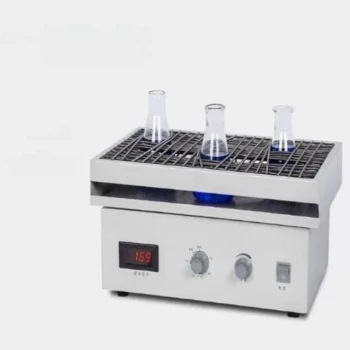
Laboratory Multifunctional Small Speed-Adjustable Horizontal Mechanical Shaker for Lab

Laboratory Multifunctional Small Speed-Adjustable Horizontal Mechanical Shaker for Lab

The laboratory multifunctional speed-regulating oscillator is a constant-speed experimental equipment specially developed for modern bioengineering production units.

Cylindrical Resonator MPCVD Machine System Reactor for Microwave Plasma Chemical Vapor Deposition and Lab Diamond Growth

Cylindrical Resonator MPCVD Machine System Reactor for Microwave Plasma Chemical Vapor Deposition and Lab Diamond Growth

Learn about Cylindrical Resonator MPCVD Machine, the microwave plasma chemical vapor deposition method used for growing diamond gemstones and films in the jewelry and semi-conductor industries. Discover its cost-effective advantages over traditional HPHT methods.

Custom Machined and Molded PTFE Teflon Parts Manufacturer with PTFE Crucible and Lid

Custom Machined and Molded PTFE Teflon Parts Manufacturer with PTFE Crucible and Lid

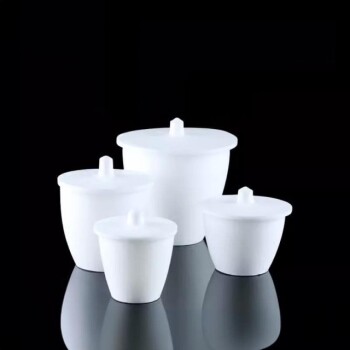
PTFE crucibles, made from pure Teflon, offer chemical inertness and resistance from -196°C to 280°C, ensuring compatibility with a wide range of temperatures and chemicals. These crucibles feature machine-finished surfaces for easy cleaning and prevention of contamination, making them ideal for precise laboratory applications.

Custom PTFE Teflon Parts Manufacturer for Three-Necked Round Bottom Flask

Custom PTFE Teflon Parts Manufacturer for Three-Necked Round Bottom Flask

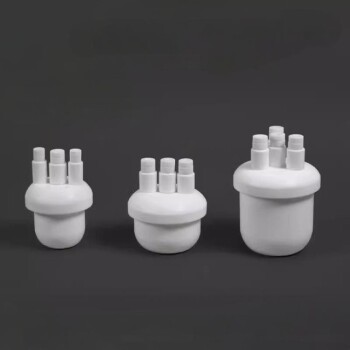
PTFE flask, is a versatile laboratory container made from PTFE, offering exceptional chemical resistance, temperature stability, and non-stick properties. Ideal for handling corrosive substances and high-temperature applications, these flasks are essential in various laboratory procedures, including heating, mixing, and storage of chemicals.

Custom PTFE Teflon Parts Manufacturer for PTFE Measuring Cylinder 10/50/100ml

Custom PTFE Teflon Parts Manufacturer for PTFE Measuring Cylinder 10/50/100ml

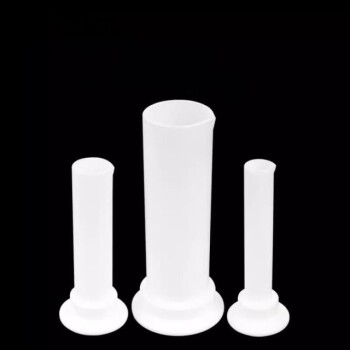
PTFE measuring cylinder are a rugged alternative to traditional glass cylinders. They are chemically inert over a wide temperature range (up to 260º C), have excellent corrosion resistance and maintain a low coefficient of friction, ensuring ease of use and cleaning.

Engineering Advanced Fine Alumina Al2O3 Ceramic Crucible for Laboratory Muffle Furnace

Engineering Advanced Fine Alumina Al2O3 Ceramic Crucible for Laboratory Muffle Furnace

Alumina ceramic crucibles are used in some materials and metal melting tools, and flat-bottomed crucibles are suitable for melting and processing larger batches of materials with better stability and uniformity.


Leave Your Message