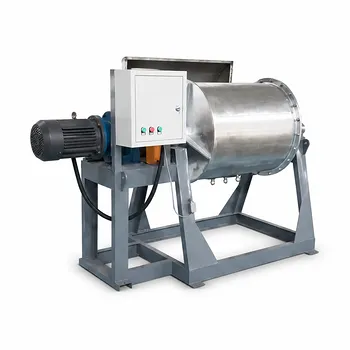
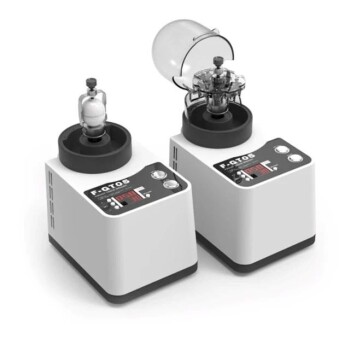
The primary function of a ball mill in this context is to achieve high-level homogenization of raw materials through prolonged wet mixing. Specifically, it mixes lithium carbonate, nickel oxide, and manganese carbonate in an ethanol medium for approximately 16 hours. This ensures that all components are uniformly distributed at a microscopic scale before the heating phase begins.
The success of the final material depends on the quality of the pre-mix. By ensuring microscopic uniformity, the ball milling process facilitates a complete solid-state reaction during calcination, which is vital for maintaining the precise chemical stoichiometry of the final LNMO product.
The Mechanics of Wet Mixing
Creating a Homogeneous Dispersion
The ball mill utilizes mechanical force to blend distinct raw material powders within a liquid medium, specifically ethanol. This wet environment helps to break up agglomerates (clusters of particles) and disperse the materials more effectively than dry mixing alone.
The Role of Prolonged Duration
Achieving true microscopic uniformity is not instantaneous. The process requires a prolonged mixing time of approximately 16 hours. This extended duration is necessary to ensure that every portion of the mixture contains the exact correct ratio of lithium, nickel, and manganese.
Why Uniformity Matters for LNMO
Facilitating Solid-State Reactions
The subsequent step in LNMO synthesis is high-temperature calcination. For this solid-state reaction to proceed to completion, the reactant particles must be in intimate contact with one another. Ball milling maximizes this contact area, allowing the reaction to occur efficiently and fully.
Maintaining Stoichiometric Accuracy
The performance of LiNi0.5Mn1.5O4 depends heavily on its specific chemical makeup. If the mixing is uneven, localized areas may be lithium-rich or manganese-poor. Thorough ball milling guarantees that the stoichiometric accuracy is preserved throughout the entire batch, preventing the formation of unwanted impurity phases.
Understanding the Trade-offs
Process Efficiency vs. Material Quality
The primary trade-off in this stage is time. Dedicating 16 hours solely to mixing is a significant bottleneck in a production timeline. However, attempting to shorten this duration often results in "hot spots" or incomplete reactions during calcination, compromising the battery material's electrochemical performance.
Solvent Handling Requirements
Using an ethanol medium introduces complexity compared to dry milling. While ethanol is excellent for dispersion and prevents oxidation better than water in some cases, it requires protocols for handling flammable solvents and necessitates a drying step to remove the liquid before calcination can begin.
Making the Right Choice for Your Goal
To ensure the best results during LNMO precursor synthesis, consider the following based on your specific objectives:
- If your primary focus is Electrochemical Performance: Prioritize the full 16-hour milling duration to guarantee the stoichiometric accuracy required for stability.
- If your primary focus is Process Safety: Ensure your equipment is rated for handling volatile solvents like ethanol to manage the risks associated with wet milling.
Ultimately, the ball mill is not just a mixer; it is the gatekeeper of chemical consistency that makes the subsequent solid-state reaction possible.
Summary Table:
| Feature | Specification/Requirement | Impact on LNMO Quality |
|---|---|---|
| Mixing Medium | Ethanol (Wet Mixing) | Superior dispersion & prevention of agglomerates |
| Mixing Duration | 16 Hours | Ensures microscopic uniformity & reaction efficiency |
| Raw Materials | Li2CO3, NiO, MnCO3 | Foundation for high-voltage cathode performance |
| Core Goal | Homogenization | Prevents impurity phases & maintains stoichiometry |
| Key Outcome | Enhanced Solid-State Reaction | Consistent electrochemical stability and capacity |
Elevate Your Battery Material Research with KINTEK
Precision in LNMO synthesis begins with the right equipment. KINTEK specializes in high-performance crushing and milling systems designed to handle the rigorous demands of battery research. From achieving microscopic uniformity in wet mixing to facilitating perfect solid-state reactions in our high-temperature muffle and tube furnaces, we provide the tools you need for stoichiometric accuracy.
Whether you require specialized ball mills, planetary mills, or vacuum furnaces for material calcination, KINTEK offers a comprehensive range of laboratory equipment and consumables tailored for energy storage innovation.
Ready to optimize your synthesis process? Contact us today to discover how our advanced solutions can enhance your lab's productivity and material quality.
Related Products
- High-Energy Omnidirectional Planetary Ball Mill Milling Machine for Laboratory
- High-Energy Omnidirectional Planetary Ball Mill Machine for Laboratory
- Stainless Steel Laboratory Ball Mill for Dry Powder and Liquid with Ceramic Polyurethane Lining
- Laboratory Planetary Ball Mill Rotating Ball Milling Machine
- Hybrid High Energy Vibratory Ball Mill for Lab Use
People Also Ask
- What is the role of a planetary ball mill in preparing doped high-nickel cathode materials? Enhance Battery Stability
- How does a planetary ball mill solve mixing challenges with PEO? Unlock solid-state synthesis for insoluble dopants
- Why is a planetary ball mill used for LNMO precursor powders? Optimize Particle Uniformity & Battery Performance
- What is the function of a planetary ball mill in the solid-state synthesis of LiTa2PO8? Achieve High-Purity Electrolytes
- What is the role of a planetary ball mill in sulfide-based solid-state batteries? Engineer High-Performance Cathodes