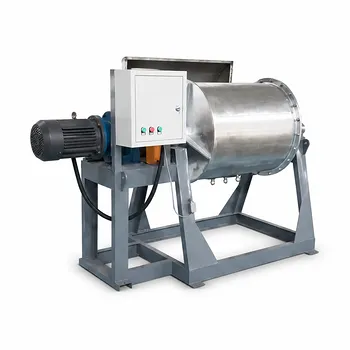
The primary function of a ball mill in the pretreatment of WC/Cu functionally graded materials is the mixed grinding of electrolytic copper powder and spherical WC particles. This mechanical process is critical for ensuring the uniform dispersion of these internal components within each specific material layer.
Core Takeaway: The ball mill does not merely mix powders; it establishes the structural foundation of the material. By ensuring homogeneity within each layer, the milling process enables the creation of a strictly controlled, accurate compositional gradient in the final layered structure.
The Mechanics of Pretreatment
Mixed Grinding of Components
The process specifically targets two distinct raw materials: electrolytic copper powder and spherical WC particles.
The ball mill applies mechanical action to these materials after they have been distributed layer by layer. This ensures that the two distinct powders are intimately combined rather than sitting loosely adjacent to one another.
Achieving Uniform Dispersion
The central goal of this stage is homogeneity.
Without sufficient mechanical intervention, the heavy WC particles and lighter copper powder might segregate. The ball mill ensures that the internal components of each layer are dispersed evenly, preventing clusters of a single material that could weaken the final part.
The Impact on Functionally Graded Materials (FGMs)
Establishing the Gradient Foundation
Functionally Graded Materials rely on precise changes in composition across the volume of the material.
The ball mill prepares the raw materials to maintain this structure. By stabilizing the mixture within each layer, it allows for the subsequent preparation of a structure with accurate compositional gradients.
Preventing Structural Inconsistencies
If the raw materials are not uniformly dispersed, the gradient becomes unpredictable.
The mechanical action of the ball mill mitigates this risk. It creates a consistent "baseline" for each layer, ensuring that the transition from metal (Cu) to ceramic (WC) occurs exactly as designed.
Understanding the Trade-offs
Mechanical Intensity vs. Particle Integrity
While the ball mill provides necessary impact and shear forces, there is a balance to be struck.
Excessive mechanical energy can potentially deform the spherical WC particles or cause unwanted cold-welding of the copper. The process must be aggressive enough to mix, but controlled enough to preserve particle morphology.
Efficiency vs. Contamination
Ball milling significantly improves the efficiency of the research and preparation process.
However, extended milling times introduce the risk of contamination from the milling media itself. In high-precision applications like FGMs, maintaining chemical purity is just as vital as achieving mechanical uniformity.
Making the Right Choice for Your Goal
To optimize the pretreatment of your WC/Cu materials, consider your specific structural requirements:
- If your primary focus is Compositional Accuracy: Ensure the ball milling parameters are tuned to maximize dispersion without destroying the spherical shape of the WC particles.
- If your primary focus is Microstructural Strength: Prioritize the uniformity of the mix to prevent particle agglomeration, which acts as a stress concentrator in the final sintered part.
The success of a functionally graded material is determined not by the sintering, but by the uniformity achieved during this initial milling stage.
Summary Table:
| Process Component | Role in Pretreatment | Key Benefit |
|---|---|---|
| Target Materials | Electrolytic copper powder & Spherical WC particles | Ensures compatibility of metal and ceramic components |
| Mechanical Action | Mixed grinding and impact forces | Prevents material segregation and particle clustering |
| Layer Integrity | Stabilizing internal component dispersion | Establishes the foundation for accurate compositional gradients |
| Optimization Goal | Balancing intensity and milling time | Preserves particle morphology while ensuring high homogeneity |
Elevate Your Material Research with KINTEK Precision Solutions
The integrity of your Functionally Graded Materials (FGMs) begins with superior pretreatment. At KINTEK, we specialize in high-performance crushing and milling systems, including advanced ball mills, specifically designed to handle the rigorous demands of WC/Cu composites.
Our extensive portfolio of laboratory equipment—from high-temperature furnaces (vacuum, CVD, sintering) to hydraulic pellet presses and isostatic presses—provides the end-to-end reliability your lab requires. Whether you are optimizing particle morphology or scaling up production, KINTEK offers the technical expertise and durable consumables like ceramics, crucibles, and milling media to ensure your results are consistent and contamination-free.
Ready to achieve perfect homogeneity in your material layers? Contact our experts today to find the ideal milling and sintering solution for your specific application!
Related Products
- High-Energy Omnidirectional Planetary Ball Mill Milling Machine for Laboratory
- Stainless Steel Laboratory Ball Mill for Dry Powder and Liquid with Ceramic Polyurethane Lining
- Laboratory Ball Mill Jar Mill with Metal Alloy Grinding Jar and Balls
- High-Energy Omnidirectional Planetary Ball Mill Machine for Laboratory
- Laboratory Planetary Ball Mill Rotating Ball Milling Machine
People Also Ask
- What is the role of a planetary ball mill in preparing doped high-nickel cathode materials? Enhance Battery Stability
- How does a planetary ball mill solve mixing challenges with PEO? Unlock solid-state synthesis for insoluble dopants
- Why is a planetary ball mill used for LNMO precursor powders? Optimize Particle Uniformity & Battery Performance
- What is the function of a planetary ball mill in the solid-state synthesis of LiTa2PO8? Achieve High-Purity Electrolytes
- What is the role of a planetary ball mill in sulfide-based solid-state batteries? Engineer High-Performance Cathodes