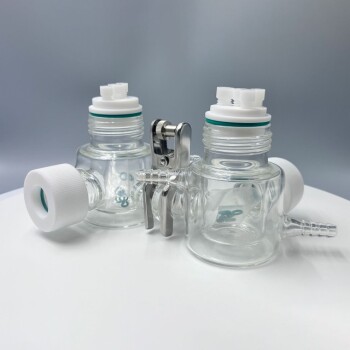
The primary function of a laboratory jacketed reaction cell is to enable precise thermal regulation of the reaction liquid during electrochemical experiments. By utilizing a double-layer jacket design connected to an external circulation system, the cell creates a controlled volume environment that maintains specific process temperatures regardless of ambient conditions.
The jacketed reaction cell acts as a thermal stabilizer; by circulating fluid through its double walls, it isolates the reaction from environmental temperature fluctuations to ensure that kinetic data remains accurate and reproducible.
The Mechanism of Temperature Control
The Double-Layer Design
The core feature of this equipment is its double-layer jacket.
This structure surrounds the inner reaction chamber, creating a hollow space between the reaction liquid and the exterior wall.
External Circulation Integration
To function, the jacket connects to an external constant-temperature circulation system.
Heating or cooling water is pumped through this jacket. This creates a thermal buffer that actively manages the temperature of the reaction liquid inside the cell.
Why Thermal Precision Matters
Stabilizing Reaction Kinetics
Electrocatalytic wastewater treatment experiments are sensitive to energy changes.
The jacketed cell allows researchers to conduct experiments under specific process conditions. This ensures that the reaction kinetics observed are a result of the catalyst and potential applied, rather than random thermal energy.
Eliminating Environmental Noise
Laboratory temperatures can fluctuate throughout the day.
This cell eliminates the influence of environmental temperature changes. By standardizing the thermal environment, it ensures that experimental data is consistent and comparable across different trials.
Operational Dependencies
Requirement for External Systems
It is important to note that the cell is a passive vessel regarding temperature generation.
It cannot heat or cool the liquid independently. Its effectiveness is entirely dependent on the reliability and connection to the external circulation system.
Making the Right Choice for Your Goal
To ensure your electrocatalytic data is robust, apply this equipment based on your specific experimental needs:
- If your primary focus is Kinetic Analysis: Use the jacketed cell to hold the temperature constant, allowing you to isolate the specific activity of the electrocatalyst.
- If your primary focus is Reproducibility: Rely on the circulation system to eliminate ambient room temperature as a variable between different experimental runs.
Precision in temperature control is the baseline for credible electrochemical analysis.
Summary Table:
| Feature | Function & Benefit |
|---|---|
| Double-Layer Jacket | Creates a hollow space for circulating fluid to manage reaction heat. |
| External Circulation | Connects to heating/cooling systems for active temperature stabilization. |
| Thermal Isolation | Shields the reaction from ambient temperature fluctuations to ensure data accuracy. |
| Kinetic Precision | Enables standardized process conditions for reproducible electrocatalytic analysis. |
Optimize Your Electrochemical Research with KINTEK
Precise temperature control is the foundation of credible kinetic data. At KINTEK, we specialize in high-performance laboratory solutions tailored for advanced wastewater treatment and battery research. Beyond our precision jacketed reaction cells and electrolytic cells, we offer a comprehensive range of equipment including high-temperature furnaces, centrifugal grinding systems, and cooling solutions like ULT freezers and chillers to support your entire experimental workflow.
Ready to eliminate environmental noise and achieve superior reproducibility? Contact our technical experts today to find the perfect equipment and consumables for your laboratory's needs!
References
- Edison GilPavas, Miguel Ángel Gómez García. Statistical optimization of industrial textile wastewater treatment by electrochemical methods. DOI: 10.1007/s10800-014-0767-y
This article is also based on technical information from Kintek Solution Knowledge Base .
Related Products
- Double-Layer Water Bath Electrolytic Electrochemical Cell
- Electrolytic Electrochemical Cell Gas Diffusion Liquid Flow Reaction Cell
- PTFE Electrolytic Cell Electrochemical Cell Corrosion-Resistant Sealed and Non-Sealed
- Side Window Optical Electrolytic Electrochemical Cell
- Electrolytic Electrochemical Cell with Five-Port
People Also Ask
- What does the routine maintenance of a double-layer water-bath electrolytic cell involve? A Guide to Ensuring Precision and Longevity
- What is the typical experimental system used with a double-layer water-bath electrolytic cell? Achieve Precise Electrochemical Control
- What are the procedures for after using a double-layer water-bath electrolytic cell? Ensure Equipment Longevity and Data Accuracy
- When is professional repair required for a double-layer water-bath electrolytic cell? Protect Your Lab's Precision and Safety
- What are the key features of a double-layer water-bath electrolytic cell? Achieve Precise Temperature Control for Your Experiments