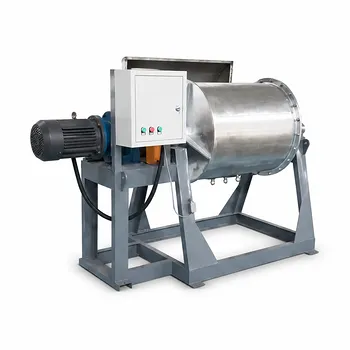
The primary function of a planetary ball mill in the pretreatment of High-Entropy Alloy (HEA) particle reinforced aluminum matrix composites is to achieve the uniform mixing of aluminum alloy powders with HEA powders. This equipment utilizes mechanical force to ensure the reinforcement particles are evenly dispersed throughout the matrix while simultaneously preventing powder oxidation.
Core Insight: The quality of a composite material is determined before the sintering process even begins. The planetary ball mill acts as a critical equalizer, using mechanical energy to break down agglomerates and create a homogeneous foundation, ensuring that the final material possesses a uniform microstructure rather than a cluster of disparate components.
The Mechanics of Uniform Dispersion
Overcoming Particle Segregation
The fundamental challenge in creating HEA-reinforced aluminum composites is ensuring the reinforcement phase does not clump together. The planetary ball mill applies mechanical force to physically disperse the HEA particles within the aluminum matrix powder.
Establishing Microstructural Consistency
By subjecting the powders to this process, you establish a foundation for a composite material with a homogeneous microstructure. Without this uniform distribution during the pretreatment phase, the final composite would likely suffer from inconsistent mechanical properties and structural weak points.
The Critical Role of Atmosphere Control
Preventing Powder Oxidation
Aluminum powders are highly reactive and prone to oxidation when exposed to air. The planetary ball mill addresses this by performing the milling process under a vacuum atmosphere.
Preserving Chemical Purity
By eliminating oxygen from the milling environment, the equipment allows for aggressive mechanical mixing without chemically degrading the aluminum matrix. This ensures that the interface between the HEA particles and the aluminum remains clean, promoting better bonding in subsequent processing stages.
Understanding the Trade-offs
Mechanical Force vs. Particle Integrity
While high-energy impact and shear forces are necessary to break agglomerates and mix powders, excessive force can lead to unwanted plastic deformation. It is essential to balance the milling speed and duration to achieve dispersion without degrading the desirable morphology of the original powders.
Uniformity vs. Contamination
The grinding balls used to generate mechanical force are physical objects that wear down over time. While they are essential for mixing, prolonged milling increases the risk of introducing impurities from the grinding media into the composite mixture, potentially altering the alloy's final composition.
Making the Right Choice for Your Goal
To apply this to your specific project, consider your primary performance objectives:
- If your primary focus is Structural Homogeneity: Prioritize the optimization of milling time and speed to ensure the HEA particles are fully dispersed and no agglomerates remain to act as stress concentrators.
- If your primary focus is Material Purity: Ensure your process strictly adheres to a vacuum atmosphere or inert environment to prevent the formation of oxide layers that could inhibit interfacial bonding.
The planetary ball mill is not just a mixer; it is a tool for strictly controlling the microstructural architecture of your composite material.
Summary Table:
| Feature | Function in HEA Composite Pretreatment | Impact on Final Material |
|---|---|---|
| Mechanical Force | Disperses HEA particles & breaks agglomerates | Ensures a homogeneous microstructure |
| Vacuum Atmosphere | Prevents reactive aluminum powder oxidation | Maintains chemical purity & bond quality |
| High-Energy Impact | Facilitates intimate mixing of matrix and reinforcement | Prevents structural weak points |
| Process Control | Balances milling speed vs. milling duration | Minimizes contamination & plastic deformation |
Elevate Your Composite Material Research with KINTEK
Achieving perfect structural homogeneity in High-Entropy Alloy (HEA) composites requires precision and reliability. KINTEK specializes in high-performance laboratory equipment designed for advanced material synthesis. Our comprehensive range of planetary ball mills, crushing and milling systems, and vacuum atmosphere solutions provides the mechanical force and environmental control necessary to prevent oxidation and ensure uniform particle dispersion.
Whether you are developing HEA-reinforced aluminum matrices or advanced battery materials, KINTEK offers the essential tools—from planetary mills and hydraulic presses to high-temperature furnaces and specialized ceramics—to guarantee the purity and consistency of your research results.
Ready to optimize your powder pretreatment process? Contact us today to find the perfect equipment solution for your lab!
Related Products
- High Energy Planetary Ball Mill for Laboratory Horizontal Tank Type Milling Machine
- High-Energy Omnidirectional Planetary Ball Mill Milling Machine for Laboratory
- Laboratory Planetary Ball Mill Rotating Ball Milling Machine
- High Energy Planetary Ball Mill Milling Machine for Laboratory
- Laboratory Horizontal Planetary Ball Mill Milling Machine
People Also Ask
- What is the role of a planetary ball mill in sulfide-based solid-state batteries? Engineer High-Performance Cathodes
- What are the parameters of a planetary ball mill? Master Speed, Time, and Media for Perfect Grinding
- What is the function of a planetary ball mill for nanostructured eutectic steel? Essential Prep for High-Strength Alloys
- What role does a planetary ball mill play in the preparation of NASICON-type solid electrolytes like LATP and LAGP?
- What is the function of a planetary ball mill in solid-state electrolyte prep? Milling vs. SDS Methods Explained