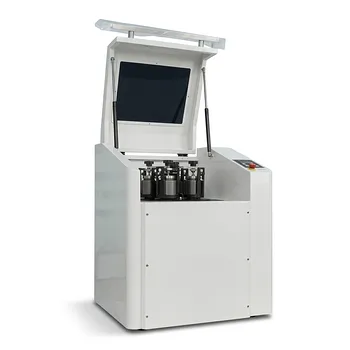
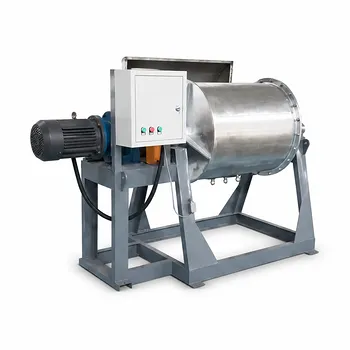
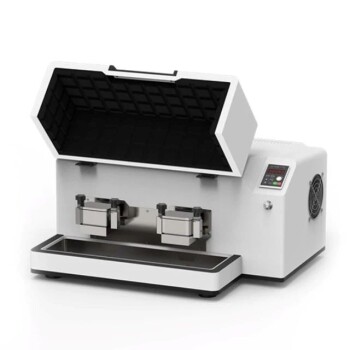
The primary function of a planetary ball mill in this context is to facilitate mechanical alloying through high-energy impact and shear forces. Specifically for TiCN-reinforced Ti-Fe matrix composites, this unit utilizes high-speed rotation to refine and uniformly mix titanium, graphite, and gray cast iron powders. This mechanical processing establishes the essential foundation required for subsequent in-situ reaction synthesis.
By converting kinetic energy into mechanical force, the planetary ball mill transforms discrete powder particles into a homogeneous mixture. This step is not merely about blending; it is a critical prerequisite that ensures reactants are sufficiently refined and distributed to achieve a uniform microstructure in the final composite.
Mechanisms of Powder Preparation
High-Energy Mechanical Alloying
The planetary ball mill operates by rotating jars at high speeds, such as 360 r/min, to generate significant centrifugal force.
This motion causes the grinding balls to impact the powder mixture with intense kinetic energy.
These impact and shear forces are the primary drivers for mechanically alloying the raw materials rather than simply stirring them.
Refinement of Raw Components
The process targets specific raw materials: titanium powder, graphite powder, and gray cast iron powder.
Under the constant bombardment of the grinding balls, these particles are physically broken down and refined.
This reduction in particle size increases the specific surface area of the reactants, making them more chemically active for future processing steps.
The Role in Composite Synthesis
Foundation for In-Situ Reactions
The ultimate goal of this milling process is to prepare the materials for in-situ reaction synthesis.
By intimately mixing the Titanium and Carbon sources (graphite) with the Iron matrix (cast iron), the mill creates a precursor where the elements are close enough to react chemically during sintering.
Without this high-energy preparation, the formation of the reinforcing TiCN phase would be inconsistent or incomplete.
Achieving Microstructural Homogeneity
A major challenge in composite fabrication is avoiding particle agglomeration.
The planetary ball mill ensures a uniform distribution of the reinforcing phases within the metal matrix.
This homogeneity is vital for the final material's performance, as it prevents structural defects and ensures consistent mechanical properties throughout the composite.
Understanding the Trade-offs
Process Parameter Sensitivity
While high-energy milling is effective, it relies heavily on precise control of rotational speed and duration.
Insufficient speed or time may result in incomplete mixing, leaving unrefined agglomerates that weaken the final composite.
Conversely, excessive milling can potentially introduce contamination from the grinding media or alter the powder characteristics beyond the desired specification.
Making the Right Choice for Your Goal
To maximize the effectiveness of the planetary ball mill for Ti-Fe composites, consider the following strategic focus areas:
- If your primary focus is Reactivity: Prioritize higher rotational speeds to maximize impact energy, ensuring the titanium and graphite are refined enough to trigger the in-situ reaction.
- If your primary focus is Uniformity: Focus on the duration of the milling process to ensure the complete dispersion of the graphite and titanium phases within the gray cast iron matrix.
Success in fabricating TiCN-reinforced composites depends not just on the ingredients, but on using the planetary ball mill to precisely engineer their physical arrangement before heat is ever applied.
Summary Table:
| Feature | Function in TiCN-Reinforced Composite Prep |
|---|---|
| Primary Mechanism | High-energy mechanical alloying via impact and shear forces |
| Target Materials | Titanium powder, graphite powder, and gray cast iron powder |
| Key Outcome | Refinement of particles and achievement of microstructural homogeneity |
| Critical Role | Creates the foundation for successful in-situ reaction synthesis |
| Process Control | Optimization of rotational speed (e.g., 360 r/min) and milling time |
Elevate Your Composite Materials Research with KINTEK
Precision in powder preparation is the secret to superior TiCN-reinforced Ti-Fe matrix composites. At KINTEK, we specialize in high-performance laboratory equipment designed to meet the rigorous demands of advanced metallurgy and material science.
Our extensive portfolio includes:
- Advanced Milling Systems: High-energy planetary ball mills and crushing/milling systems for perfect mechanical alloying.
- Thermal Processing: A comprehensive range of muffle, tube, and vacuum furnaces for precise in-situ reaction synthesis.
- Material Characterization & Preparation: Hydraulic pellet presses, isostatic presses, and sieving equipment.
- Specialized Consumables: High-purity ceramics, crucibles, and PTFE products for contamination-free processing.
Whether you are refining battery research tools or synthesizing complex metal-matrix composites, KINTEK provides the reliability and expertise your lab deserves. Contact our technical specialists today to find the perfect equipment solution for your research goals!
Related Products
- High Energy Planetary Ball Mill for Laboratory Horizontal Tank Type Milling Machine
- High-Energy Omnidirectional Planetary Ball Mill Milling Machine for Laboratory
- Laboratory Planetary Ball Mill Rotating Ball Milling Machine
- High Energy Planetary Ball Mill Milling Machine for Laboratory
- High Energy Planetary Ball Mill Machine for Laboratory Horizontal Tank Type
People Also Ask
- What is the role of a planetary ball mill in sulfide-based solid-state batteries? Engineer High-Performance Cathodes
- What are the parameters of a planetary ball mill? Master Speed, Time, and Media for Perfect Grinding
- What is the function of a planetary ball mill for nanostructured eutectic steel? Essential Prep for High-Strength Alloys
- What role does a planetary ball mill play in the preparation of NASICON-type solid electrolytes like LATP and LAGP?
- What is the function of a planetary ball mill in solid-state electrolyte prep? Milling vs. SDS Methods Explained