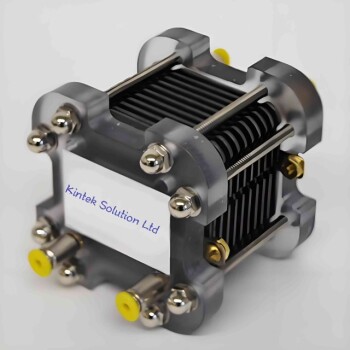
The primary function of a three-chamber interconnected reactor is to physically isolate the anodic oxidation reaction from the cathodic reduction reaction. This structural separation enables researchers to independently monitor organic pollutant degradation at the anode while simultaneously tracking hydrogen evolution at the cathode.
By decoupling the reaction environments, this design eliminates product contamination and allows for the precise calculation of Faraday efficiency, providing a clear, unclouded view of system performance.
The Mechanics of Isolation
Separating Half-Reactions
The core innovation of this design is the physical isolation of the anode and cathode. Rather than allowing reactants and products to mix freely, the reactor confines the oxidation process to one chamber and the reduction process to another.
Independent Monitoring
This separation transforms how data is collected. Researchers can observe the degradation of organic pollutants in the anodic chamber without the data being obscured by the processes occurring at the cathode.
Ensuring Data Integrity
Preventing Cross-Interference
In non-isolated systems, reaction products can migrate and react with opposing electrodes or other byproducts. The three-chamber structure prevents cross-interference, ensuring that the chemical species generated at the anode do not inhibit the reaction at the cathode, and vice versa.
Precise Hydrogen Collection
A critical advantage of this design is the ability to capture evolved gas without contamination. The isolation allows for the precise measurement and collection of hydrogen generated during the reaction.
Calculating Efficiency
Accurate data collection is the prerequisite for calculating Faraday efficiency. Because the hydrogen output is measured in isolation, researchers can definitively correlate the electrical charge passed through the system with the actual chemical yield.
Common Pitfalls to Avoid
The Risk of Mixed Reaction Environments
While simpler reactor designs exist, they often suffer from product recombination. Without the physical separation provided by a three-chamber design, oxidation byproducts can interfere with reduction kinetics.
Inaccurate Efficiency Metrics
If a system allows cross-interference, the volume of hydrogen collected may not reflect the true performance of the catalyst. Relying on data from non-isolated systems can lead to erroneous calculations of Faraday efficiency, obscuring the true effectiveness of the photoelectrocatalytic material.
Making the Right Choice for Your Goal
To determine if this reactor design aligns with your specific research objectives, consider the following:
- If your primary focus is determining Faraday efficiency: Use this design to ensure the hydrogen collected is pure and directly correlates to the charge transfer.
- If your primary focus is analyzing degradation pathways: Choose this configuration to isolate pollutant byproducts from cathodic interference, ensuring a clean chemical profile.
This design is not just about containment; it is about establishing a controlled environment where measurement precision is guaranteed.
Summary Table:
| Feature | Single-Chamber Reactor | Three-Chamber Interconnected Reactor |
|---|---|---|
| Reaction Isolation | Mixed anodic & cathodic processes | Physically separated half-reactions |
| Product Purity | High risk of cross-contamination | Eliminates product recombination |
| Measurement | Obscured by interference | Precise Faraday efficiency calculation |
| Primary Use | Simple, screening-level tests | Advanced PEC kinetics & gas collection |
Elevate Your PEC Research with KINTEK Precision
Maximize the integrity of your photoelectrocatalytic data with KINTEK’s advanced laboratory solutions. Whether you are calculating precise Faraday efficiency or monitoring complex degradation pathways, our specialized electrolytic cells and electrodes provide the controlled environment your research demands.
Beyond PEC reactors, KINTEK offers a comprehensive portfolio including high-temperature furnaces, hydraulic presses, and battery research tools to support your entire workflow. Contact us today to find the perfect reactor configuration for your lab and ensure your measurements are as accurate as your science.
References
- Murat Emre Demir, Hüseyin Selçuk. Synergistic effects of advanced oxidization reactions in a combination of TiO2 photocatalysis for hydrogen production and wastewater treatment applications. DOI: 10.1016/j.ijhydene.2019.07.110
This article is also based on technical information from Kintek Solution Knowledge Base .
Related Products
- Customer Made Versatile CVD Tube Furnace Chemical Vapor Deposition Chamber System Equipment
- Customizable High Pressure Reactors for Advanced Scientific and Industrial Applications
- Customizable PEM Electrolysis Cells for Diverse Research Applications
- Visual High-Pressure Reactor for In-Situ Observation
- Customizable Laboratory High Temperature High Pressure Reactors for Diverse Scientific Applications
People Also Ask
- What is a CVD tube furnace? A Complete Guide to Thin-Film Deposition
- What is the function of a high-temperature CVD tube furnace in 3D graphene foam prep? Master 3D Nanomaterial Growth
- What are the technical advantages of using a CVD tube furnace? Optimize Silicon-Carbon Battery Anodes
- How does a CVD tube furnace inhibit the sintering of silver supports? Boost Membrane Durability and Performance
- What is the function of a tube furnace in CVD SiC synthesis? Achieving Ultra-Pure Silicon Carbide Powders