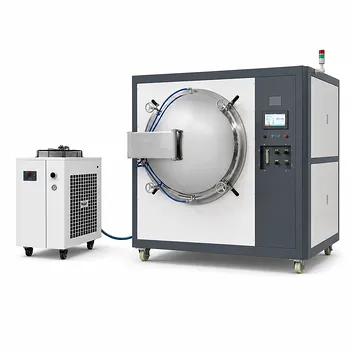
The primary function of a vacuum oven in this context is to establish a high-temperature dehydration environment specifically designed for Fluorinated Ethylene Propylene (FEP) resin and composite pore-forming agent powders. By applying heat under vacuum conditions, the equipment efficiently extracts trace moisture from these raw materials before they enter the melt phase. This pretreatment is strictly required to ensure the material is chemically and physically prepared for the rigors of spinning.
Removing moisture is a fundamental requirement for structural integrity, not just a precautionary step. By eliminating water prior to heating, you prevent vaporization during melt spinning, ensuring a homogeneous polymer melt and a defect-free final membrane.
The Mechanism of Dehydration
Creating a Constant Environment
The vacuum oven provides a stable thermal environment essential for sensitive raw materials. It processes both the FEP resin and the composite pore-forming agent powders simultaneously.
The Role of Vacuum Pressure
Heating alone is often insufficient for deep drying. The vacuum lowers the boiling point of trapped water, allowing trace moisture to evaporate rapidly and completely.
Targeting Trace Moisture
Even microscopic amounts of water can be detrimental. The vacuum oven is specifically calibrated to remove this "trace moisture" that standard drying might miss.
Impact on Downstream Processing
Preventing Bubble Formation
The most immediate risk of moisture is vaporization. When damp materials enter the high-heat melt spinning process, water turns to steam, creating bubbles.
Ensuring Melt Homogeneity
Bubbles and voids disrupt the uniformity of the polymer. The vacuum oven ensures the resulting polymer melt remains consistent and homogeneous throughout the batch.
Guaranteeing Final Forming Quality
The quality of the FEP hollow fiber membrane is determined during the spinning stage. By removing defects at the raw material stage, the vacuum oven secures the final structural quality of the membrane fibers.
Operational Considerations
Managing Processing Time
Vacuum drying is generally a time-intensive batch process compared to continuous in-line drying. It requires careful scheduling to ensure it does not become a bottleneck in the overall production line.
Equipment Integrity
The effectiveness of this step relies entirely on maintaining a perfect vacuum seal. Any leakage compromises the dehydration atmosphere, potentially allowing moisture to remain hidden until the melt spinning stage, where it causes irreversible defects.
Making the Right Choice for Your Goal
To maximize the effectiveness of your pretreatment stage, align your process controls with your specific quality metrics:
- If your primary focus is structural integrity: Prioritize the vacuum level over temperature to ensure deep moisture extraction without risking thermal degradation of the pore-forming agents.
- If your primary focus is melt consistency: Ensure the drying time is sufficient for the specific volume of composite powder to guarantee that the center of the material batch is as dry as the surface.
The vacuum oven serves as the critical quality gatekeeper, ensuring that no environmental moisture survives to compromise the mechanical properties of the final FEP membrane.
Summary Table:
| Feature | Function in FEP Pretreatment | Impact on Quality |
|---|---|---|
| Vacuum Environment | Lowers boiling point of water | Rapidly extracts deep trace moisture |
| Thermal Stability | Consistent heating of powders | Prevents thermal degradation of agents |
| Moisture Removal | Eliminates water before melting | Prevents vapor bubbles during spinning |
| Material Prep | Homogenizes raw resin/agents | Ensures uniform polymer melt consistency |
Elevate Your Membrane Research with KINTEK Precision
High-performance FEP hollow fiber membranes demand uncompromising material purity. KINTEK specializes in advanced laboratory equipment designed for the most rigorous pretreatment workflows. From our high-precision vacuum ovens that ensure total moisture extraction to our specialized high-temperature reactors and crushing systems, we provide the tools needed to guarantee melt homogeneity and structural integrity.
Whether you are refining battery research components or developing advanced filtration membranes, our comprehensive portfolio—including PTFE consumables, ceramic crucibles, and cooling solutions—is engineered for excellence.
Ready to optimize your raw material pretreatment? Contact KINTEK today to find the perfect equipment solution for your lab!
References
- Yan-Wei You, Hailiang Liu. Study on poly(tetrafluoroethylene-<i>co</i>-hexafluoropropylene) hollow fiber membranes with surface modification by a chemical vapor deposition method. DOI: 10.1039/c7ra09822g
This article is also based on technical information from Kintek Solution Knowledge Base .
Related Products
- 56L Vertical Laboratory Vacuum Drying Oven
- 23L Laboratory Vacuum Drying Oven
- Vacuum Heat Treat Sintering Brazing Furnace
- 2200 ℃ Graphite Vacuum Heat Treat Furnace
- Dental Porcelain Zirconia Sintering Ceramic Vacuum Press Furnace
People Also Ask
- Why is a laboratory vacuum drying oven recommended for rice straw residues? Protect Your Biomass Integrity
- What role does a laboratory vacuum drying oven play in the preparation of modified multi-walled carbon nanotubes?
- What is the importance of using a laboratory vacuum drying oven? Preserving Slow-Release Microcapsule Integrity
- Why is a Laboratory Vacuum Drying Oven recommended for PBAT microspheres? Protect Sensitive Polymer Integrity
- What role does a laboratory vacuum drying oven play in processing nanoparticle powder samples? Protect Sample Integrity