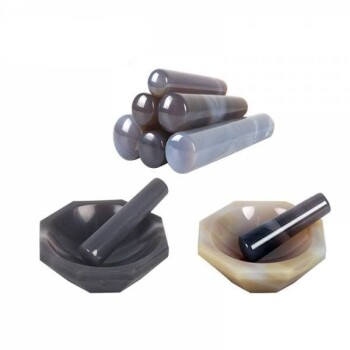
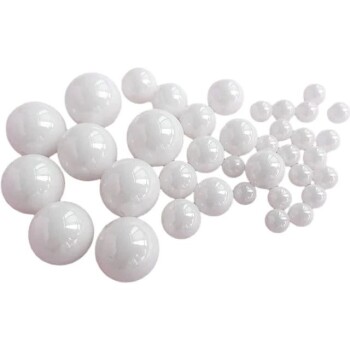
The primary function of agate grinding jars and agate balls is to act as a chemically inert, high-hardness milling medium that pulverizes reactants without contaminating them. Specifically, in the preparation of Li4Ti5O12 precursors using materials like Li2CO3 and tetrabutyl titanate, these agate components are essential for preventing the intrusion of metallic impurities.
Core Takeaway Agate media is chosen not just for its ability to grind, but for its ability to protect the chemical integrity of the sample. By offering exceptional hardness and inertness, agate eliminates the risk of iron contamination during extended milling, ensuring the synthesized anode material achieves the high purity required for optimal electrochemical performance.
The Critical Role of Purity in Synthesis
Preventing Metallic Contamination
The most significant risk during the ball milling process is the introduction of foreign materials into the precursor mixture. Standard metallic grinding jars can shed microscopic particles, specifically iron, into the solution during extended grinding periods.
Ensuring Chemical Inertness
The precursors used, such as tetrabutyl titanate solutions and lithium carbonate (Li2CO3), require a stable environment to mix effectively. Agate is chemically inert, meaning it facilitates the physical mixing of these chemicals without reacting with them. This guarantees that the final stoichiometry of the mixture remains accurate and uncompromised by side reactions.
Mechanical Advantages of Agate
Exceptional Hardness and Low Wear
Agate jars and balls possess exceptional hardness, which makes them highly resistant to wear and abrasion. This durability ensures that the grinding media itself does not degrade and become a contaminant in the final product.
Uniform Dispersion
Effective synthesis relies on the homogeneous mixing of raw materials. The physical properties of agate allows for the thorough grinding required to achieve a uniform dispersion of components. This uniformity establishes the necessary foundation for the subsequent solid-state reactions that form the final battery material.
Understanding the Trade-offs
The Consequence of Alternative Media
While other grinding media exist, failing to use agate in this specific application introduces a direct path to failure. Using metallic jars would almost certainly introduce iron impurities, which are detrimental to the battery's function.
Purity vs. Contamination Risks
The choice of agate is a deliberate prioritization of material purity over other factors. While the process focuses on grinding, the defining characteristic of this setup is the exclusion of impurities. Any compromise on the grinding media quality directly threatens the electrochemical performance of the final lithium titanate anode.
Making the Right Choice for Your Project
When preparing precursors for high-performance battery materials, the selection of grinding media is a technical decision, not just a logistical one.
- If your primary focus is maximizing electrochemical performance: Prioritize agate media to strictly eliminate iron and other metallic impurities that degrade battery efficiency.
- If your primary focus is chemical stability: Rely on agate's inert nature to process reactive solutions like tetrabutyl titanate without inducing unwanted side reactions.
The use of agate is a fundamental requirement for producing high-purity Li4Ti5O12 capable of meeting modern energy storage demands.
Summary Table:
| Feature | Agate Media Benefit | Impact on Li4Ti5O12 Synthesis |
|---|---|---|
| Material Hardness | Exceptional resistance to wear | Prevents media degradation and sample contamination |
| Chemical Inertness | Non-reactive with precursors | Maintains accurate stoichiometry of Li2CO3 and titanates |
| Purity Level | Metal-free (No iron) | Eliminates metallic impurities that degrade battery performance |
| Milling Efficiency | Uniform dispersion | Ensures homogeneous mixing for solid-state reactions |
Elevate Your Battery Material Research with KINTEK
Precision in battery synthesis starts with the right tools. At KINTEK, we specialize in providing high-performance laboratory equipment designed to protect the integrity of your samples. Whether you are developing Li4Ti5O12 anodes or advanced energy storage solutions, our premium agate grinding jars and balls, crushing and milling systems, and vacuum furnaces ensure zero metallic contamination and maximum chemical purity.
From high-temperature high-pressure reactors to specialized battery research tools and consumables, KINTEK delivers the reliability your lab demands. Don't let iron impurities compromise your electrochemical performance.
Ready to optimize your milling process? Contact our technical experts today to find the perfect solution for your lab!
Related Products
- Laboratory Jar Mill with Agate Grinding Jar and Balls
- Laboratory Jar Ball Mill with Alumina Zirconia Grinding Jar and Balls
- Nature Agate Mortar and Pestle for Grinding and Mixing
- Laboratory Ball Mill Jar Mill with Metal Alloy Grinding Jar and Balls
- Laboratory Four-Body Horizontal Jar Mill
People Also Ask
- What are the different types of laboratory mills? Choose the Right Grinder for Your Sample Material
- What is use for grinding in the laboratory? Select the Right Mill for Accurate Sample Prep
- What laboratory apparatus is used for grinding? Match the Right Mill to Your Sample Material
- What is the function of a laboratory grinding mill? Achieve Precise Sample Preparation for Accurate Results
- Why are agate milling jars and balls used for Mo-La2O3 powder mixing? Ensure High-Purity Material Dispersion