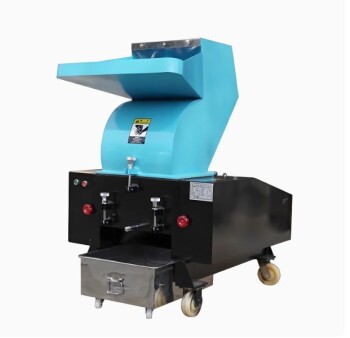
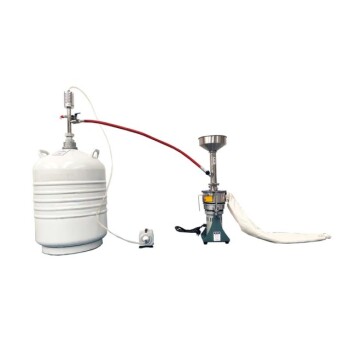
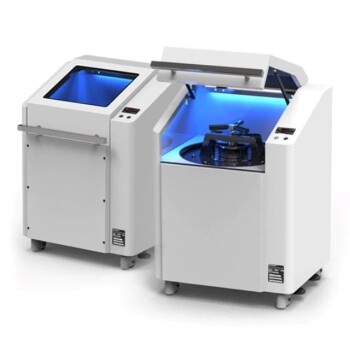
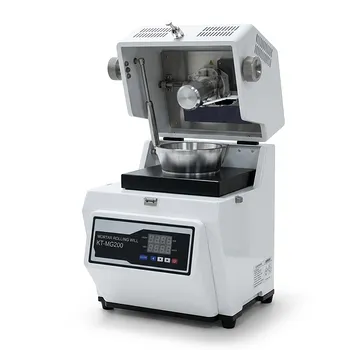
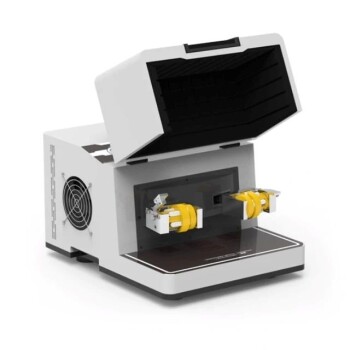
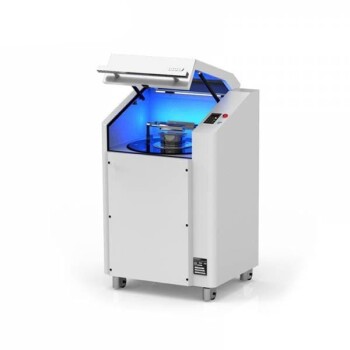
The primary function of mechanical grinding equipment in lignin modification is to utilize physical impact and friction to fracture the material's macromolecular structure. By breaking the lignin down into significantly smaller particles, this process maximizes the specific surface area, creating the necessary physical conditions for effective downstream processing.
Core Insight Mechanical grinding is not merely about size reduction; it is a strategic pretreatment to unlock chemical accessibility. By increasing the specific surface area and disrupting the fibrous structure, grinding directly amplifies the efficiency of subsequent chemical reactions or enzymatic hydrolysis.
The Mechanics of Physical Modification
Impact and Friction
Mechanical grinding equipment operates by applying physical impact and friction to the raw material.
These forces act directly on the lignin, subjecting the material to stress that exceeds its structural integrity.
Macromolecular Breakdown
The application of these forces results in the fragmentation of lignin's macromolecular structure.
This transforms coarse, fibrous biomass into fine particles, fundamentally altering the physical state of the material to prepare it for conversion.
Why Surface Area Matters
Enhancing Reaction Efficiency
The most critical outcome of mechanical grinding is the drastic increase in specific surface area.
A larger surface area exposes more of the lignin to the surrounding environment, facilitating faster and more complete interactions during processing.
Improving Reagent Accessibility
By increasing the surface area, the process improves the accessibility of hydrolysis reagents or enzymes.
This accessibility is essential for biofuel conversion, as it allows chemical agents to penetrate the material more effectively.
Strategic Benefits for Downstream Processing
Accelerating Enzymatic Hydrolysis
The physical disruption caused by grinding significantly enhances the efficiency of enzymatic hydrolysis.
When the specific surface area is increased, enzymes can more easily locate and bind to their substrates, accelerating the breakdown of the biomass.
Altering Crystallinity
Beyond simple size reduction, high-energy mechanical forces help reduce the crystallinity of the cellulose within the lignocellulosic matrix.
Lowering crystallinity disrupts the rigid structure that typically resists degradation, further shortening the time required for processes like bio-hydrogen fermentation.
Understanding the Scope and Limitations
Physical vs. Chemical Change
It is important to recognize that mechanical grinding is primarily a physical pretreatment, not a chemical conversion method.
While it significantly improves reactivity, it relies on subsequent chemical or biological processes to extract value or create final products.
Energy Implications
The process utilizes high-energy mechanical forces to achieve the necessary disruption of the fibrous structure.
Users must balance the energy input required for grinding against the efficiency gains achieved in the downstream chemical or enzymatic stages.
Making the Right Choice for Your Goal
Depending on your specific application, the role of grinding shifts slightly. Use the following guide to align your approach:
- If your primary focus is Biofuel Conversion: Prioritize grinding consistency to maximize specific surface area, ensuring the highest possible efficiency for enzymatic hydrolysis.
- If your primary focus is Microbial Fermentation: Focus on disruption that facilitates nutrient release, altering the physical form to make carbon sources easily available to microorganisms.
Effective mechanical grinding transforms lignin from a resistant raw material into a highly reactive feedstock ready for conversion.
Summary Table:
| Mechanical Action | Primary Physical Effect | Key Strategic Benefit |
|---|---|---|
| Impact & Friction | Macromolecular structure fragmentation | Drastic increase in specific surface area |
| Particle Size Reduction | Increased surface-to-volume ratio | Enhanced accessibility for enzymes and reagents |
| Structural Disruption | Reduction in cellulose crystallinity | Accelerated enzymatic hydrolysis and fermentation |
| Physical Stress | Transformation of fibrous biomass | Improved reactivity for chemical conversion |
Unlock the Potential of Your Biomass Research with KINTEK
Maximize the efficiency of your lignin modification and material preparation with KINTEK’s high-performance crushing and milling systems. As specialists in laboratory equipment, we understand that precise pretreatment is the key to successful downstream conversion.
Our laboratory solutions for lignin and biomass research include:
- Advanced Crushing and Milling Systems: Achieve optimal particle size and maximum specific surface area.
- High-Pressure Reactors & Autoclaves: For seamless subsequent chemical and enzymatic hydrolysis.
- Precision Pellet Presses: For material density and characterization studies.
- Cooling & Homogenization Solutions: To maintain sample integrity throughout the pretreatment process.
Ready to transform your raw materials into highly reactive feedstocks? Contact KINTEK today to consult with our experts on the perfect grinding solution for your lab!
References
- Engin Kocatürk, Zeki Candan. Recent Advances in Lignin-Based Biofuel Production. DOI: 10.3390/en16083382
This article is also based on technical information from Kintek Solution Knowledge Base .
Related Products
- Three-dimensional electromagnetic sieving instrument
- Powerful Plastic Crusher Machine
- Vibrating Disc Mill Small Laboratory Grinding Machine
- Liquid Nitrogen Cryogenic Grinder Mill Cryomill Airflow Ultrafine Pulverizer
- Laboratory High Throughput Tissue Grinding Mill Grinder
People Also Ask
- Why is sieving equipment essential for the classification of processed bio-activated carbon? Optimize Performance
- What are the limitations of sieving? Understanding the Constraints of Particle Size Analysis
- What are advantages and disadvantages of sieving method? A Guide to Reliable & Cost-Effective Particle Sizing
- How is sieving important? The Critical Role of Particle Size Analysis in Quality Control
- What is sieving and how does it work? A Guide to Accurate Particle Size Analysis