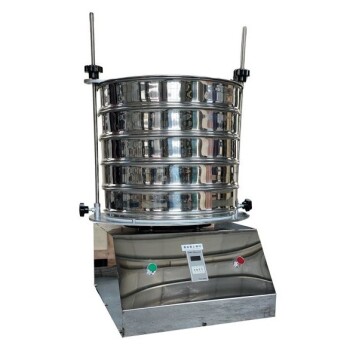
The primary purpose of processing emission control catalysts to a particle size of 250–500 µm is to ensure that high-throughput screening data accurately predicts real-world performance. By targeting this specific size range, researchers achieve a critical balance: reducing pressure drop across the laboratory catalyst bed while successfully simulating the diffusion length of the washcoat found in actual automotive systems.
High-throughput screening relies on this specific particle size to bridge the gap between lab-scale metrics and full-scale engine application, ensuring data fidelity by mimicking realistic diffusion limitations.
Bridging the Gap Between Lab and Reality
High-throughput screening allows for the rapid testing of catalyst materials. However, to make this speed valuable, the physical conditions in the lab reactor must correlate with the physical conditions of an automotive exhaust system.
Managing Pressure Drop
In a laboratory setting, catalysts are often tested in small packed beds. If the catalyst particles are too fine, they create significant resistance to gas flow.
Crushing and sieving the material to a minimum of 250 µm prevents this issue. It ensures the catalyst bed remains permeable, allowing reactant gases to flow through the system without causing an excessive pressure drop that could disrupt the experiment or damage equipment.
Simulating Washcoat Architecture
Real-world automotive catalysts are not packed beds of powder; they consist of a thin layer of catalytic material (the washcoat) applied to a ceramic or metallic support structure.
The 250–500 µm particle size is not arbitrary. It is selected to mimic the diffusion length associated with the thickness of this washcoat.
By matching the particle size to the typical washcoat thickness, the lab test accurately reproduces the distance gas molecules must travel to react. This ensures the kinetic data collected in the lab reflects the mass transfer limitations present in the final product.
Understanding the Trade-offs
While the 250–500 µm range is the established standard for this application, deviations from this range can compromise data validity.
The Risk of Finer Particles
If the material is crushed to a size significantly smaller than 250 µm, you eliminate the diffusion limitations that exist in real applications.
While this might show "better" intrinsic activity in the lab, it yields misleading data. The results would represent an idealized scenario that cannot be replicated in a real engine where washcoat diffusion is a limiting factor.
The Risk of Coarser Particles
Conversely, utilizing particles larger than 500 µm introduces excessive diffusion resistance.
This prevents the inner volume of the particle from participating effectively in the reaction. The resulting data would underestimate the catalyst's potential performance, leading to false negatives during the screening process.
Making the Right Choice for Your Screening Protocol
Standardizing your sample preparation is just as critical as the chemical composition of the catalyst itself.
- If your primary focus is Operational Stability: Ensure particles are sieved above 250 µm to prevent bed plugging and inconsistent flow rates during automated testing.
- If your primary focus is Data Correlation: Strictly enforce the 500 µm upper limit to guarantee your kinetic data accurately reflects the diffusion physics of a real-world washcoat.
Reliable scale-up begins with precise sample preparation that respects both the physical constraints of the lab and the chemical realities of the engine.
Summary Table:
| Particle Size Range | Purpose / Benefit | Risk of Deviation |
|---|---|---|
| < 250 µm | Minimizes diffusion limits | High pressure drop; bed plugging; unrealistic 'ideal' data |
| 250–500 µm | Optimal Range: Simulates washcoat diffusion length | Balanced performance; bridges lab-to-engine gap |
| > 500 µm | Simplifies crushing | Excessive diffusion resistance; underestimates catalyst potential |
Optimize Your Catalyst Research with KINTEK Precision
Achieving the perfect 250–500 µm particle size is essential for high-throughput screening that translates into real-world success. KINTEK provides the specialized crushing and milling systems and sieving equipment needed to ensure your catalyst samples meet strict architectural standards.
Beyond sample preparation, we support your entire lab workflow with high-temperature furnaces, hydraulic presses for pelletizing, and high-pressure reactors. Partner with KINTEK today to enhance your data fidelity and operational stability. Contact our specialists now to find the right equipment for your lab!
References
- Andreas Sundermann, Olga Gerlach. High-Throughput Screening as a Supplemental Tool for the Development of Advanced Emission Control Catalysts: Methodological Approaches and Data Processing. DOI: 10.3390/catal6020023
This article is also based on technical information from Kintek Solution Knowledge Base .
Related Products
- Laboratory Test Sieves and Sieving Machines
- Three-dimensional electromagnetic sieving instrument
- Custom PTFE Teflon Parts Manufacturer for PTFE Mesh F4 Sieve
People Also Ask
- What are laboratory test sieves used for? A Guide to Particle Size Analysis
- How do you calculate the sieve test? Master Particle Size Distribution for Quality Control
- How does a lab test sieve contribute to biomass charcoal powder preparation? Achieve Uniform Particle Size
- What are the specifications for test sieves? A Guide to ASTM & ISO Standards for Accurate Particle Analysis
- What materials are required for sieving? Achieve Accurate Particle Size Analysis