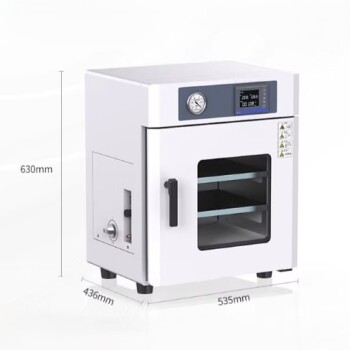
In the preparation of thermochemical energy storage materials, the constant temperature oven serves a critical dual function: pretreatment and regeneration. It is responsible for clearing the porous structure of raw vermiculite and subsequently driving the material to an anhydrous state after salt impregnation. This precise thermal control is what effectively "charges" the material for energy storage.
The constant temperature oven is not merely a drying tool; it is the primary instrument for enabling energy storage potential. By removing native moisture to create space and later locking in the impregnated salt, it transforms inert vermiculite into a functional thermal battery.
The Two-Stage Thermal Process
To understand the oven's role, you must look at the specific changes occurring within the material's microstructure at two distinct phases.
Stage 1: Pretreatment and Pore Clearing
Before any chemical modification can occur, the raw vermiculite must be prepared.
The oven is used for high-temperature pre-drying, typically set to approximately 120°C.
The objective here is to forcibly remove adsorbed water that naturally occupies the vermiculite's pores.
By eliminating this native moisture, the oven maximizes the available internal volume.
This ensures there is sufficient physical space for the subsequent salt solution impregnation, directly impacting the material's final storage capacity.
Stage 2: Regeneration and Charging
Once the vermiculite has been impregnated with the salt solution, the oven performs its second role.
It is used to dry the now-moist precursor until it reaches an anhydrous (water-free) state.
This step is technically defined as the 'charging' process.
Through precise temperature regulation, the oven ensures the salt remains stably loaded within the vermiculite matrix, ready to release heat when re-hydrated later.
Critical Operational Considerations
While the concept is straightforward, the precision of the equipment is paramount for material stability.
The Necessity of Precision
The oven must maintain a constant temperature to ensure uniform drying.
Inconsistent heating during the charging phase can lead to uneven salt distribution or incomplete drying.
Stability vs. Volatility
The process relies on precise temperature control to balance drying speed with material integrity.
The goal is to achieve an anhydrous state without degrading the matrix or destabilizing the loaded salt.
Optimizing the Preparation Process
To achieve high-performance thermochemical storage materials, your use of the oven must be targeted toward specific physical outcomes.
- If your primary focus is maximizing storage capacity: Ensure the pre-drying phase at 120°C is thorough to completely evacuate pores for maximum salt uptake.
- If your primary focus is material longevity: Prioritize precise temperature regulation during the second drying phase to ensure the salt remains stably loaded within the matrix.
The constant temperature oven is the bridge that converts raw chemical potential into a stable, usable energy storage medium.
Summary Table:
| Process Phase | Temperature Goal | Primary Function | Material Outcome |
|---|---|---|---|
| Pretreatment | ~120°C | High-temperature pre-drying | Clears pores by removing adsorbed water |
| Regeneration | Constant / Controlled | Driving to anhydrous state | 'Charges' the material by locking in salt |
| Optimization | Uniform Precision | Consistent heat distribution | Stable salt loading and high storage capacity |
Elevate Your Materials Research with KINTEK Precision
High-performance thermochemical energy storage requires absolute thermal accuracy. KINTEK provides state-of-the-art laboratory solutions tailored for advanced material synthesis, from constant temperature ovens and high-temperature muffle furnaces to high-pressure reactors and battery research tools.
Whether you are clearing pores in vermiculite or synthesizing complex CVD/PECVD coatings, our equipment ensures the stability and precision your research demands. Enhance your lab's efficiency and secure reliable results with our comprehensive range of heating, milling, and crushing systems.
Ready to optimize your thermal storage materials? Contact KINTEK today for a customized quote!
References
- G.L. Sullivan, Jonathon Elvins. Cycling Stability of Calcium-Impregnated Vermiculite in Open Reactor Used as a Thermochemical Storage Material. DOI: 10.3390/en16217225
This article is also based on technical information from Kintek Solution Knowledge Base .
Related Products
- High Temperature Constant Temperature Heating Circulator Water Bath Chiller Circulator for Reaction Bath
- 5L Heating Chilling Circulator Cooling Water Bath Circulator for High and Low Temperature Constant Temperature Reaction
- 10L Heating Chilling Circulator Cooling Water Bath Circulator for High and Low Temperature Constant Temperature Reaction
- 10L Chilling Circulator Cooling Water Bath Low Temperature Constant Temperature Reaction Bath
- 50L Heating Chilling Circulator Cooling Water Bath Circulator for High and Low Temperature Constant Temperature Reaction
People Also Ask
- What is the necessity of a circulating water bath in chlorate production? Optimize Yield & Purity with Precision
- How do constant temperature circulators impact weight-loss immersion tests? Ensure Precision in Corrosion Analysis
- How does a constant temperature circulator support the leaching reaction of gold scrap? Optimize Gold Recovery Results
- Why is a constant temperature water bath used for precursor storage in CVD? Achieve Stable Nanocrystalline SiC Deposition
- Why is a high-precision constant temperature water bath necessary for anaerobic digestion? Ensure Success at 37±0.02°C