Knowledge Vacuum Furnace What is the purpose of the vacuum in a heat exchanger? Prevent Damage or Enable Critical Processes
Author avatar

Tech Team · Kintek Solution

Updated 2 months ago

What is the purpose of the vacuum in a heat exchanger? Prevent Damage or Enable Critical Processes


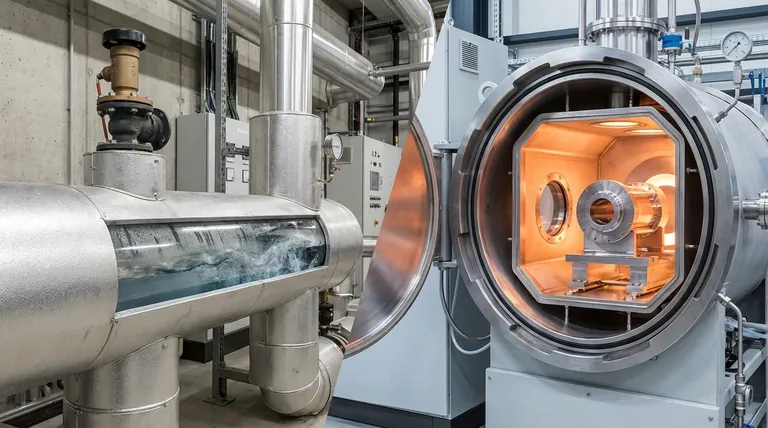
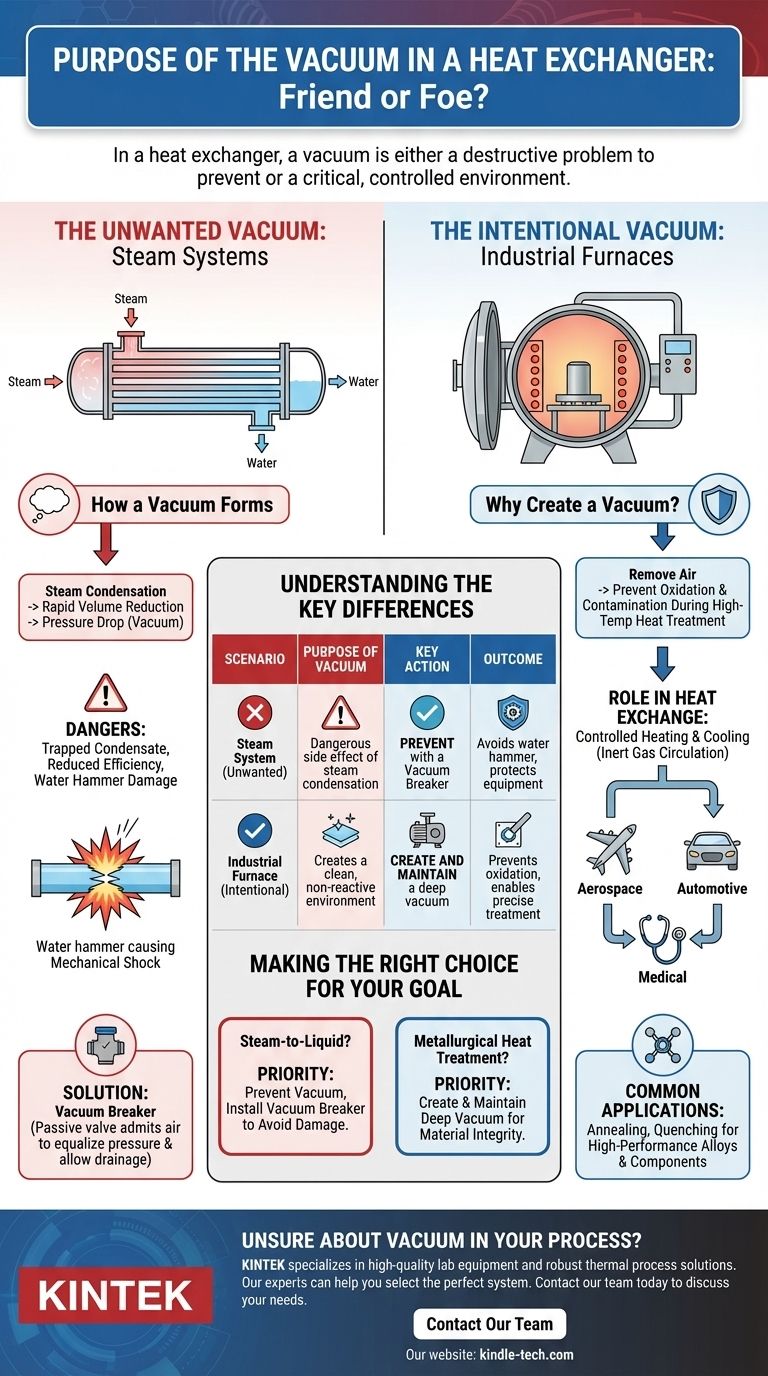
In the context of a heat exchanger, the role of a vacuum is fundamentally twofold: it is either a highly destructive problem that must be prevented or a highly controlled, intentional environment required for a specific industrial process. In common steam-to-water systems, an unwanted vacuum can form that traps water, leading to violent water hammer and tube damage. Conversely, in specialized applications like heat treatment furnaces, a vacuum is deliberately created to protect materials from oxidation at high temperatures.

Understanding the purpose of a vacuum in your heat exchanger system first requires identifying your application. In most HVAC and process heating systems, a vacuum is a dangerous side effect to be eliminated, whereas in advanced metallurgy, it is the essential operating environment.
What is the purpose of the vacuum in a heat exchanger? Prevent Damage or Enable Critical Processes

The Unwanted Vacuum: Steam Systems

In many common heat exchangers, particularly those using steam to heat water or another liquid, a vacuum is not a feature but a critical failure condition that must be actively prevented.

How a Vacuum Forms During Condensation

When steam transfers its energy to the colder fluid in the heat exchanger, it condenses back into water. The volume of this resulting water (condensate) is drastically smaller than the volume of the steam it came from. This rapid, massive reduction in volume inside a sealed shell creates a pressure drop, often falling well below atmospheric pressure, forming a vacuum.

The Dangers of an Unwanted Vacuum

This vacuum actively works against the system, preventing condensate from draining properly out of the heat exchanger shell. The trapped water then creates two major problems: it reduces the surface area available for new steam to condense, drastically lowering efficiency, and it sets the stage for water hammer—a destructive phenomenon where incoming high-velocity steam collides with the stationary slug of trapped water, causing a violent mechanical shock that can damage or even rupture the equipment.

The Solution: The Vacuum Breaker

To solve this, steam-to-liquid heat exchangers are fitted with a vacuum breaker. This is a simple, passive check valve installed on the steam shell. If the internal pressure drops below the external atmospheric pressure, the valve automatically opens, allowing air to enter and "break" the vacuum. This equalizes the pressure, allowing the condensate to drain freely by gravity as intended.

The Intentional Vacuum: Industrial Furnaces

In stark contrast to steam systems, some industrial processes use vacuum furnaces for highly specialized heat treatments. Here, the vacuum is not a problem but the core requirement for the process to succeed.

Why Create a Vacuum?

In applications like annealing or quenching heat-resistant alloys (such as those used in aerospace), heating the metal in the presence of air would cause it to oxidize and become contaminated. A deep vacuum is pulled to remove nearly all the air and other gases from the furnace chamber before the heat treatment begins. This creates a clean, non-reactive environment.

The Role of Heat Exchange in a Vacuum

Within these furnaces, heating elements bring the target materials up to extreme temperatures. The system must also be able to cool them at a controlled rate. This often involves flowing an inert gas into the chamber after the heating cycle, which is then circulated through an internal heat exchanger to remove heat. The entire process—heating and cooling—occurs within this tightly controlled vacuum environment.

Common Applications

This method is crucial for manufacturing high-performance components that must withstand extreme stress and heat. You will find vacuum heat treatment used extensively in the aerospace, automotive, and medical industries for parts like engine turbines, exhaust components, and surgical tools.

Understanding the Key Differences

It is critical to distinguish between these two scenarios, as they represent opposite operational goals.

Heat Transfer vs. Material Protection

In a steam system, the goal is maximum heat transfer from the steam to the liquid. A vacuum hinders this process. In a vacuum furnace, the primary goal is material protection from atmospheric reaction; heat transfer is simply part of the treatment process within that protected environment.

Pressure as a Fault vs. a Feature

For a steam heat exchanger, sub-atmospheric pressure is a fault condition that indicates poor drainage and imminent risk of damage. For a vacuum furnace, sub-atmospheric pressure is the primary operational state required for a successful outcome.

Making the Right Choice for Your Goal

To determine whether a vacuum is a friend or foe in your system, you must first identify the fundamental purpose of your equipment.

  • If you are working with a steam-to-liquid heat exchanger: Your priority is to prevent vacuum formation using a correctly installed vacuum breaker to ensure proper condensate drainage and avoid equipment damage.
  • If you are involved in metallurgical heat treatment: Your priority is to create and maintain a deep vacuum using a robust pumping system to protect the integrity of the material during its thermal processing.

Ultimately, understanding the core objective of your thermal process will tell you whether a vacuum is a dangerous problem to be solved or a critical environment to be created.

Summary Table:

Scenario Purpose of Vacuum Key Action Outcome
Steam System (Unwanted) A dangerous side effect of steam condensation Prevent with a Vacuum Breaker Avoids water hammer, ensures proper drainage, protects equipment
Industrial Furnace (Intentional) Creates a clean, non-reactive environment Create and Maintain a deep vacuum Prevents material oxidation, enables precise heat treatment

Unsure if a vacuum is a problem or a requirement for your process? The right equipment is critical for safety and performance. KINTEK specializes in high-quality lab equipment and consumables, including robust solutions for demanding thermal processes. Our experts can help you select the perfect system for your application, whether you need to prevent a damaging vacuum or create a controlled one.

Contact our team today to discuss your specific laboratory needs and ensure optimal results.

Visual Guide
What is the purpose of the vacuum in a heat exchanger? Prevent Damage or Enable Critical Processes Visual Guide

Related Products

People Also Ask

Related Products

Electric Heated Hydraulic Vacuum Heat Press for Lab

Electric Heated Hydraulic Vacuum Heat Press for Lab

The Electric Vacuum Heat Press is a specialized heat press equipment that operates in a vacuum environment, utilizing advanced infrared heating and precise temperature control for high quality, rugged and reliable performance.

Vacuum Heat Treat Furnace with Ceramic Fiber Liner

Vacuum Heat Treat Furnace with Ceramic Fiber Liner

Vacuum furnace with polycrystalline ceramic fiber insulation liner for excellent heat insulation and uniform temperature field. Choose from 1200℃ or 1700℃ max. working temperature with high vacuum performance and precise temperature control.

Heated Hydraulic Press Machine with Heated Plates for Vacuum Box Laboratory Hot Press

Heated Hydraulic Press Machine with Heated Plates for Vacuum Box Laboratory Hot Press

Enhance your lab's precision with our lab press for vacuum box. Press pills and powders with ease and precision in a vacuum environment, reducing oxidation and improving consistency. Compact and easy to use with a digital pressure gauge.

Vacuum Hot Press Furnace Machine Heated Vacuum Press

Vacuum Hot Press Furnace Machine Heated Vacuum Press

Discover the advantages of Vacuum Hot Press Furnace! Manufacture dense refractory metals & compounds, ceramics, and composites under high temp and pressure.

Vacuum Heat Treat and Molybdenum Wire Sintering Furnace for Vacuum Sintering

Vacuum Heat Treat and Molybdenum Wire Sintering Furnace for Vacuum Sintering

A vacuum molybdenum wire sintering furnace is a vertical or bedroom structure, which is suitable for withdrawal, brazing, sintering and degassing of metal materials under high vacuum and high temperature conditions. It is also suitable for dehydroxylation treatment of quartz materials.

Vacuum Heat Treat and Pressure Sintering Furnace for High Temperature Applications

Vacuum Heat Treat and Pressure Sintering Furnace for High Temperature Applications

Vacuum pressure sintering furnaces are designed for high temperature hot pressing applications in metal and ceramic sintering. Its advanced features ensure precise temperature control, reliable pressure maintenance, and a robust design for seamless operation.

Vacuum Heat Treat Sintering Brazing Furnace

Vacuum Heat Treat Sintering Brazing Furnace

A vacuum brazing furnace is a type of industrial furnace used for brazing, a metalworking process that joins two pieces of metal using a filler metal that melts at a lower temperature than the base metals. Vacuum brazing furnaces are typically used for high-quality applications where a strong, clean joint is required.

Small Vacuum Heat Treat and Tungsten Wire Sintering Furnace

Small Vacuum Heat Treat and Tungsten Wire Sintering Furnace

The small vacuum tungsten wire sintering furnace is a compact experimental vacuum furnace specially designed for universities and scientific research institutes. The furnace features a CNC welded shell and vacuum piping to ensure leak-free operation. Quick-connect electrical connections facilitate relocation and debugging, and the standard electrical control cabinet is safe and convenient to operate.

Molybdenum Vacuum Heat Treat Furnace

Molybdenum Vacuum Heat Treat Furnace

Discover the benefits of a high-configuration molybdenum vacuum furnace with heat shield insulation. Ideal for high-purity, vacuum environments like sapphire crystal growth and heat treatment.

Vacuum Hot Press Furnace Heated Vacuum Press Machine Tube Furnace

Vacuum Hot Press Furnace Heated Vacuum Press Machine Tube Furnace

Reduce forming pressure & shorten sintering time with Vacuum Tube Hot Press Furnace for high-density, fine-grain materials. Ideal for refractory metals.

2200 ℃ Graphite Vacuum Heat Treat Furnace

2200 ℃ Graphite Vacuum Heat Treat Furnace

Discover the power of the KT-VG Graphite Vacuum Furnace - with a maximum working temperature of 2200℃, it's perfect for vacuum sintering of various materials. Learn more now.

600T Vacuum Induction Hot Press Furnace for Heat Treat and Sintering

600T Vacuum Induction Hot Press Furnace for Heat Treat and Sintering

Discover the 600T Vacuum Induction Hot Press Furnace, designed for high-temperature sintering experiments in vacuum or protected atmospheres. Its precise temperature and pressure control, adjustable working pressure, and advanced safety features make it ideal for nonmetal materials, carbon composites, ceramics, and metal powders.

2200 ℃ Tungsten Vacuum Heat Treat and Sintering Furnace

2200 ℃ Tungsten Vacuum Heat Treat and Sintering Furnace

Experience the ultimate refractory metal furnace with our Tungsten vacuum furnace. Capable of reaching 2200℃, perfect for sintering advanced ceramics and refractory metals. Order now for high-quality results.

10L Heating Chilling Circulator Cooling Water Bath Circulator for High and Low Temperature Constant Temperature Reaction

10L Heating Chilling Circulator Cooling Water Bath Circulator for High and Low Temperature Constant Temperature Reaction

Experience efficient lab performance with KinTek KCBH 10L Heating Chilling Circulator. Its all-in-one design offers reliable heating, chilling, and circulating functions for industrial and lab use.

High Temperature Constant Temperature Heating Circulator Water Bath Chiller Circulator for Reaction Bath

High Temperature Constant Temperature Heating Circulator Water Bath Chiller Circulator for Reaction Bath

Efficient and reliable, KinTek KHB Heating Circulator is perfect for your lab needs. With a max. heating temperature of up to 300℃, it features accurate temperature control and fast heating.

100L Heating Chilling Circulator Cooling Water Bath Circulator for High and Low Temperature Constant Temperature Reaction

100L Heating Chilling Circulator Cooling Water Bath Circulator for High and Low Temperature Constant Temperature Reaction

Get all-in-one heating, chilling, and circulating capabilities with our KinTek KCBH 80L Heating Chilling Circulator. High efficiency, reliable performance for labs and industrial applications.

5L Heating Chilling Circulator Cooling Water Bath Circulator for High and Low Temperature Constant Temperature Reaction

5L Heating Chilling Circulator Cooling Water Bath Circulator for High and Low Temperature Constant Temperature Reaction

KinTek KCBH 5L Heating Chilling Circulator - Ideal for labs and industrial conditions with multi-functional design and reliable performance.

20L Heating Chilling Circulator Cooling Water Bath Circulator for High and Low Temperature Constant Temperature Reaction

20L Heating Chilling Circulator Cooling Water Bath Circulator for High and Low Temperature Constant Temperature Reaction

Maximize lab productivity with KinTek KCBH 20L Heating Chilling Circulator. Its all-in-one design offers reliable heating, chilling, and circulating functions for industrial and lab use.

50L Heating Chilling Circulator Cooling Water Bath Circulator for High and Low Temperature Constant Temperature Reaction

50L Heating Chilling Circulator Cooling Water Bath Circulator for High and Low Temperature Constant Temperature Reaction

Experience versatile heating, chilling, and circulating capabilities with our KinTek KCBH 50L Heating Chilling Circulator. Ideal for labs and industrial settings, with efficient and reliable performance.

30L Heating Chilling Circulator Cooling Water Bath Circulator for High and Low Temperature Constant Temperature Reaction

30L Heating Chilling Circulator Cooling Water Bath Circulator for High and Low Temperature Constant Temperature Reaction

Get versatile lab performance with KinTek KCBH 30L Heating Chilling Circulator. With max. heating temp of 200℃ and max. chilling temp of -80℃, it's perfect for industrial needs.


Leave Your Message