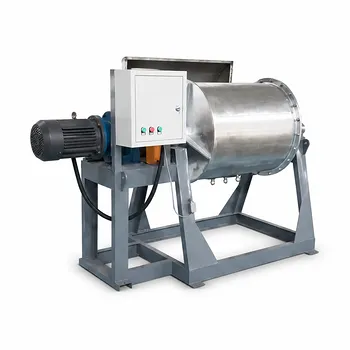
The primary role of a ball milling system in wüstite synthesis is to act as a high-energy mechanochemical reactor. By subjecting a mixture of hematite and iron powder to intense mechanical forces, the system utilizes high-speed impact and shear energy to drive interfacial solid-phase reactions. This process simultaneously converts macroscopic raw materials into wüstite nanoparticles and controls their specific particle size distributions.
The ball milling system is not merely a grinding tool but a reaction vessel that facilitates the physical transformation of hematite and iron into wüstite. It is essential for large-scale production, enabling the transition from bulk powder to high-activity nanostructures through mechanical force rather than thermal heating alone.
Mechanisms of Physical Synthesis
Generating High-Energy Impact
The fundamental function of the system is the application of high-energy mechanical forces.
Through rapid rotation, the ball mill generates kinetic energy that translates into high-speed impact and shear forces upon the material.
Inducing Solid-Phase Reactions
Unlike chemical synthesis that relies on liquid solutions, this process drives interfacial solid-phase reactions.
The mechanical energy forces the hematite and iron powders to react at their contact points. This physical coercion effectively converts the precursor mixture into the desired wüstite phase.
Particle Refinement and Distribution
From Macroscopic to Nanoscopic
The system is responsible for the physical refinement of the material.
It processes macroscopic bulk powders, breaking them down systematically. The result is the production of nanoparticles with controlled dimensions rather than coarse, irregular chunks.
Controlling Size Distributions
Achieving consistency in nanomaterials is critical, and the ball mill ensures specific particle size distributions.
By maintaining consistent impact energy, the system ensures the final wüstite nanoparticles meet the necessary size specifications for their intended application.
Operational Considerations and Trade-offs
Processing Duration and Energy
While effective for physical synthesis, this method is time and energy-intensive.
Achieving uniform mixing and complete reaction often requires extended processing times, ranging from 24 to 48 hours. The high-energy requirement is a necessary cost for achieving the solid-state transformation without external heating.
Dependence on Milling Medium
The efficiency of the grind often relies on the presence of a liquid medium, such as isopropyl alcohol.
While the primary mechanism is mechanical, the medium facilitates uniform mixing and prevents agglomeration. Omitting the proper medium can lead to uneven reactions or inconsistent particle sizes.
Making the Right Choice for Your Goal
To maximize the efficacy of a ball milling system for wüstite production, consider your specific production targets:
- If your primary focus is Phase Purity: Ensure the system is set to deliver sufficient shear energy to drive the hematite-iron reaction to completion, avoiding unreacted precursors.
- If your primary focus is Particle Uniformity: Utilize a wet grinding medium (like isopropyl alcohol) and extend the milling duration to guarantee a consistent, narrow size distribution.
The ball milling system is the bridge between raw iron oxides and functional wüstite nanostructures, providing the mechanical energy required to dictate both chemical composition and physical scale.
Summary Table:
| Feature | Role in Wüstite Synthesis |
|---|---|
| Energy Source | High-energy mechanical impact & shear forces |
| Reaction Type | Interfacial solid-phase mechanochemical reaction |
| Material Transformation | Macroscopic bulk powder to nanoscopic particles |
| Size Control | Achieves narrow particle size distributions via consistent impact |
| Process Medium | Wet grinding (e.g., isopropyl alcohol) to prevent agglomeration |
| Efficiency | Operates at room temperature; 24-48 hour typical duration |
Optimize Your Nanomaterial Production with KINTEK
High-performance wüstite synthesis demands precision, durability, and high-energy efficiency. At KINTEK, we specialize in the advanced laboratory equipment necessary to bridge the gap between raw precursors and functional nanostructures.
Whether you require high-intensity crushing and milling systems for mechanochemical synthesis, hydraulic presses for sample preparation, or high-temperature furnaces for post-processing, KINTEK provides the professional-grade tools your research depends on. Our expertise extends to a comprehensive range of laboratory consumables, including ceramics and crucibles, ensuring your workflow remains seamless and contamination-free.
Ready to elevate your material synthesis? Contact KINTEK today to discover how our high-energy milling solutions and laboratory consumables can enhance your production efficiency and particle uniformity.
References
- Seyedeh-Masoumeh Taghizadeh, Alireza Ebrahiminezhad. New Perspectives on Iron-Based Nanostructures. DOI: 10.3390/pr8091128
This article is also based on technical information from Kintek Solution Knowledge Base .
Related Products
- Laboratory Planetary Ball Mill Rotating Ball Milling Machine
- High-Energy Omnidirectional Planetary Ball Mill Milling Machine for Laboratory
- Laboratory Planetary Ball Mill Cabinet Planetary Ball Milling Machine
- High Energy Planetary Ball Mill Milling Machine for Laboratory
- Laboratory Horizontal Planetary Ball Mill Milling Machine
People Also Ask
- In what way does a laboratory ball mill affect material properties when modifying PHBV/pulp fiber composites?
- Why is a laboratory ball mill required for ultra-fine fly ash? Unlock Nano-Scale Adsorption Power
- Why is a laboratory ball mill used in Co-Ni catalyst research? Optimize CO2 Conversion with Precise Milling
- How does a laboratory ball mill ensure the mixing quality of Mn3Zn0.8Sn0.2N and Ti? Achieve Perfect Homogeneity
- What is the function of a laboratory ball mill in the preparation of AMMCs? Optimize Dispersion & Grain Refinement