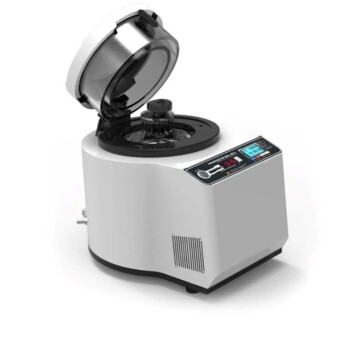
High-energy ball milling serves as the critical mechanical reactor in the production of Oxide Dispersion Strengthened (ODS) ferritic stainless steel. By facilitating high-speed collisions and shear forces, it drives the mechanical alloying process that forces distinct metal and oxide powders into a unified, atomic-level solid solution.
Core Insight: The ball mill does not simply mix ingredients; it fundamentally alters the material's atomic structure. It utilizes kinetic energy to trap nanometer-sized oxide particles inside metal grains, creating a supersaturated solid solution that provides the alloy with superior high-temperature strength and radiation resistance.
The Mechanics of Mechanical Alloying
Repetitive Cold Welding and Fracturing
The primary function of the high-energy ball mill is to subject the metal matrix powder (such as 430L) and strengthening oxides (like Y2O3 or ZrO2) to intense mechanical stress.
Through high-speed rotation, grinding media collide with the powder, causing the particles to flatten and cold-weld together.
Simultaneously, the brittle nature of work-hardened particles causes them to fracture. This continuous cycle of welding and fracturing creates a layered structure that progressively traps oxide particles within the metal matrix.
Creating a Forced Solid Solution
Beyond physical trapping, the mill drives a forced solid solution at the atomic level.
The extreme mechanical energy facilitates the mutual diffusion of alloying elements (such as Fe, Cr, W, and Ti) even at temperatures where they would not naturally mix.
This transforms the initial heterogeneous powder mixture into a single-phase alloy, ensuring that trace elements are dissolved uniformly into the iron matrix.
Dispersion of Strengthening Phases
Standard mixing cannot prevent the agglomeration of nanoparticles due to electrostatic attraction.
The high shear forces of the ball mill mechanically break apart oxide clusters, ensuring uniform dispersion throughout the matrix.
This dispersion is the structural foundation for the material's performance, as these oxides inhibit dislocation movement during high-temperature service.
Impact on Microstructure and Reactivity
Extreme Grain Refinement
The severe plastic deformation induced by the mill refines the stainless steel powder grains from the micrometer scale down to the nanometer scale (often around 20-25 nm).
This refinement increases the grain boundary area, which further assists in the rapid diffusion of elements.
Activation for Sintering
The milling process induces significant dislocation density and plastic strain within the powder particles.
This "stored energy" increases the reaction activity of the powder.
It acts as a driving force during the subsequent sintering stages, promoting the uniform precipitation of oxide nanoparticles and densification of the final part.
Understanding the Trade-offs
The Risk of Contamination
While high collision energy is necessary for alloying, it causes wear on the grinding media (balls) and the jar liners.
This wear can introduce unintended debris into the ODS powder, altering the alloy's chemical composition and potentially degrading its final properties.
Managing Media Selection
To mitigate contamination, the hardness of the grinding media must be carefully matched to the powder.
High-hardness stainless steel balls and wear-resistant jars are essential to ensure energy transfer while minimizing the erosion of the grinding tools.
Making the Right Choice for Your Goal
When configuring a high-energy ball milling process for ODS steel, your priorities will dictate your parameter selection.
- If your primary focus is High-Temperature Strength: Prioritize longer milling times to maximize the forced solid solution and ensure the finest possible dispersion of Y2O3 particles.
- If your primary focus is Material Purity: Select highly wear-resistant grinding media and optimize the ball-to-powder ratio to minimize contamination from the milling tools.
- If your primary focus is Additive Manufacturing (AM): Focus on embedding nano-particles onto micron-sized base powders to improve flowability and prevent agglomeration in powder feeding systems.
The success of ODS steel production relies on using the ball mill not just as a grinder, but as a precision instrument for atomic-level structural engineering.
Summary Table:
| Process Function | Key Mechanism | Resulting Material Property |
|---|---|---|
| Mechanical Alloying | Repeated cold welding & fracturing | Homogeneous atomic-level solid solution |
| Dispersion Control | High shear forces | Uniform distribution of Y2O3 nanoparticles |
| Grain Refinement | Severe plastic deformation | Nanometer-scale grains (20-25 nm) |
| Powder Activation | Increased dislocation density | High reactivity for efficient sintering |
| Surface Engineering | Kinetic energy transfer | Embedded oxides for high-temp strength |
Elevate Your Material Research with KINTEK Precision
Unlock the full potential of Oxide Dispersion Strengthened (ODS) materials with KINTEK’s industry-leading laboratory solutions. We specialize in providing the high-performance tools necessary for complex metallurgical processes, including:
- High-Energy Ball Mills & Grinding Media: Durable systems designed for mechanical alloying with minimal contamination.
- Crushing & Milling Systems: Engineered for extreme grain refinement and powder activation.
- High-Temperature Furnaces: Specialized vacuum and atmosphere furnaces for the precise sintering of ODS alloys.
- Advanced Laboratory Equipment: From hydraulic presses for pellet preparation to cooling solutions and essential ceramics.
Whether you are refining stainless steel powders for nuclear applications or optimizing additives for manufacturing, KINTEK delivers the reliability your research demands.
Contact us today to find the perfect equipment for your lab!
References
- Dharmalingam Ganesan, Konda Gokuldoss Prashanth. Vacuum Hot Pressing of Oxide Dispersion Strengthened Ferritic Stainless Steels: Effect of Al Addition on the Microstructure and Properties. DOI: 10.3390/jmmp4030093
This article is also based on technical information from Kintek Solution Knowledge Base .
Related Products
- High Energy Planetary Ball Mill Milling Machine for Laboratory
- High Energy Planetary Ball Mill for Laboratory Horizontal Tank Type Milling Machine
- High-Energy Omnidirectional Planetary Ball Mill Milling Machine for Laboratory
- High Energy Planetary Ball Mill Milling Machine for Laboratory
- High Energy Planetary Ball Mill Machine for Laboratory Horizontal Tank Type
People Also Ask
- What role do planetary ball mills and zirconia media play in LLZT preparation? Optimize Your Solid Electrolyte Research
- What is the primary function of a planetary ball mill? Mastering SiC/Al Composite Mixing for Homogeneity
- What is the primary purpose of using a planetary ball mill for LAGP? Achieve High-Purity Solid-State Electrolytes
- What role does a planetary ball mill play in the preparation of LGVO powders? Precision Refinement for Aerosol Deposition
- What is the function of a planetary ball mill in the preparation of high-entropy rare earth silicate multi-phase ceramics?