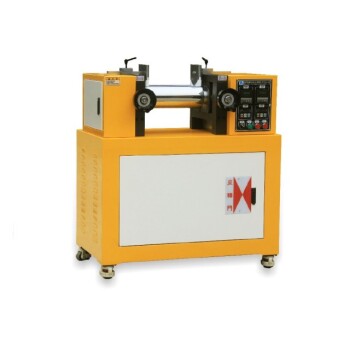
The primary role of a high-energy mixer mill in NVPF precursor preparation is to execute intense mechanical grinding that merges Sodium Fluoride (NaF) and Vanadium Phosphate (VPO4) powders at an atomic or micron level. This mechanical action is required to pulverize reactant agglomerates and maximize the contact surface area between particles, setting the stage for a successful solid-state reaction.
Core Takeaway The mixer mill does not simply blend ingredients; it mechanically refines them to ensure atomic-level homogeneity. This step is the physical foundation that allows subsequent sintering processes to create a highly uniform and effective cathode material.
The Mechanics of Precursor Preparation
Achieving Deep Homogeneity
The high-energy mixer mill goes beyond simple stirring. It utilizes intense mechanical energy to achieve a mixture of NaF and VPO4 (or carbon-coated VPO4) that is uniform down to the atomic or micron level.
Breaking Down Agglomerates
Raw material powders often clump together in "agglomerates" that inhibit chemical reactions. The mill applies significant force to physically shatter these clusters, ensuring that no isolated pockets of unmixed material remain.
Maximizing Reaction Surface Area
By refining the particle size and breaking down clumps, the mill drastically increases the specific surface area of the reactants. This increased contact area is the critical factor that facilitates efficient chemical bonding during later processing stages.
The Critical Link to Sintering
Ensuring Uniform Precursors
The ultimate goal of this milling process is to create a "highly uniform reaction precursor." If the precursor mix is inconsistent, the final material will lack structural integrity.
Facilitating Solid-State Reactions
The output of the mixer mill is not the final product, but the essential setup for the subsequent solid-state reaction or sintering. The intense grinding creates the optimal physical conditions for the heat treatment to drive the chemical conversion effectively.
Understanding Process Constraints
The Necessity of "High Energy"
Standard mixing methods are insufficient for NVPF preparation. Without the intense mechanical grinding provided by a high-energy mill, the reactants will not achieve the necessary contact proximity.
Mechanical vs. Chemical Action
It is important to distinguish that the mixer mill focuses on physical refinement and contact creation. While it prepares the materials for chemical change, its primary function is mechanical: maximizing the interface where the future chemical reaction will occur.
Making the Right Choice for Your Goal
To optimize your NVPF synthesis, consider these specific objectives:
- If your primary focus is Reaction Efficiency: Ensure the milling duration is sufficient to fully break down agglomerates, as this maximizes the surface area available for the sintering reaction.
- If your primary focus is Material Uniformity: Prioritize high-energy settings that achieve atomic-level mixing between the NaF and VPO4 components to prevent phase separation.
High-energy milling is the non-negotiable bridge between raw powder and a high-performance active cathode material.
Summary Table:
| Feature | Function in NVPF Preparation | Benefit to Final Material |
|---|---|---|
| Mechanical Grinding | Breaks down reactant agglomerates | Ensures consistent particle size distribution |
| Atomic Homogeneity | Blends NaF and VPO4 at micron level | Prevents phase separation during sintering |
| Surface Area Boost | Increases specific surface area | Facilitates faster, efficient solid-state reactions |
| Physical Refinement | Creates uniform reaction precursors | Enhances structural integrity of the cathode |
Elevate Your Battery Research with KINTEK Precision
High-performance NVPF cathode materials demand absolute precision in precursor preparation. KINTEK specializes in advanced crushing and milling systems, including high-energy mixer mills designed to achieve the atomic-level homogeneity your research requires.
Beyond milling, our comprehensive laboratory portfolio supports your entire workflow—from battery research tools and consumables to high-temperature furnaces for sintering and vacuum systems for material stability. Whether you are optimizing solid-state reactions or scaling up production, KINTEK provides the high-quality equipment needed to ensure material uniformity and reaction efficiency.
Ready to optimize your synthesis process? Contact KINTEK today to find the perfect milling and thermal solutions for your lab!
Related Products
- High Energy Planetary Ball Mill Milling Machine for Laboratory
- High-Energy Omnidirectional Planetary Ball Mill Milling Machine for Laboratory
- High-Energy Omnidirectional Planetary Ball Mill Machine for Laboratory
- High Energy Planetary Ball Mill Milling Machine for Laboratory
- High Energy Vibratory Laboratory Ball Mill Grinding Mill Single Tank Type
People Also Ask
- How does a planetary ball mill provide mechanical activation for scandium recovery? Maximize Your Leaching Efficiency
- What role do planetary ball mills and zirconia media play in LLZT preparation? Optimize Your Solid Electrolyte Research
- What is the function of a planetary ball mill in the preparation of high-entropy rare earth silicate multi-phase ceramics?
- What is the purpose of using a planetary ball mill for cathode material regeneration? Achieve Atomic-Level Mixing
- What is the primary function of a planetary ball mill? Mastering SiC/Al Composite Mixing for Homogeneity