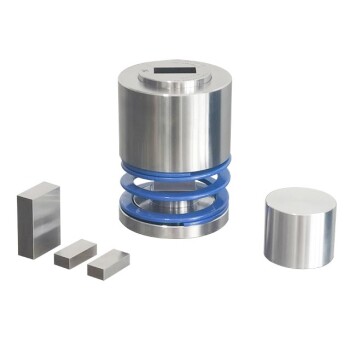
A high-pressure reactor acts as the essential forcing function in the hydrothermal synthesis of rare earth modified catalysts. By creating a sealed, high-temperature environment, it generates the internal pressure necessary to drive the uniform integration of doping elements, such as Lanthanum, directly into the crystal lattice of the metal oxide.
Core Takeaway The reactor does not merely speed up the reaction; it creates a unique physical environment that alters crystal growth dynamics. This enables the formation of abundant oxygen vacancies on the catalyst surface—a critical factor for improving adsorption and reaction performance during complex chemical processes like the hydrolysis of carbonyl sulfide (COS).
Driving Atomic Integration and Structural Control
The value of a high-pressure reactor lies in its ability to manipulate materials at the microscopic level. By sealing the reactants, the system transcends the limitations of standard atmospheric synthesis.
Creating a Subcritical Reaction Environment
A high-pressure reactor allows aqueous solutions to reach a subcritical state. In this state, the solubility of precursors increases significantly, and reaction kinetics are enhanced.
This environment is vital for rare earth elements, which can be difficult to dissolve or integrate uniformly under standard conditions. The elevated pressure forces these elements to react more completely with the base material.
Facilitating Uniform Doping
The primary role of the reactor in this specific application is ensuring the uniform integration of Lanthanum into the crystal lattice.
Without the high-pressure environment, dopants often aggregate on the surface rather than integrating into the structure. Successful lattice integration creates "oxygen vacancies"—defects in the crystal structure that serve as highly active sites for catalytic reactions.
Regulating Crystal Growth and Morphology
The reactor provides a controlled environment that regulates the nucleation and growth of metal oxide crystals.
By manipulating the pressure and temperature, you can direct the self-assembly of components. This leads to specific morphologies, such as nanotubes or nanorods, and significantly increases the specific surface area (often exceeding 100 m²/g). A larger surface area directly correlates to higher reactivity.
Understanding the Trade-offs
While high-pressure reactors are essential for synthesizing advanced catalysts, they introduce specific challenges that must be managed to ensure success.
The Risk of Chemical Impurities
The harsh internal environment can cause the reactor walls to degrade, potentially leaching metal ions into your sample.
For sensitive catalysts like Lanthanum-doped Cerium Oxide, chemical purity is paramount. If the reactor is not made of corrosion-resistant materials (such as Hastelloy or a Teflon liner), leached iron or other metals will contaminate the catalyst, altering its electronic properties and skewing performance data.
Complexity of Diffusion Control
High pressure alters how fast molecules move through the solution.
While this allows for precise control over particle size, it requires exact temperature management. If the temperature fluctuates, the diffusion rates change, leading to uneven crystal structures or poor reproducibility between batches.
Making the Right Choice for Your Goal
To maximize the effectiveness of your hydrothermal synthesis, align your operational focus with your specific material requirements.
- If your primary focus is Catalytic Activity: Prioritize high pressure and temperature stability to maximize the density of oxygen vacancies and active sites on the surface.
- If your primary focus is Chemical Purity: Ensure your reactor utilizes a corrosion-resistant liner (like PTFE or PPL) to prevent lattice contamination from the reactor body.
- If your primary focus is Structural Durability: Use the pressure to control morphology, aiming for nanostructures that enhance the mechanical bonding strength between the catalyst and its substrate.
Ultimately, the high-pressure reactor is not just a heating vessel, but a precision tool for engineering the atomic architecture of your catalyst.
Summary Table:
| Feature | Impact on Catalyst Synthesis | Key Benefit |
|---|---|---|
| Subcritical Environment | Increases precursor solubility and kinetics | Enhanced atomic integration |
| Pressure Control | Forces dopants into the crystal lattice | Creation of active oxygen vacancies |
| Morphology Regulation | Controls nucleation and crystal growth | High specific surface area (>100 m²/g) |
| Thermal Stability | Maintains uniform diffusion rates | Consistent particle size and structure |
Elevate Your Catalyst Research with KINTEK Precision
Precision engineering of atomic structures requires reliable high-pressure environments. At KINTEK, we specialize in providing high-performance high-temperature high-pressure reactors and autoclaves designed specifically for hydrothermal synthesis. Whether you are developing Lanthanum-doped Cerium Oxide or advanced metal-organic frameworks, our reactors—available with corrosion-resistant PTFE and ceramic liners—ensure maximum chemical purity and structural integrity.
Why choose KINTEK?
- Advanced Material Science: Expertly crafted pressure vessels that withstand harsh subcritical conditions.
- Comprehensive Solutions: From crushing and milling systems for precursor preparation to ULT freezers for sample preservation.
- Customized for Labs: Tailored laboratory equipment and consumables to meet the rigorous demands of battery research and catalyst engineering.
Ready to achieve superior catalytic activity and reproducibility? Contact us today to find the perfect reactor for your laboratory!
References
- Xun Zhang, Rui Wang. Enabling Catalysts for Carbonyl Sulfide Hydrolysis. DOI: 10.3390/catal14120952
This article is also based on technical information from Kintek Solution Knowledge Base .
Related Products
- Customizable Laboratory High Temperature High Pressure Reactors for Diverse Scientific Applications
- Customizable High Pressure Reactors for Advanced Scientific and Industrial Applications
- Stainless High Pressure Autoclave Reactor Laboratory Pressure Reactor
- Mini SS High Pressure Autoclave Reactor for Laboratory Use
- High Pressure Laboratory Autoclave Reactor for Hydrothermal Synthesis
People Also Ask
- How do high-pressure and high-temperature reactors ensure the effective treatment of lignocellulosic wastewater in WAO?
- What equipment is required for high-pressure high-temperature reactions? Master Extreme Chemistry Safely
- How do you control high pressure in a reactor? A Guide to Safe & Stable Operation
- How does initial oxygen pressure affect the wet oxidation of pharmaceutical sludge? Master Your Oxidation Depth
- Why is argon better than nitrogen for inert atmosphere? Ensure Absolute Reactivity & Stability