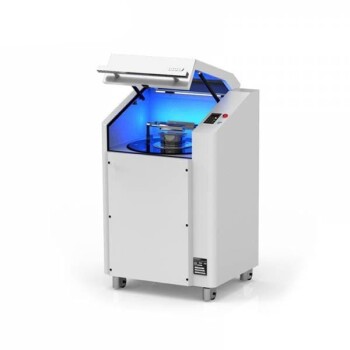
The planetary ball mill serves as a critical benchmarking tool for determining the "grindability" of Miscanthus hydrochar. By subjecting the material to high-energy impact and intense frictional forces, the mill quantifies how effectively the tough fibrous structure of the biomass has been compromised during pretreatment.
By simulating the mechanical stresses of pulverization, the planetary ball mill provides essential data on energy efficiency, proving that hydrochar is easier to grind than raw biomass—a prerequisite for viable industrial combustion.
Mechanisms of Evaluation
Applying High-Energy Mechanical Force
To evaluate processing performance, the planetary ball mill uses high-speed rotation to generate significant kinetic energy.
The grinding media inside the mill delivers high-energy impacts and friction to the Miscanthus hydrochar. This intense mechanical action mimics the physical stresses the material would face in industrial pulverizers.
Verifying Structural Breakdown
Raw biomass typically possesses a resilient fibrous structure that is difficult and costly to break down.
The ball mill tests the efficacy of wet torrefaction, a pretreatment process designed to weaken this structure. If the milling process pulverizes the material easily, it confirms that the fibrous network has been successfully compromised.
The Significance of Grindability Data
Predicting Energy Consumption
The primary goal of these tests is to measure the reduction in mechanical energy required for processing.
Comparative experiments in the ball mill demonstrate that pretreated hydrochar requires less energy to reach a specific particle size than untreated material. This data is vital for calculating the operational costs of a fuel production facility.
Ensuring Combustion Readiness
For biomass to be used effectively in industrial boilers, it must often be ground into a fine powder.
The planetary ball mill evaluates whether the hydrochar can be pulverized to the necessary fineness. This ensures the material helps achieve stable and efficient combustion downstream.
Understanding the Limitations
Lab-Scale vs. Industrial Reality
While the planetary ball mill is excellent for comparative testing, it operates as a batch process in a laboratory setting.
It indicates relative grindability, but it may not perfectly replicate the continuous throughput dynamics of large-scale industrial vertical roller mills or hammer mills.
Specificity of Application
It is important to distinguish the physical grinding used here from other ball mill applications.
In materials science (such as with Inconel composites or ZrO2 ceramics), ball mills are used for homogenization or mechanochemical synthesis. For Miscanthus hydrochar, the focus remains strictly on physical size reduction and friability, not chemical alloying or phase transformation.
Making the Right Choice for Your Goal
To maximize the value of your grindability tests, consider your specific objectives:
- If your primary focus is process efficiency: Use the mill to compare energy inputs between raw and treated biomass to justify the cost of the wet torrefaction step.
- If your primary focus is fuel quality: Use the mill to verify that the hydrochar achieves a consistent particle size distribution suitable for your specific burner specifications.
Ultimately, the planetary ball mill validates that your pretreatment process has successfully transformed fibrous biomass into a friable, energy-efficient solid fuel.
Summary Table:
| Evaluation Metric | Role of Planetary Ball Mill | Industrial Benefit |
|---|---|---|
| Grindability | Quantifies resistance to mechanical stress | Minimizes processing time |
| Energy Efficiency | Measures energy required for size reduction | Reduces operational costs |
| Structural Assessment | Verifies the breakdown of fibrous networks | Ensures pretreatment efficacy |
| Particle Fineness | Reaches powder consistency for boilers | Ensures stable combustion |
Optimize Your Biomass Research with KINTEK
Transitioning from raw biomass to efficient fuel requires precision and the right tools. KINTEK specializes in high-performance laboratory equipment designed for rigorous testing environments. Our industry-leading planetary ball mills and crushing and milling systems provide the high-energy impact needed to accurately benchmark material grindability.
Whether you are refining hydrochar production or advancing battery research, we offer a comprehensive range of laboratory equipment and consumables, including high-temperature furnaces, hydraulic presses, and high-pressure reactors.
Ready to enhance your lab's efficiency and data accuracy?
Contact KINTEK today to find the perfect milling solution!
References
- Mateusz Wnukowski, Łukasz Niedźwiecki. WET TORREFACTION OF MISCANTHUS – CHARACTERIZATION OF HYDROCHARS IN VIEW OF HANDLING, STORAGE AND COMBUSTION PROPERTIES. DOI: 10.12911/22998993/2950
This article is also based on technical information from Kintek Solution Knowledge Base .
Related Products
- High Energy Planetary Ball Mill for Laboratory Horizontal Tank Type Milling Machine
- High-Energy Omnidirectional Planetary Ball Mill Milling Machine for Laboratory
- Laboratory Planetary Ball Mill Rotating Ball Milling Machine
- High Energy Planetary Ball Mill Milling Machine for Laboratory
- Laboratory Horizontal Planetary Ball Mill Milling Machine
People Also Ask
- What is the role of a planetary ball mill in sulfide-based solid-state batteries? Engineer High-Performance Cathodes
- What are the parameters of a planetary ball mill? Master Speed, Time, and Media for Perfect Grinding
- What is the function of a planetary ball mill for nanostructured eutectic steel? Essential Prep for High-Strength Alloys
- What role does a planetary ball mill play in the preparation of NASICON-type solid electrolytes like LATP and LAGP?
- What is the function of a planetary ball mill in solid-state electrolyte prep? Milling vs. SDS Methods Explained