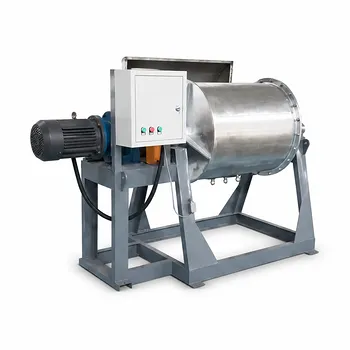
In the synthesis of Silicon-Fluorinated Graphene (Si-FG) composites, the planetary ball mill acts as the primary mechanical activation tool for the raw silicon feedstock. Specifically, it is utilized in the early stages to subject raw silicon powder to high-energy impact and friction, pulverizing micron-sized agglomerates and refining the material into discrete micro-nano particles.
Core Takeaway The planetary ball mill does not merely grind silicon; it engineers the material's surface for reactivity. By breaking down agglomerates and reducing particle size, the milling process creates the necessary physical foundation for silicon to uniformly disperse and chemically bond with fluorinated graphene during subsequent hydrothermal processing.
The Mechanics of Silicon Refinement
Destabilizing Agglomerates
Raw silicon powder naturally exists in clustered, agglomerated structures. These clusters inhibit chemical interaction and lead to inconsistencies in the final composite material.
The planetary ball mill uses centrifugal force to generate intense impact and shear between the grinding balls and the silicon powder. This mechanical force effectively breaks apart these hard agglomerates, ensuring the starting material is loose and dispersible.
Creating Micro-Nano Architectures
Beyond breaking clumps, the milling process physically refines the silicon grains. It reduces the particle size from the micron scale down to the micro-nano level.
This size reduction is critical because it drastically increases the specific surface area of the silicon. A larger surface area exposes more active sites, making the silicon physically ready for integration with other materials.
Preparing for Composite Integration
Establishing High Reactivity
The transformation from coarse powder to micro-nano particles changes the silicon from a passive filler into a reactive component.
The primary reference notes that this "high-reactivity foundation" is essential for the steps that follow. Without this mechanical activation, the silicon would remain inert and difficult to process chemically.
Enabling Uniform Dispersion
The ultimate goal of Si-FG synthesis is to combine silicon with fluorinated graphene. However, this mixing does not happen effectively if the silicon is coarse.
By refining the silicon first, the ball mill ensures that when the powder is introduced to solvents later, it can be mixed uniformly. This homogeneity is a prerequisite for the successful "in-situ self-assembly" that occurs in the hydrothermal stage.
Understanding the Process Limits
Pretreatment vs. Synthesis
It is vital to distinguish between the physical preparation and the chemical synthesis.
The planetary ball mill handles the physical refinement of the silicon before the composite is fully formed. The actual chemical bonding and heterojunction formation—where the graphene coats or anchors the silicon—occur later in a high-pressure reactor (hydrothermal environment), not in the ball mill itself.
The Risk of Under-Milling
If the milling duration or energy is insufficient, the silicon will retain its agglomerated structure.
This leads to "dead zones" in the final composite where silicon is not in contact with the fluorinated graphene, resulting in weak structural bonding and poor material performance.
Making the Right Choice for Your Goal
To optimize the preparation of Si-FG composites, you must align your milling parameters with the requirements of the subsequent hydrothermal stage.
- If your primary focus is Material Homogeneity: Ensure the milling process runs long enough to fully de-agglomerate the silicon, as this dictates the uniformity of the final dispersion in solvents.
- If your primary focus is Reactivity: Prioritize milling protocols that achieve a specific micro-nano particle size, as this surface area directly influences the efficiency of the bonding with fluorinated graphene.
Successful Si-FG composites rely on the planetary ball mill to transform raw silicon from a coarse powder into a highly active, chemically receptive building block.
Summary Table:
| Stage | Function of Planetary Ball Mill | Outcome for Si-FG Composite |
|---|---|---|
| Particle Size Reduction | Breaks micron-sized agglomerates into micro-nano grains | Increases specific surface area and active sites |
| Surface Engineering | Subjects feedstock to high-energy impact and shear | Creates a highly reactive physical foundation |
| Pre-synthesis Prep | Prepares silicon for hydrothermal processing | Enables uniform dispersion and in-situ self-assembly |
| Quality Control | Eliminates material "dead zones" | Ensures strong chemical bonding and material homogeneity |
Elevate your material synthesis with KINTEK’s precision engineering. From high-energy planetary ball mills and crushing systems for flawless mechanical activation to high-temperature high-pressure reactors and autoclaves for advanced hydrothermal synthesis, we provide the end-to-end solutions your lab needs. Whether you are developing Si-FG composites or researching battery materials, our comprehensive range of furnaces, electrolytic cells, and hydraulic presses ensures peak performance. Contact KINTEK today to optimize your research workflow!
Related Products
- High Energy Planetary Ball Mill for Laboratory Horizontal Tank Type Milling Machine
- Laboratory Planetary Ball Mill Rotating Ball Milling Machine
- High-Energy Omnidirectional Planetary Ball Mill Milling Machine for Laboratory
- High Energy Planetary Ball Mill Milling Machine for Laboratory
- Laboratory Horizontal Planetary Ball Mill Milling Machine
People Also Ask
- What is the role of a planetary ball mill in sulfide-based solid-state batteries? Engineer High-Performance Cathodes
- What are the parameters of a planetary ball mill? Master Speed, Time, and Media for Perfect Grinding
- What is the function of a planetary ball mill for nanostructured eutectic steel? Essential Prep for High-Strength Alloys
- What role does a planetary ball mill play in the preparation of NASICON-type solid electrolytes like LATP and LAGP?
- What is the function of a planetary ball mill in solid-state electrolyte prep? Milling vs. SDS Methods Explained