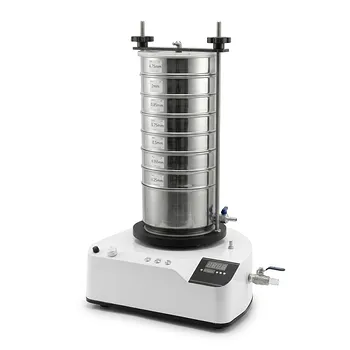
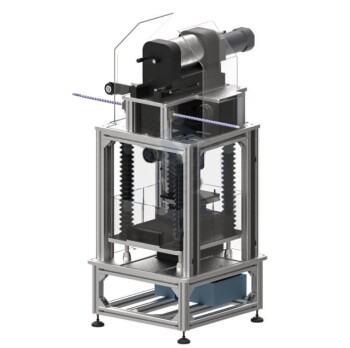
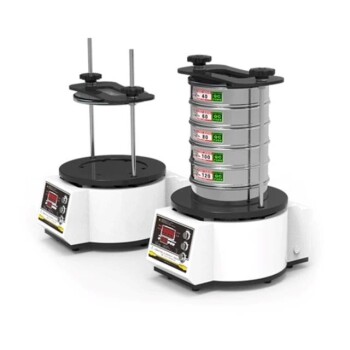
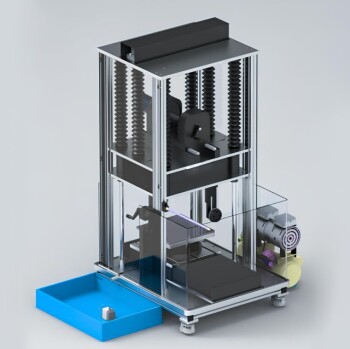
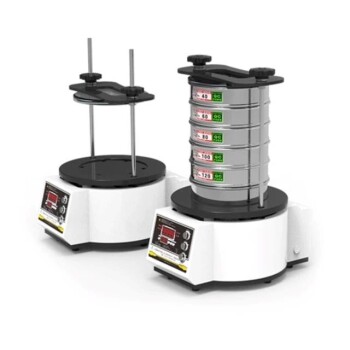
A precision sieving system acts as the critical quality control gate used to mechanically classify crushed phosphate rock into a strict particle size range, typically between 200 and 400 μm. This mechanical separation is the essential precursor to chemical processing, ensuring the raw material possesses a consistent specific surface area before it enters the acid leaching phase.
Core Takeaway: By standardizing the physical dimensions of the phosphate rock, the sieving system stabilizes the reaction kinetics of subsequent chemical treatments. This uniformity maximizes the efficiency of phosphate ion extraction, directly influencing the quality of the final silver phosphate product.
Achieving Mechanical Uniformity
The Role of Particle Classification
Crushed phosphate rock is naturally heterogeneous, containing a chaotic mix of dust, varying fragments, and large chunks.
The sieving system filters this mixture to isolate a specific fraction of material.
By excluding particles outside the target range (e.g., retaining only those between 200–400 μm), the system ensures that every grain entering the chemical reactor is physically uniform.
Standardization of Surface Area
The physical size of a particle dictates its specific surface area—the total area available for chemical interaction relative to its mass.
Without precision sieving, the surface area would fluctuate wildly across the batch.
The system guarantees that the raw material presents a predictable, uniform surface area to the solvent in the next stage of processing.
Optimizing Chemical Reactivity
Controlling Reaction Kinetics
The preparation of silver phosphate involves acid leaching, a chemical reaction heavily influenced by surface area.
If particles are too large, the reaction is slow and incomplete; if too small, the reaction may be too rapid or uncontrollable.
Precision sieving allows engineers to "tune" the reaction speed (kinetics) by controlling the particle size, ensuring the acid dissolves the phosphate at a steady, predictable rate.
Enhancing Extraction Efficiency
The ultimate goal is to extract phosphate ions from the natural ore effectively.
Uniform particles allow the acid to penetrate the material evenly, maximizing the release of phosphate ions.
This leads to a higher yield of the precursor material needed to synthesize silver phosphate (Ag3PO4), reducing waste and improving overall process efficiency.
The Cost of Inconsistency
The Risk of "Oversize" Particles
If the sieving system fails to remove larger particles, the acid leaching process becomes inefficient.
Large particles often have unreacted cores, meaning valuable phosphate remains trapped inside the rock and is discarded as waste.
The Risk of "Fines" (Undersize Particles)
While high surface area is generally good, excessive "fines" or dust can cause processing issues.
Extremely small particles may react violently or create sludge that is difficult to filter later.
A precision system removes these extremes, balancing reactivity with processability.
Making the Right Choice for Your Goal
To optimize the preparation of silver phosphate, you must view the sieving stage not just as a sizing step, but as a chemical regulator.
- If your primary focus is maximizing yield: Ensure your sieving system strictly isolates the 200–400 μm range to eliminate unreacted cores associated with larger particles.
- If your primary focus is process stability: Use precision sieving to standardize specific surface area, which guarantees predictable reaction kinetics during acid leaching.
Precision sieving transforms variable raw ore into a standardized chemical reagent, laying the foundation for high-quality silver phosphate production.
Summary Table:
| Feature | Role in Ag3PO4 Preparation | Impact on Process |
|---|---|---|
| Particle Classification | Filters crushed rock into 200–400 μm range | Ensures mechanical uniformity of raw materials |
| Surface Area Control | Standardizes specific surface area per batch | Stabilizes chemical reaction kinetics |
| Acid Leaching Optimization | Prevents unreacted cores in large particles | Maximizes phosphate ion extraction efficiency |
| Process Stability | Removes excessive 'fines' and dust | Prevents violent reactions and filtration sludge |
Elevate Your Chemical Processing with KINTEK Precision
High-quality silver phosphate production begins with flawless mechanical separation. KINTEK specializes in advanced sieving equipment and crushing and milling systems designed to transform raw phosphate rock into a standardized chemical reagent.
Our comprehensive laboratory solutions include:
- Sieving & Milling: Achieve precise particle size distributions for optimal reaction kinetics.
- Thermal Processing: High-temperature furnaces (muffle, tube, vacuum) for synthesis.
- Liquid Processing: High-pressure reactors, autoclaves, and homogenizers.
- Lab Essentials: Specialized ceramics, crucibles, and PTFE products for corrosive environments.
Don't let inconsistent particle sizes compromise your yield. Contact KINTEK today to discover how our precision tools can streamline your research and production workflows.
References
- Karim Dânoun, Mohamed Zahouily. A novel approach for the synthesis of nanostructured Ag3PO4 from phosphate rock: high catalytic and antibacterial activities. DOI: 10.1186/s13065-021-00767-w
This article is also based on technical information from Kintek Solution Knowledge Base .
Related Products
- Three-dimensional electromagnetic sieving instrument
- Custom PTFE Teflon Parts Manufacturer for PTFE Mesh F4 Sieve
- Laboratory Vibratory Sieve Shaker Machine for Dry and Wet Three-Dimensional Sieving
- Laboratory Test Sieves and Sieving Machines
- Precision Wire Saw Laboratory Cutting Machine with 800mm x 800mm Workbench for Diamond Single Wire Circular Small Cutting
People Also Ask
- Why is sieving equipment essential for the classification of processed bio-activated carbon? Optimize Performance
- What are the limitations of sieving? Understanding the Constraints of Particle Size Analysis
- What are advantages and disadvantages of sieving method? A Guide to Reliable & Cost-Effective Particle Sizing
- How is sieving important? The Critical Role of Particle Size Analysis in Quality Control
- What is sieving and how does it work? A Guide to Accurate Particle Size Analysis