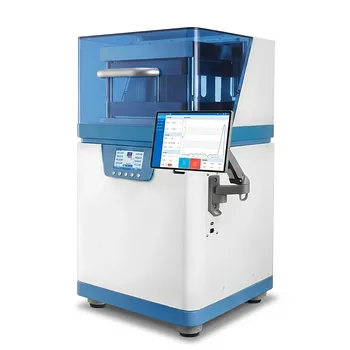
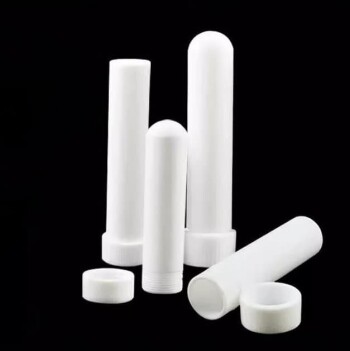
The PTFE-lined high-temperature high-pressure reactor acts as the primary reaction vessel that enables the selective chemical stripping of aluminum from $Ti_3AlC_2$ to form MXenes. It provides a specialized, sealed environment where concentrated alkaline solutions can operate at elevated temperatures (typically 180°C) and autogenous pressures, conditions necessary to overcome the thermodynamic stability of the MAX phase.
The reactor’s dual-material design provides a critical synergy: the internal PTFE liner ensures chemical inertness against harsh alkaline etchants, while the external pressure vessel maintains the high-energy environment required to drive the Al-layer removal process.
Facilitating the Alkaline Etching Mechanism
Overcoming Reaction Inertia at High Temperatures
Alkaline etching is often more kinetically demanding than traditional hydrofluoric acid methods, requiring temperatures around 180°C to effectively remove the aluminum layer. The high-pressure reactor allows the NaOH solution to reach these temperatures without boiling off, maintaining the liquid-solid interface necessary for the reaction.
Enabling High-Pressure Subcritical Conditions
By sealing the reactants, the vessel generates autogenous pressure as the temperature rises. This pressurized environment increases the solubility of the reaction intermediates and accelerates the diffusion of hydroxide ions into the $Ti_3AlC_2$ layers, facilitating a more thorough etching process.
The Critical Function of the PTFE Liner
Resistance to Strong Alkaline Corrosion
Polytetrafluoroethylene (PTFE) is selected for its exceptional chemical stability in the presence of concentrated bases like NaOH. Unlike glass or certain metals that would degrade or dissolve under high-temperature alkaline conditions, PTFE remains non-reactive and maintains its structural integrity.
Preventing Metallic Impurity Contamination
The liner serves as a physical barrier between the corrosive etchant and the reactor’s outer steel shell. This is vital for ensuring material purity, as it prevents metal ions from the vessel wall from leaching into the solution and contaminating the resulting MXene product.
Structural Integrity and Safety
Supporting the Stainless Steel External Shell
While the PTFE liner provides chemical resistance, it lacks the mechanical strength to withstand high internal pressures. The external stainless steel autoclave provides the necessary structural reinforcement to ensure the system remains safe and intact during the prolonged high-pressure reaction.
Facilitating Accordion-Like Morphologies
The stable, controlled environment within the reactor allows for the gradual and uniform removal of aluminum. This controlled kinetic environment is essential for producing the typical accordion-like layered structure of $Ti_3C_2T_x$, which is highly valued for its surface area and electrochemical properties.
Understanding the Trade-offs and Limitations
Temperature Constraints of PTFE
While PTFE is highly resistant to chemicals, it has a functional temperature ceiling, usually around 250°C. Operating near or above this limit can cause the liner to soften or deform, potentially compromising the seal and leading to "creeping" of the material under pressure.
Heat Transfer and Cooling Rates
The insulating properties of PTFE mean that heat transfer between the external heating source and the internal reaction mixture is not instantaneous. Users must account for thermal lag when timing the etching process and should manage cooling rates carefully to prevent the liner from contracting at a different rate than the steel shell.
Applying This to Your Synthesis Goals
How to Apply This to Your Project
- If your primary focus is maximizing MXene purity: Always inspect the PTFE liner for any signs of discoloration or pitting before use to ensure no previous reaction residues contaminate your $Ti_3AlC_2$ etching.
- If your primary focus is safety and vessel longevity: Never exceed 80% of the reactor's total volume with your NaOH solution to allow sufficient "headspace" for pressure expansion at 180°C.
- If your primary focus is structural consistency: Maintain a constant temperature for the duration of the 180°C cycle, as fluctuations in the hydrothermal environment can lead to incomplete etching or non-uniform layer spacing.
The PTFE-lined reactor is the indispensable "chemical engine" that makes the safer, alkaline-based synthesis of high-quality MXenes technically feasible.
Summary Table:
| Component | Primary Function | Key Benefit for MXene Synthesis |
|---|---|---|
| PTFE Liner | Chemical Resistance | Prevents corrosion from NaOH & ensures product purity |
| Stainless Steel Shell | Structural Support | Withstands high autogenous pressures at 180°C+ |
| Sealed Design | Subcritical Environment | Accelerates ion diffusion for thorough Al-layer removal |
| Temperature Control | Kinetic Management | Enables uniform accordion-like layered morphology |
Elevate Your MXene Synthesis with KINTEK
Precision is paramount in the chemical stripping of $Ti_3AlC_2$. KINTEK specializes in high-performance laboratory equipment, offering a premium range of high-temperature high-pressure reactors and autoclaves engineered to withstand the most demanding alkaline etching environments.
Whether you are focusing on hydrothermal synthesis, material crushing, or advanced thermal processing, our portfolio—including muffle furnaces, hydraulic presses, and high-purity ceramics—is designed to deliver reliable, repeatable results.
Ready to optimize your lab’s efficiency and material purity? Contact our technical experts today to find the perfect reactor solution for your research goals.
References
- Hangwei Jiang, Xingguang Zhang. Systematic Investigation on Supported Gold Catalysts Prepared by Fluorine-Free Basic Etching Ti3AlC2 in Selective Oxidation of Aromatic Alcohols to Aldehydes. DOI: 10.3390/ma16083139
This article is also based on technical information from Kintek Solution Knowledge Base .
Related Products
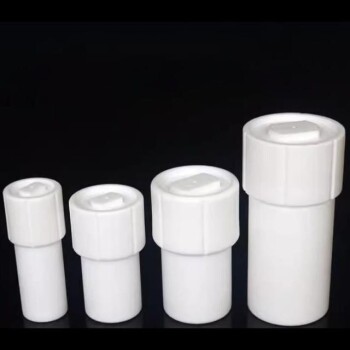
- Custom PTFE Teflon Parts Manufacturer for Reagent Wide Mouth Fine Mouth Sample High Temperature Bottles
- Customizable Laboratory High Temperature High Pressure Reactors for Diverse Scientific Applications
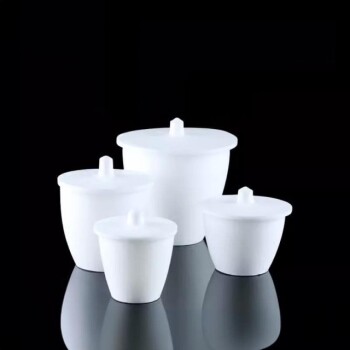
- Custom Machined and Molded PTFE Teflon Parts Manufacturer with PTFE Crucible and Lid
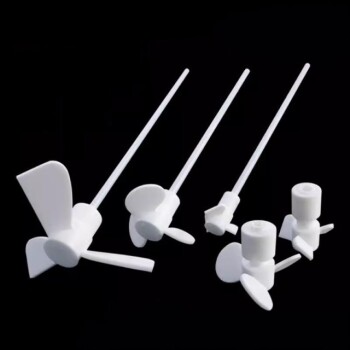
- Custom PTFE Teflon Parts Manufacturer Laboratory High Temperature Mixing Paddle Mixer
- Custom PTFE Teflon Parts Manufacturer for Hydrothermal Synthesis Reactor Polytetrafluoroethylene Carbon Paper and Carbon Cloth Nano-growth
People Also Ask
- What makes PTFE bottles suitable for static leaching? Ensure Zero-Contamination for Glass Testing
- Why Use PTFE Sample Bottles for Coal Demineralization? Ensure Chemical Stability and Data Integrity
- Why are PTFE containers necessary for selective HF etching of MAX phases? Ensure Safe & Pure MXene Synthesis
- Why use high-quality PTFE containers for CO2 reduction electrolytes? Eliminate silicon contamination and ensure data.
- Why is a PTFE container required for acid leaching of silicon nanosheets? Ensure High Purity and Safety