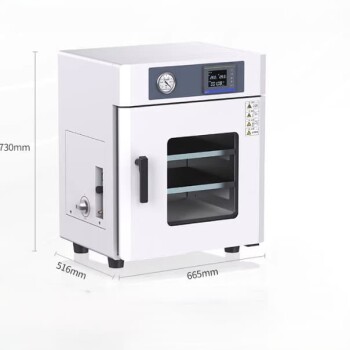
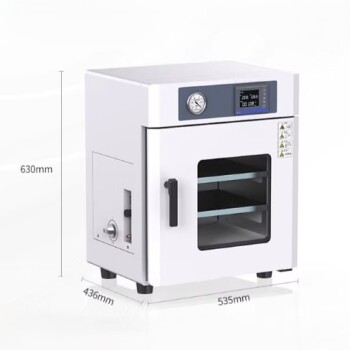
The role of a vacuum drying oven in granite pre-treatment is to establish a standardized, moisture-free baseline for experimental samples without compromising their structural integrity. By subjecting samples to a constant temperature of 40°C under vacuum conditions for at least 48 hours, researchers ensure the complete removal of residual water trapped within the rock's pore network.
Core Takeaway Accurate physical property measurements in granite depend entirely on removing pore moisture without thermally damaging the sample. The vacuum drying oven achieves this by lowering the boiling point of liquids, allowing effective drying at just 40°C to guarantee reliable porosity and permeability data.
The Mechanics of Effective Pre-Treatment
Lowering the Evaporation Threshold
The fundamental advantage of a vacuum drying oven is its ability to create a low-pressure environment.
This reduction in pressure allows residual solvents and moisture to evaporate at significantly lower temperatures than they would at standard atmospheric pressure.
Gentle Drying Parameters
For granite samples specifically, the process is conducted at a controlled temperature of 40°C.
This relatively low thermal setting is maintained for a duration of over 48 hours to ensure deep-penetrating dryness throughout the rock matrix.
Preservation of Sample Morphology
By avoiding high temperatures, the vacuum method prevents the physical alteration of the material.
It mitigates risks such as thermal sintering or the destruction of delicate morphological features, ensuring the rock remains representative of its natural state.
Ensuring Data Integrity
Establishing Accurate Mass
The primary step in physical property analysis is recording the precise mass of the dry sample.
Vacuum drying removes variable moisture content, which would otherwise skew weight measurements and introduce errors into density calculations.
Optimizing Porosity Measurements
Accurate porosity determination, specifically when using helium pycnometry, requires an empty pore structure.
Any residual water occupying the pore space will block helium intrusion, leading to an underestimation of the rock's effective porosity.
Validating Permeability Tests
Gas permeability tests rely on the flow of fluid through connected pathways within the granite.
Pre-treatment in a vacuum oven ensures these pathways are clear of liquid obstructions, providing a true measure of the rock's transport properties.
Understanding the Trade-offs
Preventing Oxidation
A distinct advantage of drying under vacuum conditions is the removal of oxygen from the chamber.
This prevents the potential oxidation of mineral components during the long drying cycle, which could chemically alter the sample surface.
Avoiding Thermal Agglomeration
Standard ovens often require higher temperatures to achieve the same level of dryness, which can cause particles to agglomerate or sinter.
Vacuum drying sidesteps this issue, preserving the original distribution and arrangement of the material's particles.
Making the Right Choice for Your Goal
To ensure your granite stimulation research yields valid results, align your pre-treatment with your specific analytical objectives:
- If your primary focus is Porosity and Permeability: Prioritize the 48-hour duration to guarantee that deep-seated moisture in the pore network is fully evacuated.
- If your primary focus is Material Preservation: Strictly adhere to the 40°C temperature limit to prevent thermal stress or oxidation from altering the rock's physical structure.
Consistent use of vacuum drying is the only way to ensure valid, comparable data across different granite samples.
Summary Table:
| Feature | Vacuum Drying (at 40°C) | Standard Oven Drying (at >100°C) |
|---|---|---|
| Moisture Removal | Complete (deep pore penetration) | Surface-level or incomplete |
| Structural Integrity | Preserved (no thermal stress) | Risk of sintering/cracking |
| Sample Morphology | Original state maintained | Risk of physical alteration |
| Oxidation Risk | Negligible (oxygen-free) | High (exposure to air/heat) |
| Data Accuracy | High (true porosity/mass) | Lower (residual moisture error) |
Elevate Your Geological Research with KINTEK Precision
Precise physical property measurements in granite require the perfect balance of deep-penetration drying and material preservation. KINTEK specializes in advanced vacuum drying ovens and high-performance laboratory equipment designed to help researchers achieve standardized, moisture-free baselines without compromising sample integrity.
From high-temperature furnaces and vacuum systems to precision crushing and milling tools, our comprehensive portfolio supports the most demanding geological and materials science applications. Ensure your porosity and permeability data is beyond reproach by choosing the right equipment for your pre-treatment protocol.
Ready to optimize your lab’s accuracy? Contact KINTEK today to discover how our tailored solutions can enhance your research outcomes!
References
- Jamie Farquharson, Patrick Baud. Physical property evolution of granite during experimental chemical stimulation. DOI: 10.1186/s40517-020-00168-7
This article is also based on technical information from Kintek Solution Knowledge Base .
Related Products
- 56L Vertical Laboratory Vacuum Drying Oven
- 23L Laboratory Vacuum Drying Oven
- Laboratory Scientific Electric Heating Blast Drying Oven
- Benchtop Laboratory Vacuum Freeze Dryer
- Dental Porcelain Zirconia Sintering Ceramic Vacuum Press Furnace
People Also Ask
- Why is a laboratory vacuum drying oven recommended for rice straw residues? Protect Your Biomass Integrity
- What role does a laboratory vacuum drying oven play in the preparation of modified multi-walled carbon nanotubes?
- What is the importance of using a laboratory vacuum drying oven? Preserving Slow-Release Microcapsule Integrity
- Why is a Laboratory Vacuum Drying Oven recommended for PBAT microspheres? Protect Sensitive Polymer Integrity
- What role does a laboratory vacuum drying oven play in processing nanoparticle powder samples? Protect Sample Integrity