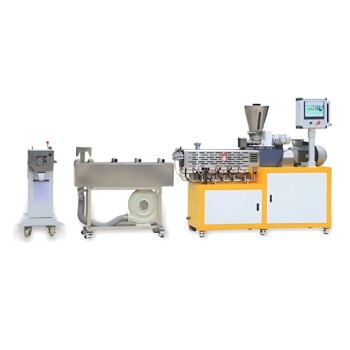
High-speed melt mixing functions as the critical homogenization engine in the synthesis of thermoplastic elastomers derived from recycled polyethylene (RPE) and chlorosulfonated polyethylene (CSPE). By applying intense high shear forces and precise thermal energy to the polymers while they are in a molten state, this equipment drives the components to disperse uniformly at a molecular level. This mechanical intervention is essential to overcome the natural incompatibility of the base materials and ensure the resulting elastomer has sufficient structural integrity.
High-speed melt mixing goes beyond simple blending; it utilizes high-energy shear to force the formation of stable physical cross-linking structures. This process compensates for compatibility gaps between RPE and CSPE, directly determining the mechanical performance of the final material.
The Mechanics of Molecular Dispersion
Application of High Shear Forces
The primary role of the equipment is to generate high shear forces.
These forces physically disrupt the polymer domains of the RPE and CSPE.
By breaking these domains down, the equipment forces the two distinct polymers to interact intimately, rather than remaining in separate phases.
Controlled Thermal Energy
Simultaneously, the equipment creates an environment of controlled thermal energy.
This maintains the polymers in a molten state, lowering viscosity to facilitate flow.
Proper thermal control ensures the materials are pliable enough to be mixed at the molecular level without resisting the shear forces.
Overcoming Compatibility Challenges
Compensating for Differences
RPE and CSPE possess inherent compatibility differences.
Without aggressive intervention, these materials would likely separate or bond weakly.
The high-speed mixing process mechanically forces these disparate components into a unified matrix, effectively overriding their natural tendency to segregate.
Establishing Physical Cross-Links
The most critical outcome of this process is the formation of stable physical cross-linking structures.
Unlike chemical cross-linking, which alters molecular bonds permanently, these physical structures rely on chain entanglement and interaction driven by the mixing energy.
These structures provide the "elastic" behavior in the thermoplastic elastomer.
Impact on Final Properties
Enhancing Mechanical Integrity
The thoroughness of the mix directly correlates to mechanical properties.
A uniform dispersion prevents weak points within the material structure.
This results in a robust elastomer capable of withstanding stress, rather than a brittle mixture of recycled plastic.
Understanding the Processing Trade-offs
Balancing Shear and Degradation
While high shear is necessary for dispersion, excessive force can be detrimental.
Over-shearing can physically break polymer chains, reducing the molecular weight and weakening the material.
The process requires a precise balance to achieve dispersion without damaging the polymer backbone.
Thermal Management Risks
The thermal energy must be strictly controlled.
High-speed mixing generates significant frictional heat internally.
If the temperature rises too high, the polymers (especially the recycled components) may undergo thermal degradation, compromising the final cross-linking structures.
Optimizing Your Production Strategy
To achieve the best results when preparing thermoplastic elastomers from RPE and CSPE, consider your specific performance targets:
- If your primary focus is material durability: Prioritize maximizing shear forces within safe limits to ensure the most robust physical cross-linking structures are formed.
- If your primary focus is material consistency: Focus on precise thermal regulation to maintain a steady molten state that facilitates uniform molecular dispersion without degradation.
Success in this synthesis relies entirely on using the mixing equipment not just to blend, but to engineer the material's internal structure through force and heat.
Summary Table:
| Process Element | Role in Synthesis | Key Benefit |
|---|---|---|
| High Shear Force | Disrupts RPE/CSPE polymer domains | Overcomes material incompatibility |
| Thermal Energy | Maintains molten state & lowers viscosity | Facilitates molecular-level flow |
| Homogenization | Uniform dispersion of components | Prevents structural weak points |
| Cross-Linking | Forms stable physical chain entanglements | Provides the "elastic" behavior |
Optimize Your Polymer Research with KINTEK Precision
Unlock the full potential of your material synthesis with KINTEK's advanced laboratory solutions. Whether you are engineering recycled thermoplastic elastomers or developing next-generation composites, our high-speed crushing and milling systems, precision high-temperature furnaces, and hydraulic presses provide the exact mechanical and thermal control required for superior homogenization.
Why choose KINTEK?
- Expertise in Complex Synthesis: From RPE/CSPE blending to battery research and ceramic consumables.
- Comprehensive Equipment Portfolio: Including high-pressure reactors, autoclaves, and cooling solutions for every stage of your workflow.
- Targeted Performance: Achieve the perfect balance of shear and thermal management to prevent material degradation.
Contact KINTEK today to enhance your lab's efficiency and material integrity!
References
- Fayzulla Nurkulov, U. Shoazimova. Study of modified thermoplastic elastomers based on polyethylene chlorinated with thiokol rubbers. DOI: 10.1051/e3sconf/202449101021
This article is also based on technical information from Kintek Solution Knowledge Base .
Related Products
- Vacuum Induction Melting Spinning System Arc Melting Furnace
- Laboratory Disc Rotary Mixer for Efficient Sample Mixing and Homogenization
- High Performance Laboratory Stirrers for Diverse Applications
- Lab-Scale Vacuum Induction Melting Furnace
- Laboratory Benchtop High Speed Small Centrifuge for Low Temp Serum Separation Dehydration Research
People Also Ask
- What are the advantages of a vacuum induction melting furnace? Achieve High-Purity Alloys with Precision VIM
- Why use VIM for rare earth steel? Essential Precision for Melting Reactive Lanthanum and Cerium
- What is the primary function of a vacuum induction melting furnace in Ni-Mo-Cr-Fe master alloy prep? Ensure High Purity
- What is the function of a vacuum induction melting furnace? Essential Guide for High-Purity FeCrAl Alloy Production
- What types of metals are typically processed in a vacuum induction melting furnace? High-Purity Alloys for Critical Applications