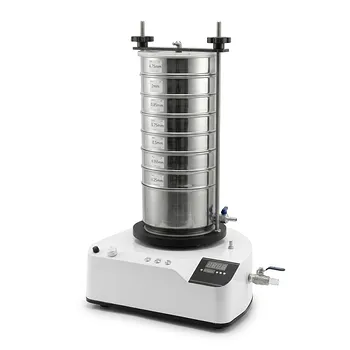
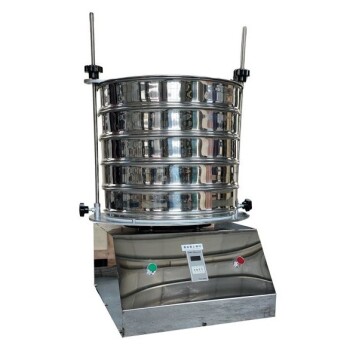
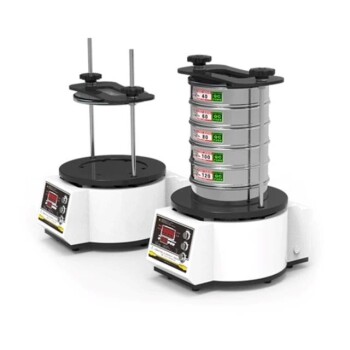
Precision in particle size is the cornerstone of high-performance carbon synthesis. In the production of modified activated porous carbon (APC), laboratory sieving equipment acts as a critical quality control gatekeeper during the raw material processing stage. Its primary role is to classify crushed precursors—such as coconut shells or biomass—into a strictly defined size range, typically below 425 micrometers, to ensure uniform chemical reactivity and structural integrity in the final product.
The core function of sieving equipment is to eliminate particle size as a variable, ensuring that chemical activators penetrate the raw material uniformly. This standardization is the physical prerequisite for optimizing the specific surface area and achieving a predictable pore size distribution.
Enhancing Chemical Impregnation Efficiency
Facilitating Uniform Activator Penetration
Standardized sieving ensures that every particle of the raw material has a similar surface-area-to-volume ratio. This consistency allows chemical activators, such as phosphoric acid, to penetrate the precursor evenly during the impregnation phase.
Without this uniformity, smaller particles may become over-saturated while larger fragments remain untreated at their core. This leads to an inconsistent chemical reaction that compromises the quality of the activated carbon.
Accelerating Reaction Kinetics
By grading materials to a fine level (often between 75 and 150 µm), sieving equipment significantly increases the available contact surface area. This refinement accelerates the physical and chemical reaction kinetics during subsequent high-temperature activation and sintering.
Consistent particle sizes ensure that thermal energy is distributed evenly throughout the sample. This prevents localized under-activation or over-burning, resulting in a more homogeneous final material.
Structural Integrity and Pore Development
Optimizing Pore Size Distribution
The initial particle size directly influences the development of the internal pore structure during carbonization. Precise sieving allows researchers to control the diffusion speeds within the material, which is critical for tailoring the APC for specific adsorption tasks.
When the raw material is uniform, the resulting pore network—ranging from micropores to macropores—develops more predictably. This predictability is essential for applications requiring high-precision molecular filtering.
Eliminating Physical Inconsistencies
Removing oversized coarse particles or organic residues prevents "weak spots" in the material matrix. In processes like pelletizing, sieving ensures that die holes are filled consistently, which effectively prevents brittle cracks and uneven density distribution.
Maintaining a tight particle size distribution also ensures the dispersibility and stability of the carbon powder in liquid applications. This makes the final product more reliable for end-users in filtration or energy storage sectors.
Understanding the Trade-offs
Material Recovery vs. Precision
While finer sieving improves reaction kinetics, it can lead to significant material loss. Striking a balance between the "ideal" particle size for chemistry and the "economical" yield of the raw material is a constant challenge in APC production.
Screen Blinding and Contamination
High-intensity sieving of resinous materials, like sugarcane bagasse or coconut shells, can lead to screen blinding, where particles clog the mesh. This reduces sieving efficiency and, if not managed, can lead to inaccurate size grading and potential cross-contamination between batches.
Implementing Precise Sieving for Your Production Goals
The selection of your sieving parameters should be dictated by the intended application of your modified activated porous carbon.
- If your primary focus is Maximum Surface Area: Use ultra-fine mesh sizes (below 150 µm) to maximize the contact area for chemical activators, ensuring a high density of micropores.
- If your primary focus is Adsorption Kinetics: Prioritize a narrow particle size distribution (e.g., 0.25 mm to 1.19 mm) to ensure consistent diffusion speeds and reproducible testing results.
- If your primary focus is Structural Durability: Focus on the removal of all particles larger than 2mm to prevent density variations and mechanical failure in pelletized carbon products.
By mastering the sieving stage, you transform a raw, heterogeneous precursor into a precision-engineered feedstock capable of producing superior activated carbon.
Summary Table:
| Key Role | Impact on APC Quality | Recommended Size/Action |
|---|---|---|
| Uniform Impregnation | Ensures even penetration of chemical activators (e.g., phosphoric acid) | Typically < 425 µm |
| Reaction Kinetics | Accelerates chemical reactions and ensures even heat distribution | 75 µm – 150 µm |
| Pore Development | Enables predictable micropore and macropore network formation | Narrow size distribution |
| Structural Integrity | Eliminates weak spots and prevents brittle cracks in pellets | Remove particles > 2 mm |
Elevate Your Carbon Synthesis with KINTEK Precision
Don’t let particle size variables compromise your research. KINTEK provides the high-performance laboratory equipment you need to transform raw precursors into precision-engineered activated carbon. Our comprehensive portfolio is designed for every stage of your workflow:
- Material Processing: Advanced sieving equipment, crushing and milling systems, and hydraulic presses for consistent pelletizing.
- Thermal Activation: High-temperature furnaces including CVD, vacuum, muffle, and atmosphere models to ensure uniform sintering.
- Reaction Control: High-temperature high-pressure reactors and electrolytic cells for advanced chemical modification.
Whether you are a researcher aiming for maximum surface area or a manufacturer focused on adsorption kinetics, KINTEK offers the technical expertise and reliable equipment to optimize your yields and consistency.
Ready to refine your process? Contact our laboratory specialists today for a tailored solution!
References
- Siqi Lv, Zichuan Ma. Removal of Hexamethyldisiloxane via a Novel Hydrophobic (3–Aminopropyl)Trimethoxysilane-Modified Activated Porous Carbon. DOI: 10.3390/molecules28186493
This article is also based on technical information from Kintek Solution Knowledge Base .
Related Products
- Laboratory Vibratory Sieve Shaker Machine for Dry and Wet Three-Dimensional Sieving
- Laboratory Test Sieves and Sieving Machines
- Laboratory Vibratory Sieve Shaker Machine Slap Vibrating Sieve
- Laboratory Test Sieves and Vibratory Sieve Shaker Machine
- Laboratory Wet Three-Dimensional Vibratory Sieve Shaker Machine
People Also Ask
- How does a laboratory vibratory sieve shaker facilitate the microstructural study of gas-atomized alloy powders?
- What role does a laboratory vibrating sieve shaker play in the LiFePO4 powder processing workflow? Ensure Batch Quality
- Why use a vibratory sieve shaker for PET powder? Achieve Precise Particle Size Control for Chemical Research
- What is the principle of vibratory sieve shaker? Achieve Accurate Particle Size Analysis
- What is the function of a vibratory sieve shaker? Achieve Precise Particle Size Analysis