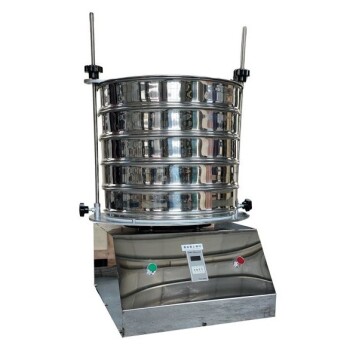
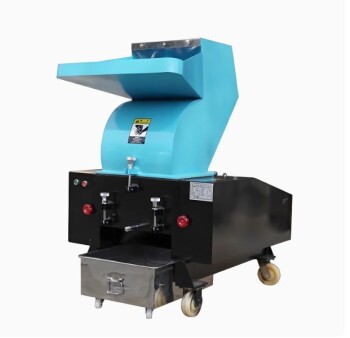
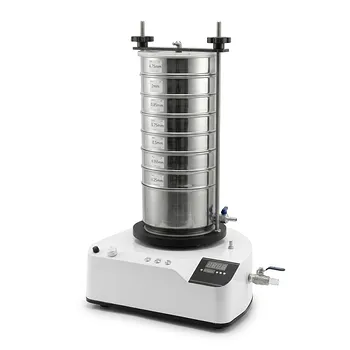
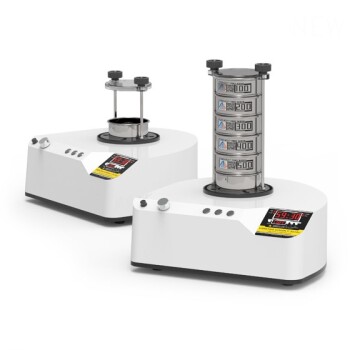
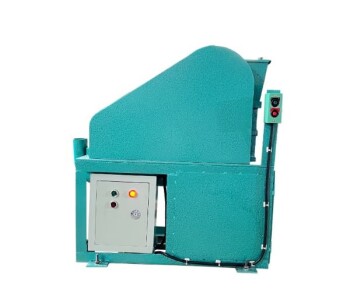
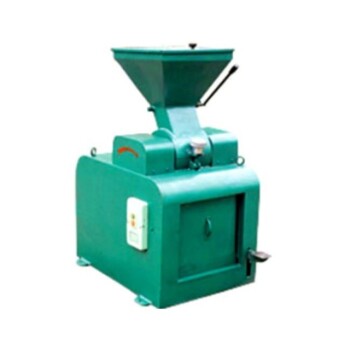
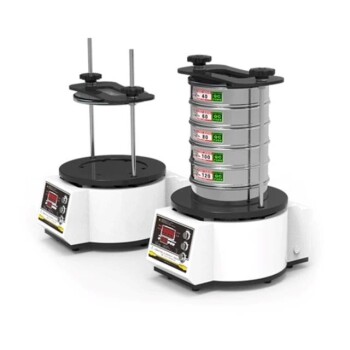
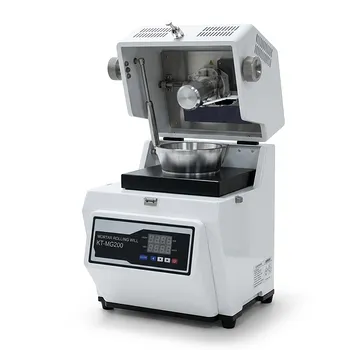
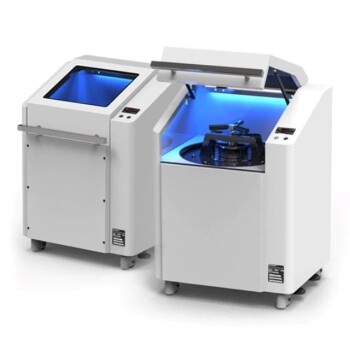
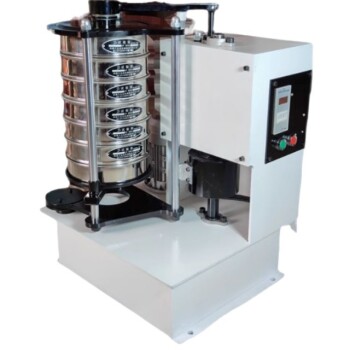
The primary role of mechanical crushing and sieving is to optimize the physical form of the resin for composite integration. Specifically, these processes convert bulk or spherical quaternized cross-linked polystyrene resins into fine powders with a strictly controlled particle size, typically between 30 and 80 µm. This transformation is not merely about size reduction; it is the critical step that enables the material to be effectively suspended within a support matrix.
By converting bulk resin into fine powder, you significantly increase the geometric surface area of the active components. This process directly counteracts the slow adsorption kinetics associated with low porosity in the original resin, ensuring faster chemical reactivity and uniform distribution.
Optimizing Adsorption Performance
Increasing Geometric Surface Area
The effectiveness of an adsorbent is heavily dependent on how much of its surface interacts with the target substance. Mechanical crushing breaks down larger spherical beads into fine particles.
This maximizes the geometric surface area, exposing a significantly higher number of active sites per unit of volume compared to the original bulk material.
Overcoming Porosity Limitations
Many original resin materials suffer from low porosity, which naturally limits how quickly they can absorb contaminants.
By reducing the particle size to a fine powder (30–80 µm), you minimize the distance fluids must travel to reach active sites. This effectively solves the problem of slow adsorption kinetics, allowing the material to perform efficiently despite its inherent internal structure.
Enhancing Composite Integration
Ensuring Uniform Dispersion
To create a high-quality composite adsorbent, the active resin must be spread evenly throughout the support material.
Crushing and sieving produce a powder that can be uniformly dispersed within a matrix, such as polyethersulfone (PES). Without this step, large or irregular particles would create weak points or voids within the composite.
Creating a Homogeneous Mixture
The sieving process acts as a quality control filter, rejecting particles that are too large to integrate or too small to be useful.
This ensures that the final composite material has consistent physical properties throughout, leading to predictable and reliable performance in filtration or adsorption applications.
Understanding the Trade-offs
The Necessity of Particle Size Control
It is not enough to simply crush the material; the resulting particle size must be precise.
The reference specifically highlights the 30–80 µm range. Particles larger than this may fail to improve kinetics sufficiently, while particles significantly smaller could potentially lead to handling difficulties or agglomeration during the mixing phase.
Mechanical Stress on Materials
While necessary, mechanical crushing is an aggressive process.
The goal is to reduce physical size without chemically degrading the quaternized functional groups. Proper control of the crushing intensity is required to ensure the chemical identity of the resin remains intact while altering its physical geometry.
Maximizing Efficiency in Adsorbent Preparation
To ensure you are getting the most out of your Quaternary Ammonium composite adsorbents, align your processing steps with your specific performance goals.
- If your primary focus is Adsorption Speed: Prioritize crushing to the lower end of the size spectrum (near 30 µm) to maximize geometric surface area and offset low porosity.
- If your primary focus is Composite Structural Integrity: Strictly enforce the upper sieving limit (80 µm) to ensure the resin disperses evenly within the PES matrix without clustering.
The success of your composite relies not just on the chemistry of the resin, but on the precision of its physical preparation.
Summary Table:
| Process Step | Primary Objective | Key Benefit |
|---|---|---|
| Mechanical Crushing | Reduce bulk resin to 30–80 µm powder | Increases geometric surface area and overcomes low porosity. |
| Sieving | Filter particles for size consistency | Ensures uniform dispersion within the PES matrix and eliminates voids. |
| Particle Control | Target precise 30–80 µm range | Balances fast adsorption kinetics with structural integrity. |
| Composite Mixing | Homogeneous integration | Creates reliable, high-performance filtration materials. |
Elevate Your Material Preparation with KINTEK Precision
Maximize the efficiency of your Quaternary Ammonium composite adsorbents with KINTEK’s industry-leading crushing and milling systems. Whether you are optimizing particle size for faster adsorption kinetics or ensuring uniform dispersion in PES matrices, our equipment delivers the precision required for high-stakes research and industrial applications.
Why choose KINTEK?
- Comprehensive Solutions: From advanced crushing and milling systems to precise sieving equipment and hydraulic presses, we provide the tools to refine your materials.
- Lab-to-Scale Expertise: Our portfolio includes high-temperature furnaces, high-pressure reactors, and specialized battery research tools designed for the most demanding environments.
- Quality Consumables: We offer essential ceramics, crucibles, and PTFE products to support every stage of your chemical processing.
Ready to achieve superior particle consistency and composite performance? Contact our technical experts today to find the perfect solution for your laboratory needs.
References
- Chenglong Hou, Tao Wang. Porosity and hydrophilicity modulated quaternary ammonium-based sorbents for CO2 capture. DOI: 10.1016/j.cej.2020.127532
This article is also based on technical information from Kintek Solution Knowledge Base .
Related Products
- Laboratory Test Sieves and Sieving Machines
- Laboratory Jaw Crusher
- Powerful Plastic Crusher Machine
- Laboratory Vibratory Sieve Shaker Machine for Dry and Wet Three-Dimensional Sieving
- Three-dimensional electromagnetic sieving instrument
People Also Ask
- What are laboratory test sieves used for? A Guide to Particle Size Analysis
- How do you calculate the sieve test? Master Particle Size Distribution for Quality Control
- How does a lab test sieve contribute to biomass charcoal powder preparation? Achieve Uniform Particle Size
- What are the specifications for test sieves? A Guide to ASTM & ISO Standards for Accurate Particle Analysis
- What materials are required for sieving? Achieve Accurate Particle Size Analysis