Knowledge What is the specific utility of cryomilling for Cantor alloys? Unlock High-Strength Nanocrystalline Structures
Author avatar

Tech Team · Kintek Solution

Updated 4 days ago

What is the specific utility of cryomilling for Cantor alloys? Unlock High-Strength Nanocrystalline Structures


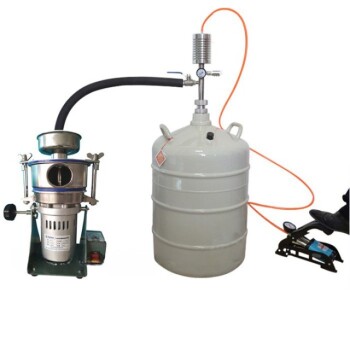
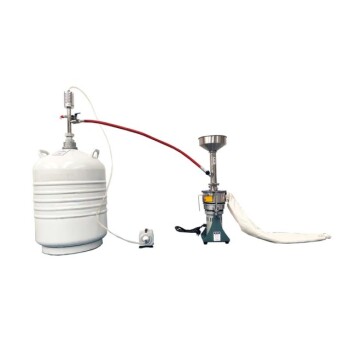
Cryomilling is a specialized mechanical alloying process that utilizes cooling media, typically liquid nitrogen, to conduct grinding operations at extremely low temperatures. Its primary utility in processing Cantor alloys (CrMnFeCoNi) lies in its ability to fracture ductile metal powders that would otherwise fuse together, enabling the creation of high-strength, nanocrystalline structures.

By maintaining cryogenic temperatures during milling, this process effectively halts the material's natural tendency to "heal" its crystal lattice under stress. This allows for significantly finer grain sizes and superior mechanical strength compared to standard milling techniques.

Overcoming Material Ductility

The Challenge of Cantor Alloys

Cantor alloys are high-entropy alloys known for their ductility. In standard milling, the heat generated by friction often causes these ductile powders to clump together rather than fracture.

Suppressing Cold Welding

Cryomilling solves this by freezing the material. The extreme cold suppresses the cold welding of the powders, ensuring they remain distinct and can be continuously ground into finer particles.

Mechanisms of Structural Refinement

Inhibiting Dynamic Recovery

During conventional milling, the energy input creates heat, which can lead to dynamic recovery and recrystallization. This is effectively the material relaxing and reforming its grain structure, which limits how small the grains can get.

Freezing the Microstructure

Cryomilling inhibits this thermal recovery. Because the material cannot "relax" due to the low temperature, the accumulation of defects continues without interruption.

Achieving Nanocrystalline States

The inhibition of recovery results in "further grain refinement." This allows the production of nanocrystalline high-entropy alloy powders that are much finer than those produced at room temperature.

Altering Stacking Fault Energy

The process results in lower stacking fault energy within the alloy. This microstructural change directly contributes to the increased strength of the final powder.

Understanding the Trade-offs

Complexity of Thermal Control

While cryomilling offers superior microstructural results, it introduces operational complexity. The process requires the continuous management of cooling media (liquid nitrogen) to maintain the required cryogenic environment.

Processing Requirements

Unlike standard milling, which relies solely on mechanical force, cryomilling is strictly dependent on thermal suppression. If the temperature is not maintained, the benefits regarding cold welding suppression and inhibited recrystallization are immediately lost.

Making the Right Choice for Your Goal

To determine if cryomilling is the correct approach for your specific application of CrMnFeCoNi, consider your target material properties:

  • If your primary focus is Maximum Strength: Cryomilling is essential, as it leverages suppressed recrystallization to produce nanocrystalline powders with increased strength.
  • If your primary focus is Particle Size Reduction: Cryomilling is the superior choice for ductile alloys, as it prevents particle agglomeration (cold welding) that hampers standard milling.

Cryomilling is the definitive solution for converting ductile Cantor alloys into high-strength, nanocrystalline powders by substituting thermal recovery with thermal suppression.

Summary Table:

Feature Standard Milling Cryomilling (Liquid Nitrogen)
Material Behavior Ductile powders fuse (cold welding) Materials become brittle and fracture
Microstructure Limited grain refinement due to heat Nanocrystalline grain size achieved
Thermal Recovery High (leads to recrystallization) Inhibited (freezes defects in place)
Final Property Standard mechanical strength Superior strength & hardness
Best Used For Brittle materials/standard alloys Ductile Cantor alloys & high-entropy alloys

Elevate Your Materials Research with KINTEK

Precision in mechanical alloying requires more than just force—it requires superior thermal control and reliable equipment. KINTEK provides industry-leading crushing and milling systems, including high-performance solutions for processing complex high-entropy alloys like CrMnFeCoNi.

Whether you are developing nanocrystalline powders or advancing battery research, our comprehensive range of laboratory equipment and consumables—from high-temperature furnaces and hydraulic presses to PTFE products and crucibles—ensures your lab achieves repeatable, high-quality results.

Ready to optimize your alloy synthesis? Contact our technical experts today to find the perfect milling and thermal solution for your specific application.

Related Products

People Also Ask

Related Products

Laboratory Ten-Body Horizontal Jar Mill for Lab Use

Laboratory Ten-Body Horizontal Jar Mill for Lab Use

The Ten-body horizontal jar mill is for 10 ball mill pots (3000ml or less). It has frequency conversion control, rubber roller movement, and PE protective cover.

Powerful Plastic Crusher Machine

Powerful Plastic Crusher Machine

KINTEK's powerful plastic crusher machines process 60-1350 KG/H of diverse plastics, ideal for labs and recycling. Durable, efficient, and customizable.

Small Lab Rubber Calendering Machine

Small Lab Rubber Calendering Machine

Small lab rubber calendering machine is used for producing thin, continuous sheets of plastic or rubber materials. It is commonly employed in laboratories, small-scale production facilities, and prototyping environments to create films, coatings, and laminates with precise thickness and surface finish.

Single Punch Electric Tablet Press Machine Laboratory Powder Tablet Punching TDP Tablet Press

Single Punch Electric Tablet Press Machine Laboratory Powder Tablet Punching TDP Tablet Press

The single-punch electric tablet press is a laboratory-scale tablet press suitable for corporate laboratories in pharmaceutical, chemical, food, metallurgical and other industries.

Rubber Vulcanizer Vulcanizing Machine Plate Vulcanizing Press for Lab

Rubber Vulcanizer Vulcanizing Machine Plate Vulcanizing Press for Lab

The Plate vulcanizing press is a kind of equipment used in the production of rubber products, mainly used for the vulcanization of rubber products. Vulcanization is a key step in rubber processing.

Lab Internal Rubber Mixer Rubber Kneader Machine for Mixing and Kneading

Lab Internal Rubber Mixer Rubber Kneader Machine for Mixing and Kneading

Lab internal rubber mixer is suitable for mixing, kneading and dispersing various chemical raw materials such as plastics, rubber, synthetic rubber, hot melt adhesive and various low-viscosity materials.

Electric Split Lab Cold Isostatic Press CIP Machine for Cold Isostatic Pressing

Electric Split Lab Cold Isostatic Press CIP Machine for Cold Isostatic Pressing

Split cold isostatic presses are capable of providing higher pressures, making them suitable for testing applications that require high pressure levels.

Metallographic Specimen Mounting Machine for Laboratory Materials and Analysis

Metallographic Specimen Mounting Machine for Laboratory Materials and Analysis

Precision metallographic mounting machines for labs—automated, versatile, and efficient. Ideal for sample prep in research and quality control. Contact KINTEK today!

Automatic Heated Hydraulic Press Machine with Heated Plates for Laboratory Hot Press 25T 30T 50T

Automatic Heated Hydraulic Press Machine with Heated Plates for Laboratory Hot Press 25T 30T 50T

Efficiently prepare your samples with our Automatic Heated Lab Press. With a pressure range up to 50T and precise control, it's perfect for various industries.

Laboratory Sterilizer Lab Autoclave Herbal Powder Sterilization Machine for Plant

Laboratory Sterilizer Lab Autoclave Herbal Powder Sterilization Machine for Plant

The herbal powder sterilization autoclave machine for Chinese medicine uses saturated steam for effective sterilization. It utilizes the heat and penetrative properties of steam, achieves sterilization after heat preservation, and maintains a good drying effect with a dedicated drying system.

Laboratory Vibratory Sieve Shaker Machine Slap Vibrating Sieve

Laboratory Vibratory Sieve Shaker Machine Slap Vibrating Sieve

KT-T200TAP is a slapping and oscillating sieving instrument for laboratory desktop use, with 300 rpm horizontal circular motion and 300 vertical slapping motions to simulate manual sieving to help sample particles pass through better.

Manual High Temperature Heated Hydraulic Press Machine with Heated Plates for Lab

Manual High Temperature Heated Hydraulic Press Machine with Heated Plates for Lab

The High Temperature Hot Press is a machine specifically designed for pressing, sintering and processing materials in a high temperature environment. It is capable of operating in the range of hundreds of degrees Celsius to thousands of degrees Celsius for a variety of high temperature process requirements.

Laboratory Test Sieves and Vibratory Sieve Shaker Machine

Laboratory Test Sieves and Vibratory Sieve Shaker Machine

Efficiently process powders, granules, and small blocks with a high-frequency vibration sieve. Control vibration frequency, screen continuously or intermittently, and achieve accurate particle size determination, separation, and classification.

Single Punch Tablet Press Machine and Mass Production Rotary Tablet Punching Machine for TDP

Single Punch Tablet Press Machine and Mass Production Rotary Tablet Punching Machine for TDP

Rotary tablet punching machine is an automatic rotating and continuous tableting machine. It is mainly used for tablet manufacturing in the pharmaceutical industry, and is also suitable for industrial sectors such as food, chemicals, batteries, electronics, ceramics, etc. to compress granular raw materials into tablets.

Heated Hydraulic Press Machine with Integrated Manual Heated Plates for Lab Use

Heated Hydraulic Press Machine with Integrated Manual Heated Plates for Lab Use

Efficiently process heat-pressing samples with our Integrated Manual Heated Lab Press. With a heating range up to 500°C, it's perfect for various industries.

Automatic High Temperature Heated Hydraulic Press Machine with Heated Plates for Lab

Automatic High Temperature Heated Hydraulic Press Machine with Heated Plates for Lab

The High Temperature Hot Press is a machine specifically designed for pressing, sintering and processing materials in a high temperature environment. It is capable of operating in the range of hundreds of degrees Celsius to thousands of degrees Celsius for a variety of high temperature process requirements.

Automatic Lab Cold Isostatic Press CIP Machine Cold Isostatic Pressing

Automatic Lab Cold Isostatic Press CIP Machine Cold Isostatic Pressing

Efficiently prepare samples with our Automatic Lab Cold Isostatic Press. Widely used in material research, pharmacy, and electronic industries. Provides greater flexibility and control compared to electric CIPs.

Lab Plastic PVC Calender Stretch Film Casting Machine for Film Testing

Lab Plastic PVC Calender Stretch Film Casting Machine for Film Testing

The cast film machine is designed for the molding of polymer cast film products and has multiple processing functions such as casting, extrusion, stretching, and compounding.

Small Injection Molding Machine for Lab Use

Small Injection Molding Machine for Lab Use

The small injection molding machinehas fast and stable movements; good controllability and repeatability, super energy saving; the product can be automatically dropped and formed; the machine body is low, convenient for feeding, easy to maintain, and no height restrictions on the installation site.

Single Punch Electric Tablet Press Machine TDP Tablet Punching Machine

Single Punch Electric Tablet Press Machine TDP Tablet Punching Machine

The electric tablet punching machine is a laboratory equipment designed for pressing various granular and powdery raw materials into discs and other geometric shapes. It is commonly used in pharmaceutical, healthcare products, food, and other industries for small batch production and processing. The machine is compact, lightweight, and easy to operate, making it suitable for use in clinics, schools, laboratories, and research units.


Leave Your Message