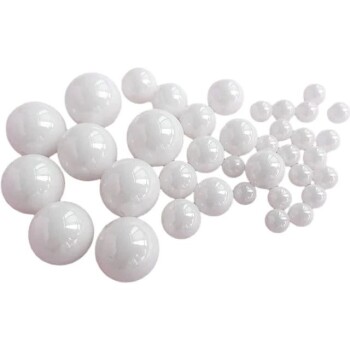
The selection of hardened stainless steel media and a specific ball-to-powder ratio is the primary control mechanism for balancing kinetic energy transfer with material purity. Hardened stainless steel provides the structural integrity to generate impact pressures as high as 5 GPa with minimal self-wear, while a high ball-to-powder ratio (such as 40:1) maximizes energy density. Together, these factors accelerate reaction kinetics, enabling the rapid formation of supersaturated solid solutions and carbide phases that would be impossible under lower-energy conditions.
Core Insight: Mechanochemistry is not merely crushing material; it is forcing atomic-level integration through kinetic impact. The grinding media and ratio act as the "engine" of this process—high hardness and high ratios provide the intense energy density required to overcome activation barriers for deep microstructural changes.
The Role of Media Material Selection
Hardness and Impact Resistance
The primary technical requirement for high-energy milling is the ability to withstand extreme forces. Hardened stainless steel is selected because it possesses the high hardness and impact resistance necessary to generate and survive impact pressures of up to 5 GPa.
Minimizing Contamination
In high-energy environments, softer media would degrade rapidly. This degradation introduces significant impurities into the powder mixture. Hardened stainless steel mitigates this by sustaining high-impact collisions with minimal wear to the grinding media itself, ensuring the chemical composition of the product remains consistent.
Influence on Chemical Pathways
Material selection goes beyond durability; it dictates the energy available for reaction. The density of the grinding media determines the physical impact energy delivered. While lighter materials (like PTFE) offer low-energy impacts suitable for mild transformations, dense materials like stainless steel deliver the high-energy impacts necessary for complex structural changes.
The Physics of Ball-to-Powder Ratio (BPR)
Increasing Energy Density
The ball-to-powder ratio (BPR) is a critical variable defining the "energy density" within the mill. A high ratio, such as 40:1, significantly increases the frequency of collisions between the balls and the powder.
Accelerating Process Efficiency
By increasing the collision frequency, you drastically shorten the processing time. The high energy input provided by a 40:1 ratio accelerates the rate at which mechanical energy is converted into chemical potential, driving the reaction forward much faster than lower ratios (e.g., 10:1 or 20:1).
Microstructural Implications
Forcing Atomic Integration
The combination of hardened steel and a high BPR creates an environment intense enough to embed atoms directly into metal matrices. This process forces carbon atoms into the lattice structure, creating supersaturated solid solutions.
Nucleation of New Phases
The high-energy input does not just mix materials; it alters their phase. The intense processing conditions accelerate the nucleation and growth of carbide phases on the surface of metal particles. This allows for the synthesis of advanced composite microstructures that are difficult to achieve via thermal processing alone.
Understanding the Trade-offs
The Risk of Media Influence
While hardened stainless steel is resistant to wear, it is not chemically inert. In some chemical reactions, the media material can influence the final crystal structure or act as a catalyst. You must verify that the iron or alloying elements in stainless steel will not detrimentally alter your specific reaction pathway, as seen in cases like yttrium oxide transformations where different media yield different polymorphs.
Balancing Energy vs. Sensitivity
"More energy" is not always the correct technical answer. While stainless steel and high BPRs are excellent for hard ceramics or metals, they may be excessive for soft organic synthesis. For heat-sensitive or energy-sensitive materials, high-impact energy can degrade the product. in these cases, lower-hardness materials (like PTFE) or lower BPRs are preferable to prevent unwanted decomposition or metallic contamination.
Making the Right Choice for Your Goal
To optimize your mechanochemical process, align your media and ratio selection with your specific end-goal requirements:
- If your primary focus is synthesizing hard carbides or solid solutions: Use hardened stainless steel and a high BPR (e.g., 40:1) to maximize impact pressure (5 GPa) and drive atomic embedding.
- If your primary focus is minimizing all metallic contamination: Avoid stainless steel; opt for softer, polymer-based media (like PTFE) or lower-energy ceramic options, accepting that impact energy will be significantly lower.
- If your primary focus is processing efficiency and speed: Prioritize a high ball-to-powder ratio to increase collision frequency, but ensure your cooling systems can handle the increased kinetic heat generation.
Select your media not just for its ability to grind, but for its ability to deliver the precise energy density required to overcome the activation barrier of your specific chemical reaction.
Summary Table:
| Parameter | Technical Impact | Typical Value/Result |
|---|---|---|
| Media Material | Hardness & Impact Resistance | Hardened Stainless Steel |
| Impact Pressure | Energy for Atomic Integration | Up to 5 GPa |
| Ball-to-Powder Ratio | Collision Frequency & Energy Density | 40:1 (High Energy) |
| Wear Resistance | Minimizing Sample Contamination | High Durability |
| Reaction Kinetics | Formation of New Phases | Supersaturated Solid Solutions |
Maximize Your Material Synthesis Precision
Enhance your mechanochemical processing with high-performance laboratory solutions from KINTEK. Whether you are developing advanced carbides or supersaturated solid solutions, our specialized crushing and milling systems, including premium grinding media and high-durability containers, ensure optimal energy transfer and minimal contamination.
From high-temperature furnaces and high-pressure reactors to precision hydraulic presses and specialized milling tools, KINTEK provides the end-to-end equipment needed for rigorous material research.
Ready to optimize your lab's efficiency? Contact us today to find the perfect milling setup for your application!
References
- O. Nakonechna, N.M. Belyavina. Effect of Carbon Nanotubes on Mechanochemical Synthesis of d-Metal Carbide Nanopowders and Nanocomposites. DOI: 10.15407/ufm.20.01.005
This article is also based on technical information from Kintek Solution Knowledge Base .
Related Products
- Stainless Steel Laboratory Ball Mill for Dry Powder and Liquid with Ceramic Polyurethane Lining
- Custom PTFE Teflon Parts Manufacturer Grinding Bowl
- Laboratory Ball Mill Jar Mill with Metal Alloy Grinding Jar and Balls
- Laboratory Jar Ball Mill with Alumina Zirconia Grinding Jar and Balls
- Laboratory Jar Mill with Agate Grinding Jar and Balls
People Also Ask
- How do laboratory ball mills facilitate the mechanochemical synthesis of ZIF-8? Solvent-Free Synthesis Explained
- What is the primary function of a laboratory ball mill in the modification of sulfide-based solid electrolytes with LiPO2F2?
- How does a laboratory ball mill ensure the mixing quality of Mn3Zn0.8Sn0.2N and Ti? Achieve Perfect Homogeneity
- What is the function of a laboratory ball mill in the preparation of AMMCs? Optimize Dispersion & Grain Refinement
- In what way does a laboratory ball mill affect material properties when modifying PHBV/pulp fiber composites?