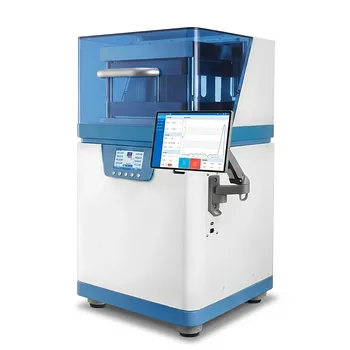
The solvothermal synthesis of $\text{Bi}_2\text{MoO}_6\text{/NO-C}$ composites requires a high-pressure reactor to establish a sealed environment at $160 \text{ °C}$ using solvents like ethylene glycol and ethanol. This specific configuration generates autogenous pressure, which significantly increases the solubility and diffusion rates of precursors, enabling the direct nucleation of $\text{Bi}_2\text{MoO}_6$ nanosheets onto the 3D NO-C substrate.
The high-pressure reactor acts as a catalyst for reaction kinetics, creating subcritical conditions that allow precursors to overcome atmospheric energy barriers. This ensures the formation of high-crystallinity nanosheets with superior interfacial contact for efficient electron transport.
The Synergistic Environment of Solvothermal Synthesis
Thermal Management and Autogenous Pressure
The reactor, typically constructed from stainless steel with a PTFE liner, maintains a constant temperature of $160 \text{ °C}$. At this temperature, the organic solvents (ethylene glycol and ethanol) expand within the sealed vessel to generate autogenous pressure.
This pressure elevates the boiling point of the solvents, allowing the reaction to occur in a subcritical liquid phase. This phase shift is essential for dissolving precursors that would otherwise remain inert at standard atmospheric conditions.
Enhanced Solubility and Diffusion Kinetics
The high-pressure environment fundamentally alters the physicochemical properties of the solvent mixture. By increasing the kinetic energy and reducing solvent viscosity, the reactor facilitates a much higher diffusion rate for bismuth and molybdenum ions.
Rapid diffusion ensures that the reactants reach the surface of the NO-C substrate uniformly. This prevents localized concentration gradients that would otherwise lead to uneven crystal growth or secondary phase impurities.
Structural Evolution and Interfacial Integrity
Nucleation on 3D NO-C Substrates
The reactor provides the energy necessary for direct nucleation on the nitrogen-and-oxygen-doped carbon (NO-C) framework. The high-pressure conditions force the precursors into the pores of the 3D substrate, ensuring that growth begins at the molecular interface.
This results in tight interfacial contact, which is critical for the resulting composite's performance. Without this pressurized environment, the $\text{Bi}_2\text{MoO}_6$ would likely precipitate as isolated particles rather than anchoring to the carbon support.
Controlled Growth of $\text{Bi}_2\text{MoO}_6$ Nanosheets
The specific temperature-pressure profile promotes the growth of 2D nanosheet morphologies. These structures offer a high specific surface area, which is vital for photocatalytic or electrochemical applications.
By maintaining a sealed, stable environment, the reactor ensures that these nanosheets develop with high crystallinity. The ordered growth of the crystal lattice is a direct result of the controlled, steady-state conditions provided by the high-pressure vessel.
Understanding the Trade-offs and Limitations
Kinetic Sensitivity and Over-pressurization
While high pressure accelerates reactions, it also demands precise filling ratios within the PTFE liner. If the reactor is overfilled, the autogenous pressure can exceed the safety limits of the stainless steel shell, leading to equipment failure.
Conversely, if the temperature is too low or the seal is imperfect, the kinetic limits of the reaction may not be reached. This often results in incomplete crystallization or weak bonding between the $\text{Bi}_2\text{MoO}_6$ and the carbon substrate.
Material Compatibility and Corrosion
The use of a PTFE (Teflon) liner is non-negotiable due to the corrosive nature of some precursors and solvents at high temperatures. Without this protective barrier, the metallic ions could react with the stainless steel walls, introducing impurities into the $\text{Bi}_2\text{MoO}_6\text{/NO-C}$ composite.
How to Apply This to Your Project
Effective solvothermal synthesis depends on balancing temperature, pressure, and solvent choice to achieve the desired material properties.
- If your primary focus is maximizing interfacial bonding: Ensure the 3D NO-C substrate is fully submerged and the reactor maintains a constant $160 \text{ °C}$ to promote deep precursor penetration.
- If your primary focus is high crystallinity: Extend the reaction duration within the high-pressure environment to allow for the slow, ordered recrystallization of $\text{Bi}_2\text{MoO}_6$ nanosheets.
- If your primary focus is morphological control: Experiment with the ratio of ethylene glycol to ethanol, as this will alter the autogenous pressure and the resulting growth patterns of the nanosheets.
By precisely controlling the high-pressure environment, you can engineer composite materials with the exact structural and electronic properties required for advanced technical applications.
Summary Table:
| Key Condition | Parameter/Detail | Impact on Bi2MoO6/NO-C Synthesis |
|---|---|---|
| Temperature | 160 °C | Provides energy for direct nucleation and crystal growth. |
| Pressure | Autogenous (Sealed) | Creates subcritical phase; increases solubility and diffusion. |
| Environment | PTFE-lined Stainless Steel | Prevents corrosion and ensures high-purity composite formation. |
| Solvent Matrix | Ethylene Glycol / Ethanol | Controls kinetic energy and facilitates 2D nanosheet morphology. |
| Substrate | 3D NO-C Framework | Ensures tight interfacial contact for efficient electron transport. |
Elevate Your Material Synthesis with KINTEK Precision
Achieving the perfect high-crystallinity nanosheet structure requires uncompromising control over pressure and temperature. KINTEK specializes in high-performance laboratory solutions, offering a robust range of high-temperature high-pressure reactors and autoclaves specifically designed for demanding solvothermal and hydrothermal processes.
Whether you are synthesizing advanced Bi2MoO6/NO-C composites or exploring new energy materials, our equipment—including PTFE-lined vessels, vacuum furnaces, and precision crushing systems—ensures safety, reliability, and repeatable results.
Ready to optimize your research outcomes? Contact our technical experts today to find the ideal reactor for your lab!
References
- Xue Bai, Yan Zhao. Bi2MoO6 Embedded in 3D Porous N,O-Doped Carbon Nanosheets for Photocatalytic CO2 Reduction. DOI: 10.3390/nano13091569
This article is also based on technical information from Kintek Solution Knowledge Base .
Related Products
- Customizable Laboratory High Temperature High Pressure Reactors for Diverse Scientific Applications
- Customizable High Pressure Reactors for Advanced Scientific and Industrial Applications
- Stainless High Pressure Autoclave Reactor Laboratory Pressure Reactor
- Mini SS High Pressure Autoclave Reactor for Laboratory Use
- High Pressure Laboratory Autoclave Reactor for Hydrothermal Synthesis
People Also Ask
- How do high-pressure and high-temperature reactors ensure the effective treatment of lignocellulosic wastewater in WAO?
- What equipment is required for high-pressure high-temperature reactions? Master Extreme Chemistry Safely
- How do you control high pressure in a reactor? A Guide to Safe & Stable Operation
- Why is argon better than nitrogen for inert atmosphere? Ensure Absolute Reactivity & Stability
- How does initial oxygen pressure affect the wet oxidation of pharmaceutical sludge? Master Your Oxidation Depth