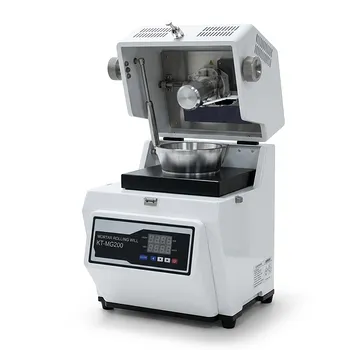
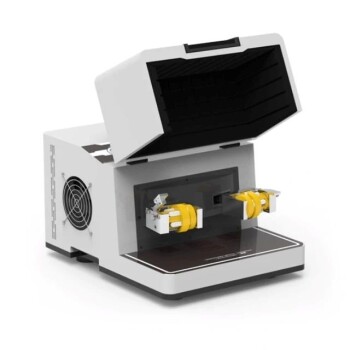
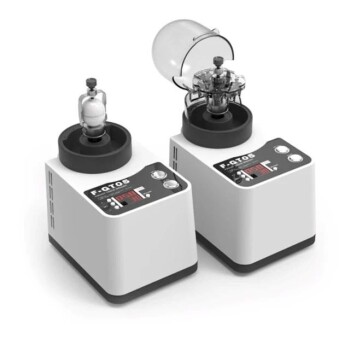
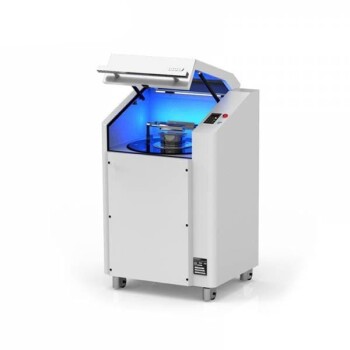
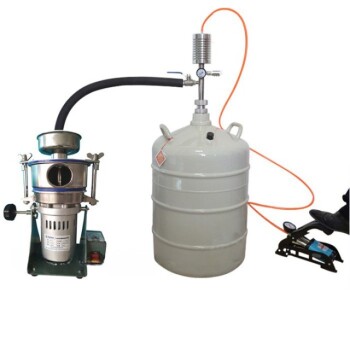
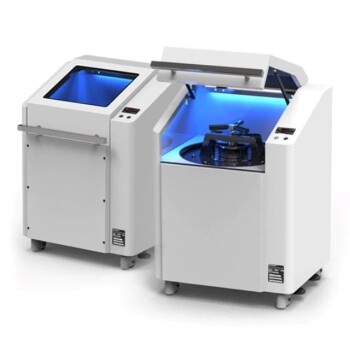
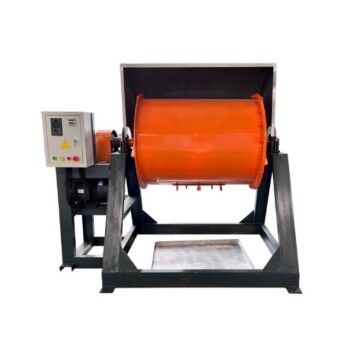
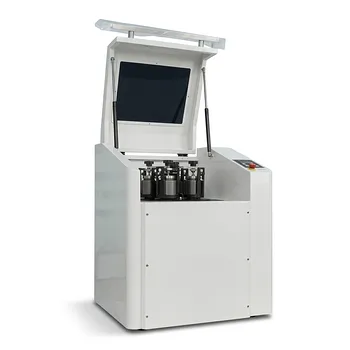
In a laboratory, the primary apparatus used for grinding is a mill. The most common types for sample preparation are ball mills, vibratory mills, and planetary mills, which reduce materials to fine powders through forces like impact, vibration, and friction. For preliminary coarse grinding of larger, harder materials, a jaw crusher is often used.
The choice of grinding apparatus is not about finding a single "best" tool. It is about matching the grinding mechanism—such as high-impact collision, shearing, or compression—to your specific sample material and desired final particle size.
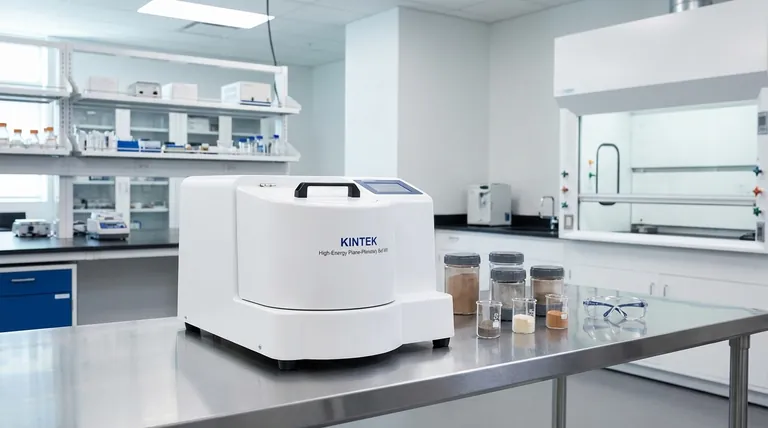
The Goal of Grinding: Particle Size Reduction
Grinding, also known as comminution, is a fundamental process in sample preparation. The primary objective is to break down a solid substance into smaller, more uniform particles.
This process is critical for increasing the surface area of a sample, which ensures that subsequent chemical analyses are accurate and representative of the whole. A homogenous, fine powder is much easier to work with than a coarse, uneven material.
Key Categories of Laboratory Mills
Different mills employ distinct physical forces to achieve size reduction. Understanding these mechanisms is the key to selecting the correct instrument for your sample.
Impact and Friction: Planetary & Ball Mills
A ball mill is a grinder that uses grinding media, typically ceramic or steel balls, inside a rotating jar. As the jar tumbles, the balls cascade and crush the sample material through a combination of impact and friction.
Planetary mills are a higher-energy version of ball mills. The sample jars rotate on a central disk while also spinning on their own axes, creating extreme centrifugal forces that dramatically increase the grinding energy and speed.
These mills excel at grinding hard, brittle, or crystalline materials down to very fine or even nano-scale particle sizes.
Vibration and Pulverization: Vibratory & Swing Mills
Vibratory mills, sometimes called swing mills, agitate the sample jar at a very high frequency. This intense vibration causes the grinding media (balls or rings) and the sample particles to collide thousands of times per minute.
This method provides rapid and efficient pulverization and is one of the most common techniques for preparing samples for analytical methods like X-ray fluorescence (XRF). They are available in various sizes to accommodate different sample weights.
Shearing and Cutting: Knife & Cutting Mills
For samples that are soft, fibrous, elastic, or heat-sensitive, impact and friction are ineffective. Materials like polymers, plant matter, or textiles will simply deform or melt.
Knife and cutting mills operate like a high-speed blender, using sharp, hardened steel rotors to shear and chop the material. This mechanism is essential for samples that cannot be fractured through brittle means.
High-Force Compression: Jaw Crushers
When starting with large, bulk materials like rocks or mineral ores, a preliminary crushing step is necessary. A jaw crusher uses two hard plates—one fixed and one moving—to crush large pieces through immense compressive force.
This is not a tool for producing fine powder. Its purpose is to perform the initial, coarse size reduction, preparing the sample for a secondary, finer grinding stage in a different type of mill.
Understanding the Trade-offs
Selecting an apparatus requires considering the interplay between your sample, the machine's mechanism, and your final goal.
Material Hardness vs. Mill Type
The most critical factor is the nature of your sample. Hard, brittle materials require the high-energy impact of a planetary mill or the pulverizing action of a vibratory mill. Soft, fibrous materials must be processed in a cutting or knife mill to prevent smearing.
Final Particle Size Requirements
Your desired final particle size dictates the energy required. A jaw crusher will only produce gravel-sized particles. A vibratory mill is excellent for micron-sized powders, while a planetary mill can achieve sub-micron or nano-scale results.
Throughput and Capacity
Consider your workload. Some vibratory mills are designed to process multiple samples simultaneously, making them ideal for high-throughput labs. Other mills may only handle one sample at a time but offer more specialized grinding capabilities.
How to Select the Right Grinding Apparatus
Your application will point you to the correct tool.
- If your primary focus is preliminary crushing of large, hard materials: A jaw crusher is the appropriate first step for coarse reduction.
- If your primary focus is creating a very fine or nano-scale powder from hard samples: A planetary or ball mill provides the necessary high-energy impact.
- If your primary focus is rapid, routine sample preparation for analysis: A vibratory or swing mill offers excellent speed and consistency for a wide range of materials.
- If your primary focus is processing soft, fibrous, or heat-sensitive materials: A knife or cutting mill is the only effective choice to achieve proper size reduction.
By understanding the mechanism behind each tool, you can confidently select the apparatus that will deliver precise and repeatable results for your analysis.
Summary Table:
| Apparatus | Primary Mechanism | Best For Sample Type | Typical Particle Size |
|---|---|---|---|
| Jaw Crusher | High-Force Compression | Large, hard materials (rocks, ores) | Coarse (gravel-sized) |
| Ball / Planetary Mill | Impact & Friction | Hard, brittle, crystalline materials | Fine to nano-scale |
| Vibratory / Swing Mill | Vibration & Pulverization | Rapid, routine preparation for analysis | Micron-sized powders |
| Knife / Cutting Mill | Shearing & Cutting | Soft, fibrous, heat-sensitive materials | Chopped, uniform particles |
Struggling to choose the right mill for your specific application? The experts at KINTEK are here to help. We specialize in providing precise laboratory equipment and consumables tailored to your unique grinding needs. Whether you're processing hard ceramics, fibrous plant matter, or require high-throughput analysis preparation, we have the solution. Contact our team today for a personalized consultation and let us help you achieve accurate, repeatable results in your lab.
Visual Guide

Related Products
- Laboratory Grinding Mill Mortar Grinder for Sample Preparation
- Laboratory Hybrid Tissue Grinding Mill
- Laboratory Micro Tissue Grinding Mill Grinder
- Vibrating Disc Mill Small Laboratory Grinding Machine
- Laboratory Jar Ball Mill with Alumina Zirconia Grinding Jar and Balls
People Also Ask
- How do laboratory grinders and standard sieving systems ensure the quality of feedstock for torrefaction?
- What is the purpose of using a laboratory grinder with specific mesh sieves for oat straw? Optimize Pellet Quality
- What is the function of a laboratory grinding mill? Achieve Precise Sample Preparation for Accurate Results
- What does a grinder do in a laboratory? Achieve Homogeneous Sample Preparation for Accurate Analysis
- What is the role of laboratory-grade grinders and sieves in sample prep? Ensure High-Precision Corrosion Analysis