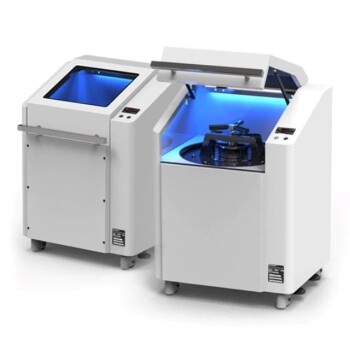
In modern gemology, the primary machine used for the most critical cutting phase of a rough diamond is a high-precision, computer-guided laser system. This technology has largely replaced older mechanical saws for its unparalleled accuracy and ability to minimize waste, fundamentally changing how the world's hardest natural material is shaped.
The core principle of diamond cutting is that only a diamond can effectively cut another diamond. While modern lasers are used for the initial sawing, the final shaping and polishing still rely on traditional techniques using diamond-dusted tools to create the gem's brilliance.

The Modern Standard: Laser Diamond Cutting
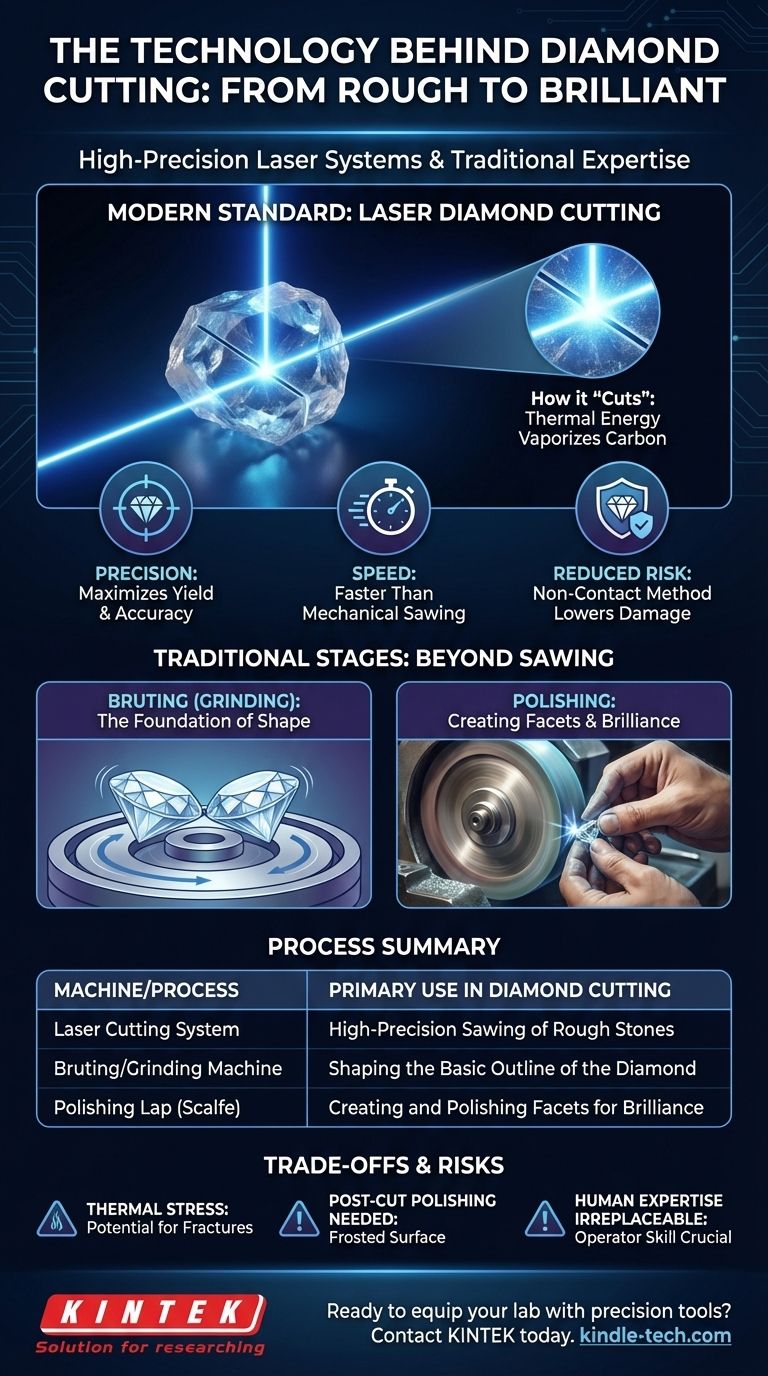
The introduction of lasers revolutionized the diamond industry, moving it from a purely mechanical craft to a high-technology process. Lasers are used for the most delicate and high-stakes step: sawing the rough stone.
How a Laser "Cuts" a Diamond
A laser doesn't "cut" in the traditional sense of a blade slicing through material. Instead, a highly focused and powerful beam of thermal energy is aimed at a precise line on the diamond.
This intense heat vaporizes the carbon of the diamond atom by atom, creating a perfect incision or kerf. The entire process is mapped and controlled by sophisticated computer software that analyzes the rough stone to plan the optimal cuts.
The Key Advantages of Lasers
Compared to the old method of using a diamond-dusted mechanical saw, lasers offer three immense benefits.
First is precision. A laser beam can make incredibly thin and accurate cuts, preserving as much of the valuable rough stone as possible.
Second is speed. Laser sawing is significantly faster than mechanical sawing, which could take many hours or even days for a large stone.
Finally, there is reduced risk. Mechanical saws created significant friction and pressure, which could cause a diamond to fracture, especially if it had internal inclusions. Lasers are a non-contact method, which dramatically lowers the risk of catastrophic damage.
Beyond Sawing: Laser Inscription
The same technology allows for microscopic inscriptions on the girdle of a diamond. This is often used to add a unique serial number from a grading laboratory, like the GIA, providing an unparalleled layer of identification and security.
The Traditional Stages Still in Use
While lasers are used for sawing, they are only one part of a multi-stage process. Several traditional techniques remain essential for creating the final, polished gem.
Bruting (or Grinding): The Foundation of Shape
After a stone is sawed, its basic round shape (for a brilliant cut) is created by a process called bruting or grinding. This involves rubbing two diamonds against each other to wear them down and form their fundamental outlines.
Polishing: Creating the Facets and Brilliance
This is the final and most artistic step. A skilled cutter presses the diamond against a spinning wheel, called a lap, which is coated in a fine paste of oil and diamond dust.
Each individual facet is carefully ground and polished onto the stone at a precise angle. The arrangement and quality of these facets are what determine the diamond's fire, sparkle, and overall brilliance.
Understanding the Trade-offs and Risks
While laser technology is superior for sawing, it is not a perfect or risk-free solution. The process requires immense expertise to manage its inherent challenges.
The Danger of Internal Stress
The intense heat generated by the laser can create thermal shock and internal stress within the diamond's crystal structure. If not managed perfectly, this can cause fractures or cleavages to form, damaging the stone.
The Need for Post-Cut Polishing
A laser-cut surface is not a finished surface. It often has a slightly frosted or rough texture left from the vaporization process. Every surface cut by a laser must be subsequently polished on a lap to become transparent and brilliant.
The Irreplaceable Human Expert
Laser cutting is not an automated "push-button" process. It requires a highly skilled operator to analyze the rough stone's inclusions, program the cutting path, and monitor the machine. The technology is a powerful tool, but the quality of the result still depends entirely on human expertise.
How the Process Creates the Final Gem
Understanding the different stages reveals how technology and human artistry work together to transform a rough stone into a finished jewel.
- If the goal is maximizing value: Lasers are used to precisely saw the rough stone, executing a pre-planned cutting pattern that yields the most valuable combination of gems with the least amount of waste.
- If the goal is creating the basic shape: The foundational outline of the diamond is still achieved through the mechanical process of grinding one diamond against another.
- If the goal is unlocking brilliance: The final, breathtaking sparkle comes from a human cutter meticulously polishing each facet onto the diamond using a diamond-dusted lap.
Ultimately, the journey of a diamond from a rough stone to a brilliant gem is a fusion of cutting-edge laser technology and centuries-old artisanal skill.
Summary Table:
| Machine/Process | Primary Use in Diamond Cutting |
|---|---|
| Laser Cutting System | High-precision sawing of rough stones |
| Bruting/Grinding Machine | Shaping the basic outline of the diamond |
| Polishing Lap (Scalfe) | Creating and polishing facets for brilliance |
Ready to equip your lab with precision tools? KINTEK specializes in high-quality lab equipment and consumables for material science and gemology applications. Whether you're researching advanced cutting techniques or need reliable tools for analysis, our solutions are designed to enhance your precision and efficiency. Contact our experts today to find the perfect equipment for your laboratory's needs!
Visual Guide
Related Products
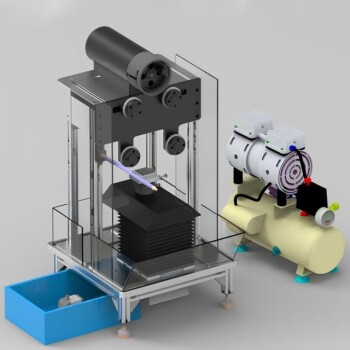
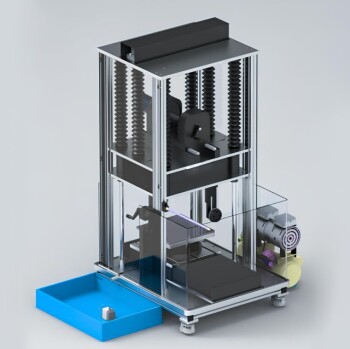
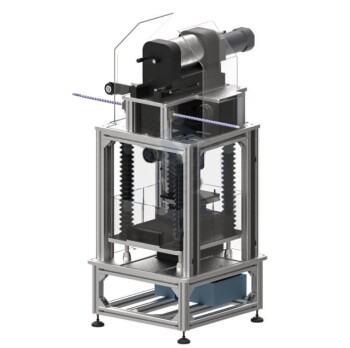
- High Precision Diamond Wire Cutting Machine Laboratory Saw Precision Wire EDM Cutting Machine
- 12 Inch 24 Inch High Precision Automatic Diamond Wire Cutting Machine Laboratory Saw Precision Wire EDM Cutting Machine
- Precision Wire Saw Laboratory Cutting Machine with 800mm x 800mm Workbench for Diamond Single Wire Circular Small Cutting
- CVD Diamond Cutting Tool Blanks for Precision Machining
- CVD Diamond Dressing Tools for Precision Applications
People Also Ask
- How long does it take to make a diamond in a machine? From Weeks to Billions of Years
- What is the best way to make lab diamonds? HPHT vs. CVD Methods Explained
- Are diamonds used in machines? Unlock Superior Performance with Diamond Tools
- What is something a hydraulic press can't break? The Physics of Force, Pressure, and Material Limits
- What is the use of diamond in electronics? Powering Next-Generation High-Performance Systems