The primary objective of using grinding tools in this specific context is to apply mechanical force that uniformly disperses trace amounts of transient solvent (DMF) and halide solutions onto the surface of LATP particles. This process is less about particle size reduction and more about surface modification, ensuring that every LATP particle is evenly coated. This uniform distribution is the critical first step in preparing the material for successful consolidation.
Grinding establishes a uniform surface coating on LATP particles, which acts as the foundation for continuous ion transport channels. This physical uniformity is a non-negotiable prerequisite for utilizing the grain boundary liquid phase to drive densification during the cold sintering process.
The Mechanics of Surface Modification
Achieving Uniform Dispersion
The introduction of liquids like DMF into a powder mixture can easily result in localized clumping or uneven distribution.
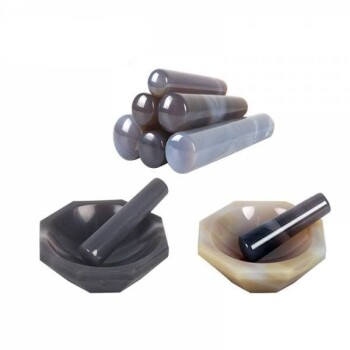
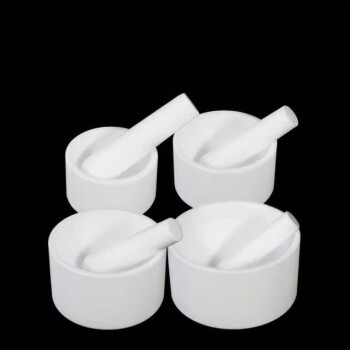
Grinding tools, such as agate mortars or ball milling equipment, solve this by applying consistent mechanical shear.
This force spreads the trace solvent and halide solution thinly and evenly across the surface of the solid LATP particles.
Creating the "Active" Interface
The goal of this mechanical mixing is to create a specific microscopic architecture.
By coating the particles effectively, you are preparing the grain boundaries—the interfaces where particles touch—for the next stage of processing.
Without this mechanical intervention, the chemical components required for sintering would remain isolated rather than covering the particle surfaces.
Why Uniformity Matters for Sintering
Enabling the Liquid Phase
The ultimate goal of this preparation is to facilitate cold sintering.
For cold sintering to work, a "grain boundary liquid phase" must be present to promote the movement and rearrangement of particles.
The grinding process ensures that the solvent (the liquid phase precursor) is exactly where it needs to be: at the grain boundaries, ready to facilitate densification when pressure is applied.
Forming Ion Transport Channels
Beyond structural density, the grinding process directly impacts the electrochemical performance of the material.
The coating formed during grinding evolves into continuous ion transport channels.
If the dispersion is uniform, these channels connect seamlessly throughout the material, allowing ions to move freely.
Risks of Inconsistent Processing
The Cost of Poor Dispersion
If the mechanical force applied during grinding is insufficient, the coating on the LATP particles will be discontinuous.
A discontinuous coating leads to gaps in the ion transport channels, significantly reducing the material's conductivity.
Failure to Densify
Furthermore, uneven dispersion means the liquid phase will not be available at every grain boundary.
This results in structural defects and low density after sintering, as the mechanism responsible for densification (the liquid phase) was missing from those specific contact points.
Optimizing Your Preparation Protocol
To ensure the best results from your LATP-Li3InCl6-DMF preparation, align your grinding technique with your specific performance targets:
- If your primary focus is Ionic Conductivity: Ensure your grinding duration is sufficient to create a perfectly continuous coating, as this directly forms the pathways for ion transport.
- If your primary focus is Structural Density: Prioritize the uniformity of the dispersion to guarantee that the liquid phase is present at all grain boundaries to drive maximum densification.
The mechanical action of grinding is the essential bridge that transforms raw powder and solvent into a cohesive, high-performance solid electrolyte.
Summary Table:
| Key Process Element | Role in Preparation | Impact on Final Material |
|---|---|---|
| Mechanical Shear | Disperses DMF and halide solutions | Ensures uniform surface coating |
| Agate Mortar / Ball Mill | Applies consistent force | Prevents localized clumping and defects |
| Liquid Phase Interface | Facilitates grain boundary contact | Drives densification during cold sintering |
| Uniform Dispersion | Creates continuous channels | Maximizes ionic conductivity and density |
Elevate Your Solid-State Battery Research with KINTEK
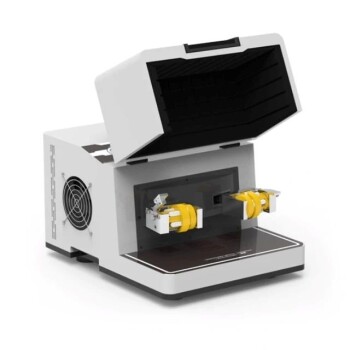
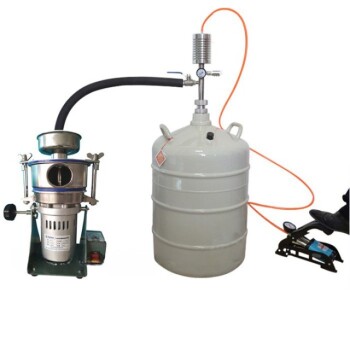
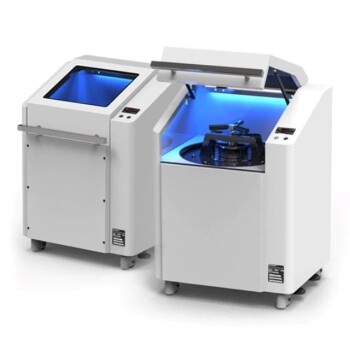
Precision in material preparation is the foundation of high-performance electrolytes. KINTEK specializes in providing the high-quality laboratory equipment and consumables essential for advanced material synthesis. Whether you need professional-grade agate mortars, high-efficiency ball milling equipment, or crushing and milling systems to achieve the perfect surface modification for your LATP powders, we have you covered.
Our extensive portfolio also includes hydraulic presses (pellet, hot, isostatic) for densification, high-temperature furnaces, and battery research tools designed to help researchers create seamless ion transport channels and superior structural density.
Ready to optimize your cold sintering process and enhance your material's conductivity? Contact KINTEK today to discover how our tailored solutions can drive your lab's success.
Related Products
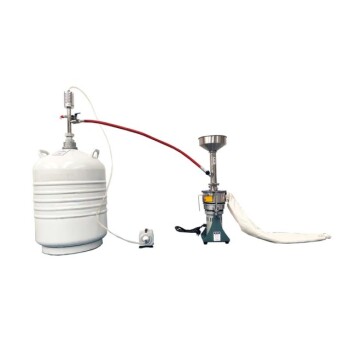
- Liquid Nitrogen Cryogenic Grinder Mill Cryomill Airflow Ultrafine Pulverizer
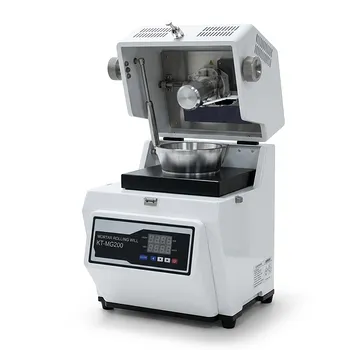
- Laboratory Grinding Mill Mortar Grinder for Sample Preparation
- Stainless Steel Laboratory Ball Mill for Dry Powder and Liquid with Ceramic Polyurethane Lining
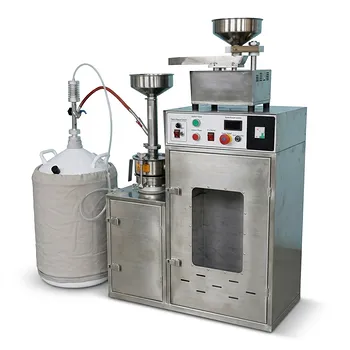
- Liquid Nitrogen Cryogenic Grinder Mill Cryomill with Screw Feeder
- Nature Agate Mortar and Pestle for Grinding and Mixing
People Also Ask
- What is cryogenic grinding of crumb rubber? Achieve Fine, High-Quality Rubber Powder
- What are the advantages of using a cryogenic grinder? Achieve Nanoscale Precision for All-Solid-State Battery Cathodes
- What is the role of a cryogenic grinder in PET recycling? Transform Waste into High-Reactive Micron Powders
- Why is a cryogenic grinder required for cured alkyd resin HRMAS NMR? Ensure Structural Integrity & Sample Precision
- What is the temperature of cryogenic grinding? Achieve Superior Particle Size & Preserve Heat-Sensitive Materials