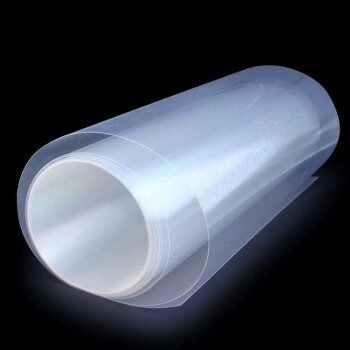
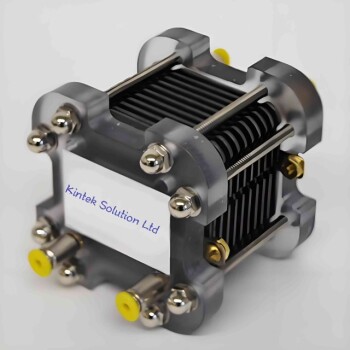
Beyond acting as a simple separator, ion exchange membranes serve as the critical solid electrolyte in zero-gap CO2 electrolyzers. They actively manage the system's electrical balance by selectively transporting specific ions (like H+ or OH-) and directly influence chemical yield by physically blocking product crossover.
Core Takeaway While structural separation is necessary, the membrane’s primary value lies in its role as a selective gatekeeper. By controlling ion flow and preventing product mixing, it dictates the system's Faradaic efficiency and the purity of the final chemical output.
The Membrane as an Active Conductor
Functioning as a Solid Electrolyte
In zero-gap configurations, the ion exchange membrane replaces the need for a liquid electrolyte gap. It functions as a solid electrolyte, providing the necessary medium for electrical continuity between the anode and cathode.
Selective Ion Transport
The membrane does not allow indiscriminate flow; it is designed for selectivity. It specifically permits the passage of ions required to balance electrical charges—typically protons (H+) or hydroxide ions (OH-)—while blocking others.
Enhancing Efficiency and Product Integrity
Preventing Product Crossover
A major role of the membrane is acting as a physical barrier against the migration of reaction products. It stops synthesized compounds, such as formates or alcohols, from crossing over to the counter electrode where they could be re-oxidized or lost.
Maximizing Faradaic Efficiency
By restricting the movement of reactants and products to their respective compartments, the membrane ensures that the electrical current is utilized for the intended reaction. This minimizes waste currents and significantly increases Faradaic efficiency.
Ensuring Final Purity
The membrane prevents the mixing of reactant gases and liquid products. This separation ensures the purity of the final output, reducing the need for complex downstream purification processes.
Understanding the Operational Trade-offs
Selectivity vs. Resistance
While the membrane must act as a barrier to products, it must offer low resistance to the target ions (H+ or OH-). If the membrane is too restrictive, it acts as a bottleneck for charge transport, reducing overall cell performance.
Physical Integrity Challenges
The membrane acts as a barrier to crossover, but it must maintain this function under operation. Any breach in this physical barrier immediately degrades product purity and lowers efficiency by allowing reactant mixing.
Optimizing Membrane Selection for Your Goals
To maximize the performance of a zero-gap CO2 electrolyzer, consider the following specific priorities:
- If your primary focus is energy efficiency: Prioritize membranes with high ionic conductivity for H+ or OH- to minimize internal resistance and facilitate rapid charge balancing.
- If your primary focus is product quality: Select membranes with superior physical barrier properties to strictly prevent the crossover of liquid products like formates and alcohols.
The membrane is not just a wall; it is the active engine of separation and transport that determines the viability of your electrochemical process.
Summary Table:
| Feature | Primary Role in Zero-Gap Electrolyzers | Impact on Performance |
|---|---|---|
| Solid Electrolyte | Provides electrical continuity without liquid gaps | Reduces internal resistance & system footprint |
| Selective Ion Flow | Controls transport of specific ions (H+ or OH-) | Balances electrical charges for continuous reaction |
| Crossover Barrier | Blocks product migration (formates, alcohols) | Maintains product purity & prevents re-oxidation |
| Efficiency Booster | Concentrates current on intended reactions | Maximizes Faradaic efficiency & chemical yield |
Elevate Your Electrochemical Research with KINTEK Precision
Unlock the full potential of your CO2 reduction experiments with high-performance components from KINTEK. Whether you are developing zero-gap electrolyzers or advanced carbon capture systems, our expertise in electrolytic cells, electrodes, and high-pressure reactors ensures your lab achieves maximum Faradaic efficiency and product purity.
Why choose KINTEK?
- Specialized Electrolytic Solutions: High-quality cells and electrodes designed for selective ion transport.
- Comprehensive Lab Portfolio: From high-temperature furnaces and crushing systems to precision hydraulic presses and cooling solutions.
- Built for Rigor: Our consumables, including PTFE products and ceramics, are engineered for demanding chemical environments.
Ready to optimize your electrochemical yields? Contact our technical specialists today to find the perfect equipment for your green energy innovations!
References
- Clara Casado‐Coterillo, Ángel Irabien. An Analysis of Research on Membrane-Coated Electrodes in the 2001–2019 Period: Potential Application to CO2 Capture and Utilization. DOI: 10.3390/catal10111226
This article is also based on technical information from Kintek Solution Knowledge Base .
Related Products
- Anion Exchange Membrane for Laboratory Use
- Proton Exchange Membrane for Batteries Lab Applications
- Polyethylene Separator for Lithium Battery
- Customizable PEM Electrolysis Cells for Diverse Research Applications
- FS Electrochemical Hydrogen Fuel Cells for Diverse Applications
People Also Ask
- What is the role of an Anion Exchange Membrane (AEM)? Boost Safety and Efficiency in Photoelectrochemical Systems
- What role does an anion exchange membrane play in a PEC battery? Ensure Safe, High-Purity Hydrogen Production
- What is the role of an ion exchange membrane in MCCA Kolbe electrolysis? Enhance Purity & Safety in Your Lab
- What should be considered when selecting an ion exchange membrane? Key Factors for Optimal Performance
- Why are ion exchange membranes essential in electrochemical cell configurations? Optimize Cell Efficiency and Safety