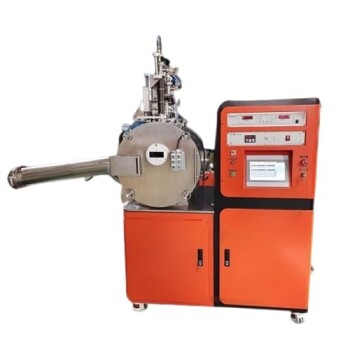
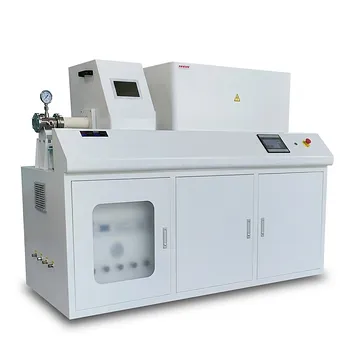
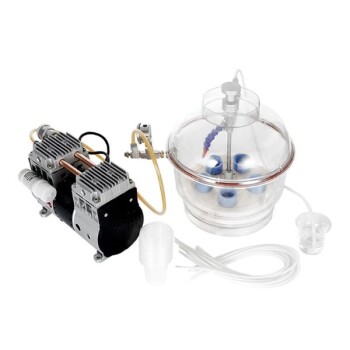
Vacuum pumps and pressure control systems serve as the precise regulators of the chemical environment during the melting process of metallic yttrium. Their primary function is to maintain specific residual oxygen partial pressures—typically between 5·10² Pa and 5·10³ Pa—which directly dictates how yttrium interacts with oxygen sources within the furnace.
By finely tuning oxygen levels, researchers can control the reduction of iron oxide by metallic yttrium. This precision is essential for creating dispersed yttrium oxide particles, the key to synthesizing high-performance nano-reinforced materials.
The Mechanics of Environment Control
Regulating Oxygen Partial Pressure
The fundamental role of the vacuum and pressure system is to move beyond simple air evacuation. It must establish and sustain a specific equilibrium of gases.
The system targets a precise window of oxygen partial pressure, specifically ranging from 5·10² Pa to 5·10³ Pa. This range is not arbitrary; it is the calculated "sweet spot" for the desired chemical activity.
Simulating Oxidative Conditions
These systems allow researchers to simulate different oxidative environments under controlled laboratory conditions.
By varying the pressure within the established range, scientists can model how metallic yttrium behaves under different levels of oxygen availability. This capability is crucial for understanding the material's stability and reactivity before finalizing a synthesis protocol.
Driving the Chemical Transformation
Enabling the Reduction Reaction
The controlled environment facilitates a specific chemical exchange: the reduction of iron oxide.
Under these regulated pressures, metallic yttrium acts as a reducing agent. It strips oxygen from iron oxide, a reaction that would be difficult to control in an open atmosphere or a fluctuating vacuum.
Creating Dispersed Yttrium Oxide
The ultimate goal of this reaction is the transformation of metallic yttrium into dispersed yttrium oxide particles.
These particles are not merely byproducts; they are the reinforcing agents in nano-reinforced materials. The vacuum system ensures these particles form with the correct dispersion characteristics, which is vital for the mechanical properties of the final material.
Understanding the Necessity of Precision
The Risk of Pressure Fluctuation
The synthesis pathway is highly sensitive to the partial pressure of oxygen. If the pressure control system fails to maintain the specific range (e.g., drifting outside 5·10² Pa to 5·10³ Pa), the reaction kinetics change.
Impact on Material Synthesis
Inaccurate pressure control compromises the optimization of synthesis pathways.
Without the stable environment provided by these systems, it becomes impossible to reliably reproduce the formation of dispersed yttrium oxide. This leads to inconsistent material properties, rendering the nano-reinforced material less effective for high-performance applications.
Making the Right Choice for Your Goal
To effectively utilize vacuum systems in yttrium oxidation studies, consider your specific research objectives:
- If your primary focus is fundamental research: Prioritize systems that offer granular control over pressure variables to simulate a wide spectrum of oxidative environments for modeling purposes.
- If your primary focus is material production: Ensure your system can rigidly maintain the 5·10² Pa to 5·10³ Pa range to guarantee the consistent reduction of iron oxide and uniform particle dispersion.
Precision in pressure control is the defining factor that turns raw metallic yttrium into advanced, nano-reinforced structural components.
Summary Table:
| System Component | Primary Role | Key Parameter (Oxygen) | Outcome |
|---|---|---|---|
| Vacuum Pump | Evacuation & Environment Stabilization | $5 \cdot 10^2$ to $5 \cdot 10^3$ Pa | Controlled reduction of iron oxide |
| Pressure Control | Regulation of Oxygen Partial Pressure | Constant Partial Pressure | Formation of dispersed $Y_2O_3$ particles |
| Furnace Atmosphere | Simulation of Oxidative Conditions | Variable Pressure Range | Optimized synthesis for nano-reinforcement |
Elevate Your Material Research with KINTEK Precision
Precise atmospheric control is the difference between inconsistent results and high-performance nano-reinforced materials. KINTEK specializes in advanced laboratory equipment designed for rigorous metallurgical research. Whether you are studying complex oxidation reactions or synthesizing advanced ceramics, our comprehensive range of vacuum and atmosphere furnaces (tube, muffle, CVD) and high-temperature high-pressure reactors provides the stability you need.
From high-purity PTFE products and crucibles to precise vacuum systems, KINTEK delivers the tools required for meticulous pressure regulation and material synthesis.
Ready to optimize your synthesis pathway? Contact KINTEK today to discover how our customized equipment solutions can enhance your lab's precision and efficiency.
References
- Alexandr Panichkin, Alexandr Arbuz. RESEARCH OF INJECTION METHODS FOR Y2O3 NANOPARTICLES INTO NICKEL- FREE STAINLESS STEEL DURING INDUCTION VACUUM REMELTING. DOI: 10.59957/jctm.v59.i1.2024.20
This article is also based on technical information from Kintek Solution Knowledge Base .
Related Products
- Laboratory Hydraulic Pellet Press for XRF KBR FTIR Lab Applications
- Vacuum Induction Melting Spinning System Arc Melting Furnace
- Chemical Vapor Deposition CVD Equipment System Chamber Slide PECVD Tube Furnace with Liquid Gasifier PECVD Machine
- Vacuum Heat Treat and Sintering Furnace with 9MPa Air Pressure
- Vacuum Heat Treat and Pressure Sintering Furnace for High Temperature Applications
People Also Ask
- What is the role of a laboratory hydraulic pellet press and stainless steel molds in the fabrication of RuO2/NbC anodes?
- What is the necessity of using a laboratory hydraulic pellet press in the preparation of biomass fuel pellets? Guide
- How does a laboratory hydraulic pellet press contribute to SiCw/2024 aluminum composite preforms? Optimize Densification
- What is the significance of applying 200 MPa of pressure with a laboratory hydraulic pellet press for composite ceramics?
- What key role does a laboratory pellet press play in FTIR analysis? Master KBr Sample Preparation Excellence