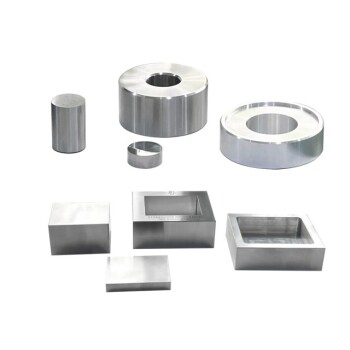
The graphite mold functions as the critical interface between the raw powder materials and the extreme forces of the hot-pressing furnace. It serves simultaneously as a precise geometric container for the layered Ti2AlN/TiN stacking and as the active transmission medium for both thermal energy and mechanical pressure.
The graphite mold acts as a conductive vessel that translates external furnace conditions into internal material properties. By ensuring uniform heat distribution and direct pressure transmission, it enables the transformation of loose, graded powder layers into a cohesive, high-density bulk material.
The Mechanics of FGM Formation
Defining Geometric Structure
The primary role of the graphite mold is to act as a containment vessel for the raw materials.
It holds the specific stacking of layered powders, ranging from pure Ti2AlN to pure TiN.
This containment defines the final geometric shape of the functionally graded material (FGM), typically forming it into a cylinder or similar simple geometry.
Uniform Thermal Conduction
Graphite is selected specifically for its excellent thermal conductivity at high temperatures.
In a vacuum hot-pressing environment, the heat source is often external to the sample.
The mold captures this heat and conducts it uniformly to the internal powder layers, ensuring consistent sintering temperatures across the material gradient.
Transmission of Mechanical Pressure
Beyond heating, the mold is the physical medium through which uniaxial pressure is applied.
The mold transmits mechanical force directly to the powder stack while maintaining structural integrity.
This pressure drives particle rearrangement and plastic flow, which are necessary to eliminate pores and achieve high density in the final composite.
Operational Considerations and Limitations
The Consumable Nature of Graphite
It is critical to recognize that the graphite mold is a core consumable in this process.
While it withstands high temperatures, the combination of pressure and thermal cycling degrades the mold over time.
It is not a permanent fixture and requires replacement to maintain geometric precision and surface quality.
Environmental Requirements
The mold's performance relies heavily on the vacuum environment of the hot-pressing furnace.
While graphite conducts well, it is susceptible to oxidation at the high temperatures required for sintering Ti2AlN and TiN.
Therefore, the mold functions effectively only when protected by the vacuum conditions that prevent material degradation.
Optimizing the Hot-Pressing Strategy
To effectively utilize graphite molds in the production of Ti2AlN/TiN composites, consider the following strategic priorities:
- If your primary focus is Geometric Precision: Ensure the mold design accounts for the specific shrinkage rates of both Ti2AlN and TiN to maintain the desired shape after densification.
- If your primary focus is Material Densification: Prioritize the quality of the graphite contact surfaces to ensure maximum pressure transmission without uneven stress distribution.
The graphite mold is not merely a container, but the active transmission tool that makes high-temperature densification physically possible.
Summary Table:
| Function | Description | Impact on FGM |
|---|---|---|
| Geometric Containment | Holds layered powder stacking | Defines final shape and structural integrity |
| Thermal Conduction | Transfers heat to internal layers | Ensures uniform sintering temperatures |
| Pressure Transmission | Applies uniaxial mechanical force | Drives densification and eliminates porosity |
| Material Interface | Acts as a conductive vessel | Translates furnace conditions into material properties |
Elevate Your Material Research with KINTEK
Ready to achieve superior density and precision in your functionally graded materials? At KINTEK, we specialize in the high-performance laboratory equipment you need to succeed. From advanced vacuum hot-pressing furnaces to a comprehensive range of crushing, milling, and hydraulic presses, we provide the tools necessary for complex material synthesis.
Our portfolio also features:
- High-Temperature Reactors & Autoclaves
- Precision Graphite Consumables & Ceramics
- Cooling Solutions (ULT Freezers & Freeze Dryers)
- Battery Research Tools & Homogenizers
Don't let equipment limitations hinder your innovation. Let KINTEK’s experts help you select the perfect system for your Ti2AlN/TiN projects and beyond. Contact us today to optimize your lab's performance!
Related Products
- Special Heat Press Mold for Lab Use
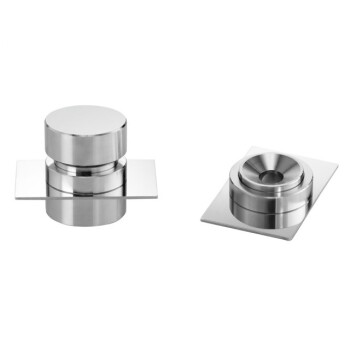
- Ball Press Mold for Lab
- Double Plate Heating Press Mold for Lab
- Anti-Cracking Press Mold for Lab Use
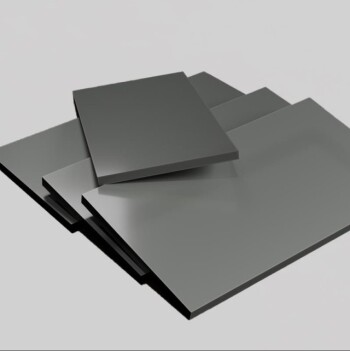
- Carbon Graphite Plate Manufactured by Isostatic Pressing Method
People Also Ask
- How to use a press mold? Master the Art of Creating Consistent Ceramic Forms
- What is the press mould method? A Guide to Consistent, Detailed Ceramic Forms
- What is a press mold used for? Achieve Repeatable Precision and Efficiency
- What is the function of press molds during the preparation of SiCf/Ti-43Al-9V composites? Achieve Structural Precision
- What is the purpose of specialized pressure devices in sulfide solid-state batteries? Ensure Chemo-Mechanical Stability