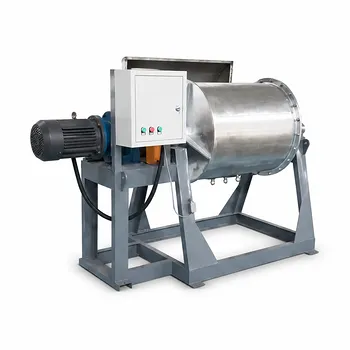
The high-energy ball mill serves as the primary engine for mechanical alloying and structural refinement. By applying intense mechanical forces, it facilitates the cold welding of the copper matrix while forcibly embedding layered graphene onto particle surfaces. This process is essential for achieving a uniform dispersion of reinforcement phases and ensuring strong interfacial bonding between the metal matrix and the nanocomposite elements.
Core Insight: The ball mill is not merely a mixer; it is a reactor that uses kinetic energy to physically force disparate materials—metals, ceramics, and carbon nanostructures—into a cohesive, uniformly dispersed composite with enhanced interfacial properties.
The Mechanics of Synthesis
The preparation of Cu/Ti3SiC2/C/Graphene nanocomposites relies on the specific physical interactions generated within the milling jar.
Facilitating Mechanical Alloying
The mill generates high-energy impacts and shear forces. These forces drive a cycle of fracture and re-welding, allowing the various components to mix at a microscopic level rather than simply sitting adjacent to one another.
Cold Welding and Diffusion
Under intense mechanical pressure, copper particle clusters undergo cold welding. This process encourages the diffusion of atoms and creates a solid metallic matrix that traps and holds the reinforcing elements.
Optimization of the Microstructure
Beyond simple mixing, the high-energy ball mill actively modifies the structure of the constituent powders to improve material performance.
Embedding Layered Graphene
One of the most critical roles of the mill is managing the graphene component. The mechanical forces forcibly embed or adhere the layered graphene sheets directly onto the surface of the copper particles, preventing the graphene from agglomerating.
Refining Reinforcement Phases
The process significantly reduces the particle size of the reinforcement phases (Ti3SiC2 and C). By refining these components, the mill ensures they are not just fillers but active structural reinforcements.
Achieving Uniform Dispersion
The impact and shear forces break down clusters of nanomaterials. This results in a homogenous distribution of all elements throughout the copper matrix, which is vital for consistent material properties.
Understanding the Trade-offs
While high-energy ball milling is effective, it involves aggressive processing conditions that require careful management.
Energy Input vs. Structural Integrity
The process relies on intense mechanical forces to achieve bonding. However, excessive energy input can potentially damage the delicate structure of nanomaterials like graphene if not properly controlled.
Agglomeration vs. Dispersion
The goal is to break down agglomerates. However, the high surface energy generated during milling can sometimes lead to new agglomerations if the milling duration or speed is not optimized for the specific material ratio.
Making the Right Choice for Your Goal
To maximize the effectiveness of high-energy ball milling for your specific nanocomposite application, focus on your end-goal requirements.
- If your primary focus is interfacial strength: Prioritize parameters that maximize the cold welding of copper, as this physically locks the graphene and Ti3SiC2 into the matrix.
- If your primary focus is microstructural homogeneity: Focus on the shear forces generated by the mill to break down reinforcement agglomerations and ensure uniform dispersion.
Summary: The high-energy ball mill is the critical tool that transforms loose powder mixtures into robust nanocomposites by leveraging mechanical force to refine particle size, embed reinforcements, and forge strong interfacial bonds.
Summary Table:
| Process Function | Mechanism | Impact on Nanocomposite |
|---|---|---|
| Mechanical Alloying | Cycle of fracture and re-welding | Creates a cohesive, microscopic mixture of disparate phases |
| Cold Welding | Intense mechanical pressure | Ensures a solid metallic matrix that traps reinforcements |
| Graphene Embedding | Forced adhesion to surfaces | Prevents graphene agglomeration and ensures interfacial bonding |
| Structural Refinement | High-energy impact and shear | Reduces particle size of Ti3SiC2 and C for active reinforcement |
| Phase Dispersion | Breaking of nanomaterial clusters | Guarantees homogenous material properties throughout the matrix |
Elevate Your Material Synthesis with KINTEK
Precision in nanocomposite preparation starts with high-performance equipment. KINTEK specializes in advanced laboratory solutions, including high-energy crushing and milling systems designed to optimize mechanical alloying and structural refinement. Whether you are engineering complex Cu/Graphene composites or refining ceramics, our range of planetary ball mills, high-temperature furnaces, and hydraulic presses ensures uniform dispersion and superior interfacial bonding.
Maximize your lab's efficiency and material performance today. Contact our specialists to find the perfect milling solution for your research!
Related Products
- High Energy Planetary Ball Mill Milling Machine for Laboratory
- High Energy Planetary Ball Mill for Laboratory Horizontal Tank Type Milling Machine
- High-Energy Omnidirectional Planetary Ball Mill Milling Machine for Laboratory
- High Energy Planetary Ball Mill Milling Machine for Laboratory
- High Energy Planetary Ball Mill Machine for Laboratory Horizontal Tank Type
People Also Ask
- What role do planetary ball mills and zirconia media play in LLZT preparation? Optimize Your Solid Electrolyte Research
- What is the primary function of a planetary ball mill? Mastering SiC/Al Composite Mixing for Homogeneity
- What is the primary purpose of using a planetary ball mill for LAGP? Achieve High-Purity Solid-State Electrolytes
- What role does a planetary ball mill play in the preparation of LGVO powders? Precision Refinement for Aerosol Deposition
- What is the function of a planetary ball mill in the preparation of high-entropy rare earth silicate multi-phase ceramics?