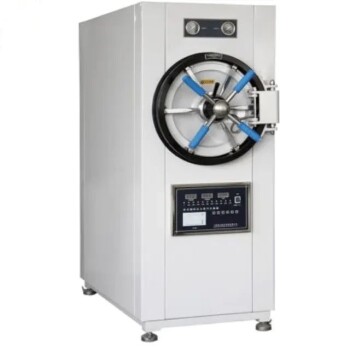
The high-pressure reactor, or autoclave, serves as the fundamental testing vessel for simulating the extreme operating environments of next-generation power systems. It functions by creating and maintaining a precise supercritical carbon dioxide (S-CO2) atmosphere, typically reaching temperatures of 650 °C and ultra-high pressures of 20 MPa. This controlled environment allows researchers to conduct long-term exposure tests to accurately evaluate the corrosion resistance of protective coatings and structural materials.
The autoclave does not merely heat and pressurize gas; it utilizes precision components like back-pressure regulators (BPR) to ensure environmental parameters remain statistically stable over hundreds of hours. This stability is critical for validating whether materials can withstand the aggressive oxidation typical of advanced power cycles.
Simulating Next-Generation Conditions
Achieving Extreme Parameters
The primary function of the autoclave is to replicate the harsh conditions found in S-CO2 power reactors.
To be effective, the system must sustain a temperature of 650 °C and a pressure of 20 MPa. These specific parameters place the carbon dioxide in a supercritical state, where it exhibits unique fluid properties that differ significantly from standard gases or liquids.
Ensuring Environmental Stability
Reaching these parameters is only the first step; maintaining them is the true challenge.
The autoclave employs a back-pressure regulator (BPR) to precisely control the internal pressure. This ensures that the environment remains stable throughout the duration of the experiment.
Without this regulation, fluctuations in pressure could alter the chemical behavior of the S-CO2, rendering the corrosion data unreliable.
Evaluating Material Performance
Long-Term Exposure Testing
Corrosion is rarely an instantaneous process; it occurs over time.
The autoclave enables long-term exposure tests, such as those lasting 500 hours. This duration allows researchers to observe how materials degrade gradually rather than just assessing their initial reaction.
Testing Protective Coatings
A key application of these reactors is evaluating the efficacy of protective coatings.
By exposing coated samples to this high-pressure, high-temperature environment, engineers can determine if the coating effectively shields the substrate or if it delaminates and fails under stress.
Analyzing Microstructural Evolution
Beyond surface coatings, the autoclave is used to test structural elements, such as diffusion-bonded joints.
Researchers use these tests to observe microstructural evolution and chemical stability. This reveals how the internal structure of the metal changes when subjected to high-temperature oxidizing gases, helping to predict mechanical failures.
Critical Considerations and Trade-offs
The Necessity of Precision Sealing
While these reactors provide valuable data, they require rigorous design standards to function safely.
The system must utilize reliable sealing and pressure-bearing designs to handle pressures exceeding 20 MPa. Any failure in the sealing mechanism not only poses a safety risk but also introduces independent variables, such as pressure loss, that invalidate the study of oxidation kinetics.
Balancing Simulation vs. Reality
The autoclave excels at simulating static or controlled circulation environments.
However, researchers must remember that this is a controlled laboratory simulation. While it effectively isolates variables to study chemical stability, it may not perfectly replicate every dynamic hydrodynamic force present in a full-scale, flowing commercial reactor pipeline.
Making the Right Choice for Your Goal
When designing an S-CO2 corrosion test, the configuration of the autoclave should match your specific research objectives.
- If your primary focus is evaluating coating durability: Prioritize a setup with a high-precision back-pressure regulator (BPR) to ensure the pressure remains constant over long durations (500+ hours).
- If your primary focus is analyzing structural joints: Ensure the reactor can reach peak thermal parameters (650 °C) to stress-test the chemical stability of diffusion bonds.
- If your primary focus is oxidation kinetics: verify the system's sealing integrity to eliminate hydrodynamic interference and isolate the effects of the oxidizing gas.
The autoclave is the bridge between theoretical material science and the practical realization of safe, efficient next-generation power plants.
Summary Table:
| Feature | Specification/Role in S-CO2 Testing |
|---|---|
| Temperature Capability | Reaches and sustains up to 650 °C |
| Pressure Rating | Maintains ultra-high pressures up to 20 MPa |
| Core Component | Back-pressure regulator (BPR) for statistical stability |
| Primary Function | Long-term exposure testing (e.g., 500+ hours) |
| Key Applications | Testing coatings, diffusion-bonded joints, and oxidation kinetics |
| Safety Design | High-integrity sealing and pressure-bearing construction |
Advance Your Power System Research with KINTEK
To develop next-generation power systems, you need laboratory equipment that can reliably withstand the most aggressive environments. KINTEK specializes in high-performance laboratory solutions, offering a comprehensive range of high-temperature high-pressure reactors and autoclaves specifically designed for S-CO2 corrosion testing and material science.
From precise back-pressure regulation to extreme thermal stability, our reactors empower researchers to validate coatings, analyze microstructural evolution, and ensure the chemical stability of structural components. Whether you are focusing on dental materials, battery research, or advanced metallurgy, KINTEK provides the crushing, milling, and high-temperature furnace systems you need to succeed.
Ready to elevate your lab's testing capabilities?
Contact our experts today to find the perfect autoclave or high-pressure reactor solution for your specific research goals.
References
- Sung Hwan Kim, Changheui Jang. Corrosion Behavior of Si Diffusion Coating on an Austenitic Fe-Base Alloy in High Temperature Supercritical-Carbon Dioxide and Steam Environment. DOI: 10.3390/coatings10050493
This article is also based on technical information from Kintek Solution Knowledge Base .
Related Products
- Stainless High Pressure Autoclave Reactor Laboratory Pressure Reactor
- Mini SS High Pressure Autoclave Reactor for Laboratory Use
- Customizable High Pressure Reactors for Advanced Scientific and Industrial Applications
- Desktop Fast High Pressure Laboratory Autoclave Sterilizer 16L 24L for Lab Use
- High Pressure Laboratory Autoclave Reactor for Hydrothermal Synthesis
People Also Ask
- Why is a laboratory high-pressure reactor necessary for synthesizing fly ash-based zeolite? Achieve Pure Crystallization
- Why is a laboratory high-pressure reactor used in the hydrothermal synthesis of hydroxyapatite catalysts?
- What role does a laboratory high-pressure reactor play in the leaching process of spent cathode materials? Optimize Recovery
- What conditions do laboratory high-pressure reactors provide for HTC? Optimize Your Biochar Production Processes
- How are high-pressure reactors used to prepare metaphosphate electrocatalysts? Master In-Situ Precursor Growth