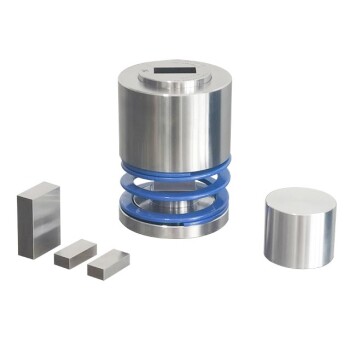
The primary function of a high-pressure reactor during the hydrothermal synthesis of Bi1-xLaxFeO3 microparticles is to generate a sealed, high-temperature environment that drives a dissolution-recrystallization mechanism. This specific thermodynamic state is required to facilitate the uniform substitution of lanthanum ions into the crystal lattice and to direct the growth of specific crystal morphologies, such as octahedrons or nanosheets. Ultimately, this controlled environment is responsible for enhancing the material's dielectric constant and photocatalytic activity.
The reactor serves as a thermodynamic tool that leverages autogenous pressure to force the uniform integration of dopants and control crystal facet exposure, directly dictating the functional performance of the final material.
The Mechanics of the High-Pressure Environment
Facilitating Dissolution-Recrystallization
The core mechanism at play is dissolution-recrystallization.
Inside the reactor, the high pressure and temperature dramatically alter the properties of the liquid medium. This environment forces the precursors to dissolve more effectively than they would under standard conditions. Once dissolved, the material recrystallizes into the desired Bi1-xLaxFeO3 structure with high purity.
Generating Autogenous Pressure
Because the reactor is a closed system, heating the solvent above its boiling point generates significant autogenous pressure.
This pressure is not merely a byproduct; it is a critical variable. It increases the boiling point of the solvent, preventing evaporation and maintaining a liquid phase at temperatures where the solvent would normally be a gas. This ensures continuous contact between the solvent and the precursors.
Controlling Diffusion Rates
The high-pressure environment allows for the precise regulation of diffusion rates within the system.
By controlling how fast ions move through the solution, the reactor dictates the kinetics of crystal growth. This control is essential for preventing the rapid, chaotic precipitation that leads to amorphous or poorly formed particles.
Impact on Crystal Structure and Performance
Regulating Morphology
The reactor conditions determine which crystal planes are exposed during growth.
Depending on the specific pressure and temperature settings, the system can promote the formation of distinct shapes, such as octahedrons or nanosheets. This morphological control is vital because different crystal faces exhibit different chemical reactivities and physical properties.
Ensuring Uniform Doping
One of the most difficult challenges in synthesis is achieving uniform substitution of doping elements.
The high-pressure hydrothermal environment promotes the even distribution of lanthanum ions (La) into the BiFeO3 lattice. Without this pressure-assisted integration, the dopants might cluster or fail to integrate, leading to inconsistent material properties.
Enhancing Functional Properties
The ultimate goal of using this reactor is to improve the material's end-use performance.
By ensuring high crystallinity and uniform doping, the reactor directly contributes to a higher dielectric constant and improved photocatalytic activity. The specific crystal faces exposed during synthesis (e.g., in nanosheets) are often the most active sites for these applications.
Understanding the Trade-offs
Operational Complexity
While high-pressure reactors offer superior control, they introduce safety and operational complexity.
Operating a vessel under high pressure and temperature requires rigorous safety protocols and precise monitoring equipment. Unlike open-air synthesis, you cannot easily adjust precursors or sample the material mid-reaction.
Batch Limitations
These reactors typically operate as batch systems.
This can limit scalability compared to continuous flow processes. Synthesizing large quantities of Bi1-xLaxFeO3 often requires multiple distinct runs or larger, more expensive autoclave systems, which may introduce slight batch-to-batch variations if not strictly controlled.
Making the Right Choice for Your Goal
To maximize the utility of your high-pressure reactor for Bi1-xLaxFeO3 synthesis, align your process parameters with your specific performance targets:
- If your primary focus is Photocatalytic Activity: Prioritize pressure and temperature settings that favor the growth of nanosheets, as this morphology typically offers a larger surface area for reactions.
- If your primary focus is Dielectric Stability: Focus on maintaining stable, prolonged high-pressure conditions to ensure the most uniform Lanthanum substitution, reducing lattice defects that degrade dielectric performance.
By strictly controlling the thermodynamic environment within the reactor, you transform basic chemical precursors into highly engineered, purpose-built microstructures.
Summary Table:
| Feature | Function in Bi1-xLaxFeO3 Synthesis | Impact on Final Material |
|---|---|---|
| Autogenous Pressure | Prevents solvent evaporation at high temperatures | Maintains liquid phase for continuous reaction |
| Dissolution-Recrystallization | Facilitates precursor breakdown and reformation | Ensures high phase purity and crystallinity |
| Morphology Control | Regulates growth of specific crystal planes | Forms octahedrons or nanosheets for activity |
| Dopant Integration | Forces uniform substitution of Lanthanum (La) | Increases dielectric constant and stability |
| Kinetic Regulation | Controls ion diffusion rates | Prevents amorphous precipitation and defects |
Elevate Your Materials Research with KINTEK
Precision in hydrothermal synthesis requires equipment that can withstand extreme thermodynamic conditions. KINTEK specializes in providing high-performance laboratory solutions, including high-temperature high-pressure reactors and autoclaves designed specifically for complex chemical synthesis like Bi1-xLaxFeO3 microparticles.
Whether you are focusing on enhancing photocatalytic activity through nanosheet growth or stabilizing dielectric properties via uniform doping, our reactors offer the safety and control you need. Beyond reactors, explore our comprehensive range of high-temperature furnaces, crushing and milling systems, and specialized consumables like PTFE products and ceramics.
Ready to achieve superior crystal morphology? Contact us today to find the perfect reactor for your lab!
References
- Yassine Nassereddine, Mustapha Jouiad. Recent Advances toward Enhanced Photocatalytic Proprieties of BiFeO3-Based Materials. DOI: 10.3390/nano14010051
This article is also based on technical information from Kintek Solution Knowledge Base .
Related Products
- Customizable Laboratory High Temperature High Pressure Reactors for Diverse Scientific Applications
- Customizable High Pressure Reactors for Advanced Scientific and Industrial Applications
- Stainless High Pressure Autoclave Reactor Laboratory Pressure Reactor
- Visual High-Pressure Reactor for In-Situ Observation
- Mini SS High Pressure Autoclave Reactor for Laboratory Use
People Also Ask
- How do high-pressure and high-temperature reactors ensure the effective treatment of lignocellulosic wastewater in WAO?
- What equipment is required for high-pressure high-temperature reactions? Master Extreme Chemistry Safely
- How do you control high pressure in a reactor? A Guide to Safe & Stable Operation
- How does initial oxygen pressure affect the wet oxidation of pharmaceutical sludge? Master Your Oxidation Depth
- Why is argon better than nitrogen for inert atmosphere? Ensure Absolute Reactivity & Stability