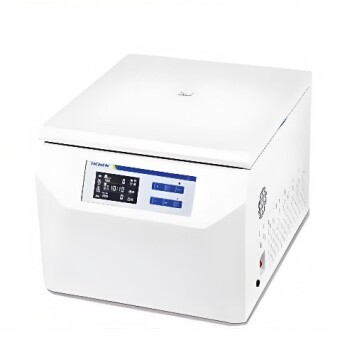
The primary role of a high-pressure reactor in biomass hydrothermal processing is to maintain water in a liquid or specific fluid state at temperatures significantly exceeding its boiling point (typically above 100°C). By creating a sealed, pressurized environment, the reactor prevents water from vaporizing, allowing it to function as a highly effective medium for breaking down complex biomass structures.
Core Takeaway The high-pressure reactor transforms water from a passive solvent into a chemically active tool. It forces water to remain liquid at high temperatures, which increases its density and ion product, effectively turning the water itself into an acid-base catalyst that drives hydrolysis without the need for external chemicals.
Transforming the Properties of Water
Maintaining the Liquid Phase
At standard atmospheric pressure, water boils and vaporizes at 100°C. However, efficient biomass processing often requires temperatures between 150°C and 185°C.
The high-pressure reactor suppresses vaporization, ensuring the biomass remains submerged in a subcritical or supercritical fluid state. This physical contact is a prerequisite for the chemical reactions required to break down organic components.
Enhancing Solvation Capacity
The high-pressure environment directly impacts the physical properties of the water. Specifically, it increases the water's density.
Higher density under these conditions significantly enhances the water's solvation capacity. This allows the fluid to penetrate the biomass matrix more effectively, dissolving and extracting components that would remain insoluble under standard conditions.
Enabling Chemical conversion
Water as an Autocatalyst
One of the most critical functions of the reactor is altering the chemical nature of water. The high temperature and pressure increase the ion product of the water.
This change allows water to act as an acid-base catalytic medium. Consequently, the reactor enables the effective hydrolysis of polysaccharides into monosaccharides without requiring the addition of external acid or base catalysts, making the process cleaner and more efficient.
Driving Complex Reactions
The sealed environment facilitates a range of deep thermochemical conversions beyond simple breakdown.
The conditions promote deacetylation, dehydration, decarboxylation, and polymerization. These reactions are essential for removing inorganic elements and modifying the organic structure of the biomass.
Shaping Material Characteristics
Regulating Product Morphology
The reactor ensures thermal uniformity and maintains autogenous pressure (often 2–10 MPa).
This control is vital for defining the physical structure of the resulting material, often referred to as hydrochar. It facilitates the formation of mesoporous structures and high surface porosity, which are critical for applications like adsorption.
Functionalizing the Surface
The high-pressure aqueous environment helps develop specific chemical traits on the material's surface.
Specifically, it promotes the formation of abundant oxygen-containing functional groups (such as aromatic groups). These groups enhance the material's chemical activity, combustion characteristics, and capacity to adsorb heavy metals.
Understanding the Trade-offs
While high-pressure reactors enable advanced processing, they introduce specific engineering challenges that must be managed.
Equipment Cost and Complexity
Operating at pressures between 2 to 10 MPa requires robust, thick-walled vessels made of high-grade materials (often PTFE-lined). This significantly increases the initial capital investment compared to atmospheric pressure systems.
Safety and Scalability
The combination of high heat and high pressure creates potential safety hazards that require rigorous monitoring and safety protocols. Furthermore, scaling these batch-style, high-pressure systems up to continuous industrial levels is technically complex and energy-intensive.
Making the Right Choice for Your Goal
The utility of a high-pressure reactor depends largely on the specific end-product you are trying to derive from the biomass.
- If your primary focus is sugar extraction: Prioritize the reactor's ability to increase the ion product of water, facilitating the hydrolysis of polysaccharides into monosaccharides without added catalysts.
- If your primary focus is biochar or fuel production: Focus on the reactor's ability to maintain autogenous pressure for carbonization, which enhances the porosity and combustion characteristics of the hydrochar.
- If your primary focus is remediation (adsorbents): Leverage the reactor's ability to increase surface functional groups, which improves the material's ability to capture heavy metals like cadmium.
By controlling pressure, you do not just contain the reaction; you fundamentally alter the chemistry of water to unlock the potential of the biomass.
Summary Table:
| Feature | Role in Hydrothermal Processing | Benefit for Biomass |
|---|---|---|
| Phase Control | Maintains water in liquid/subcritical state | Enables reactions above 100°C without vaporization |
| Solvation Capacity | Increases fluid density under pressure | Enhances penetration and dissolution of organic matrices |
| Ion Product | Boosts water's acid-base catalytic properties | Facilitates chemical-free hydrolysis of polysaccharides |
| Pressure Regulation | Maintains autogenous pressure (2–10 MPa) | Defines hydrochar morphology and surface porosity |
| Functionalization | Promotes oxygen-containing group formation | Improves chemical activity and metal adsorption capacity |
Revolutionize Your Biomass Research with KINTEK
Maximize your hydrothermal yields and achieve precise material functionalization with KINTEK’s high-performance laboratory equipment. Whether you are extracting sugars or engineering advanced hydrochar, our specialized high-temperature high-pressure reactors and autoclaves provide the safety, durability, and thermal uniformity required for complex thermochemical conversions.
Our comprehensive portfolio supports every stage of your workflow:
- Reactors & Autoclaves: Robust PTFE-lined and high-pressure vessels for subcritical water processing.
- Processing Systems: Crushing, milling, and sieving equipment for biomass preparation.
- Material Analysis: Precision dental and atmosphere furnaces for post-processing characterization.
- Lab Essentials: High-quality ceramics, crucibles, and PTFE consumables built to withstand harsh environments.
Ready to scale your innovation? Contact KINTEK today to consult with our experts on the ideal high-pressure solutions for your target applications.
References
- Fiorella P. Cárdenas‐Toro, M. Ângela A. Meireles. Obtaining Oligo- and Monosaccharides from Agroindustrial and Agricultural Residues Using Hydrothermal Treatments. DOI: 10.5923/j.fph.20140403.08
This article is also based on technical information from Kintek Solution Knowledge Base .
Related Products
- Customizable Laboratory High Temperature High Pressure Reactors for Diverse Scientific Applications
- Customizable High Pressure Reactors for Advanced Scientific and Industrial Applications
- Stainless High Pressure Autoclave Reactor Laboratory Pressure Reactor
- Mini SS High Pressure Autoclave Reactor for Laboratory Use
- High Pressure Laboratory Autoclave Reactor for Hydrothermal Synthesis
People Also Ask
- How do high-pressure and high-temperature reactors ensure the effective treatment of lignocellulosic wastewater in WAO?
- What equipment is required for high-pressure high-temperature reactions? Master Extreme Chemistry Safely
- How do you control high pressure in a reactor? A Guide to Safe & Stable Operation
- Why is argon better than nitrogen for inert atmosphere? Ensure Absolute Reactivity & Stability
- How does initial oxygen pressure affect the wet oxidation of pharmaceutical sludge? Master Your Oxidation Depth