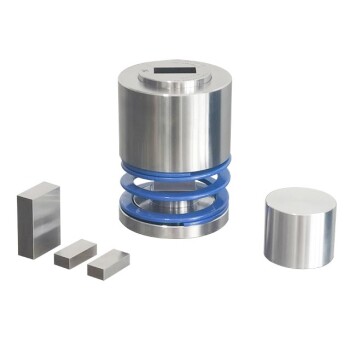
A high-pressure reactor is the critical engine for hydrothermal synthesis. It provides the sealed, high-energy environment necessary to transform liquid precursor solutions into solid Molybdenum Trioxide (MoO3) nanorods. Specifically, it enables precise control over temperature and autogenous pressure to dictate the morphology and structural integrity of the resulting nanostructures.
The high-pressure reactor creates a subcritical hydrothermal environment that facilitates controlled hydrolysis and oriented growth. This ensures the production of MoO3 nanorods with uniform dimensions and the structural stability required for subsequent chemical processing like phosphidation or carbonization.
The Hydrothermal Reaction Environment
Achieving Subcritical Conditions
The primary role of the reactor is to maintain a sealed hydrothermal environment where temperatures can safely exceed the boiling point of the solvent. Under these conditions, the physicochemical properties of the water or solvent change, increasing the solubility of reagents and accelerating the hydrolysis of molybdenum precursors.
Maintaining Constant Pressure and Volume
By preventing the evaporation of the solvent, the reactor generates autogenous pressure. This pressure is essential for driving the chemical reaction to completion and ensuring that the nutrient solution reacts continuously at a constant temperature, which is vital for high-quality crystal formation.
Mechanisms of Morphological Control
Facilitating Oriented Growth
The high-pressure environment is the primary driver for oriented growth, a process where crystals grow along a specific crystallographic axis. This directional arrangement is what transforms the bulk precursor into distinct nanorod structures rather than irregular particles.
Ensuring Uniform Supersaturation
The reactor allows for the slow, controlled decomposition of precursors, maintaining a state of stable supersaturation. This stability is necessary for the uniform nucleation of nanorods, resulting in a product with a smooth surface and a consistent average diameter (typically around 400 nm).
Optimization of Aspect Ratios
Precise pressure control within the vessel allows researchers to fine-tune the aspect ratio (the ratio of length to width) of the nanorods. This geometric precision is critical because the surface-to-volume ratio directly impacts the material's performance in downstream applications.
Establishing a Structural Framework
Foundation for Secondary Processing
In many synthesis workflows, the MoO3 nanorod is not the final product but a precursor framework. The high-pressure reactor ensures the rods are structurally stable enough to withstand subsequent high-heat processes such as phosphidation or carbonization.
Integration with Substrates
The reactor’s environment facilitates the growth of these nanostructures directly onto substrates, such as carbon cloth or metal foams. This results in a tight integration at the molecular scale, creating free-standing arrays that offer high specific surface areas for electrochemical reactions.
Understanding the Trade-offs
Safety and Equipment Complexity
High-pressure reactors require rigorous safety protocols and specialized materials (like stainless steel with Teflon liners) to withstand corrosive precursors and high internal stresses. Failure to manage these parameters can lead to equipment fatigue or hazardous pressure releases.
Sensitivity to Temperature Fluctuations
The morphology of MoO3 is highly sensitive to even minor changes in the thermal gradient within the reactor. Inconsistent heating can lead to non-uniform nanorod diameters or the unintended formation of nanobelts or flakes instead of rods.
Scalability Constraints
While hydrothermal synthesis in high-pressure reactors produces high-quality crystals, it is often difficult to scale for mass production. The batch-style nature of these reactors means that increasing output requires either larger, more dangerous pressure vessels or a significant increase in the number of individual units.
Applying These Insights to Your Synthesis
Making the Right Choice for Your Goal
To achieve the best results in MoO3 nanorod synthesis, your approach to using a high-pressure reactor should align with your specific research or production objectives.
- If your primary focus is morphological precision: Prioritize a reactor with high-accuracy PID temperature controllers to ensure stable supersaturation and uniform rod diameters.
- If your primary focus is material durability: Ensure the reactor maintains high autogenous pressure throughout the dwell time to maximize the crystallinity and structural integrity of the nanorod framework.
- If your primary focus is high surface area: Optimize the precursor concentration and reaction time within the sealed environment to favor high-aspect-ratio growth.
Effective utilization of a high-pressure reactor transforms unpredictable chemical reactions into a precise manufacturing process for advanced nanostructures.
Summary Table:
| Feature | Role in MoO3 Synthesis | Impact on Nanostructure |
|---|---|---|
| Subcritical Environment | Enables solvent temperatures above boiling point | Increases reagent solubility and hydrolysis rates |
| Autogenous Pressure | Prevents evaporation in a sealed vessel | Drives reaction completion and crystal formation |
| Oriented Growth | Directs crystallization along specific axes | Transforms bulk material into uniform nanorods |
| Stable Supersaturation | Controlled decomposition of precursors | Ensures smooth surfaces and consistent rod diameters |
| Structural Framework | Facilitates integration with substrates | Provides stability for phosphidation or carbonization |
Elevate Your Nanomaterial Synthesis with KINTEK Precision
Achieving the perfect morphology for Molybdenum Trioxide nanorods requires more than just chemistry—it requires uncompromising environmental control. KINTEK specializes in high-performance laboratory equipment designed to meet the rigorous demands of hydrothermal synthesis. Our high-temperature high-pressure reactors and autoclaves are engineered for safety and precision, providing the stable autogenous pressure and thermal accuracy necessary for superior crystal growth.
Beyond reactors, KINTEK offers a comprehensive portfolio to support your entire research workflow, including:
- Thermal Processing: Muffle, tube, and vacuum furnaces for secondary processing.
- Sample Preparation: Crushing, milling, and hydraulic presses (pellet, hot, isostatic).
- Advanced Research Tools: Electrolytic cells, battery research consumables, and high-purity ceramics.
Ready to optimize your MoO3 synthesis or upgrade your lab’s capabilities? Contact our technical experts today to discover how KINTEK’s reliable solutions can enhance your material performance and research efficiency.
References
- Jiamin Xiao, Lei Han. Synergistic Effect of Nitrogen/Phosphorus <scp>Co‐Doping</scp> and Molybdenum Carbide Induced Electron Redistribution of Carbon Layer to Boost Hydrogen Evolution Reaction<sup>†</sup>. DOI: 10.1002/cjoc.202300400
This article is also based on technical information from Kintek Solution Knowledge Base .
Related Products
- Customizable Laboratory High Temperature High Pressure Reactors for Diverse Scientific Applications
- Customizable High Pressure Reactors for Advanced Scientific and Industrial Applications
- Stainless High Pressure Autoclave Reactor Laboratory Pressure Reactor
- Visual High-Pressure Reactor for In-Situ Observation
- Mini SS High Pressure Autoclave Reactor for Laboratory Use
People Also Ask
- How do high-pressure and high-temperature reactors ensure the effective treatment of lignocellulosic wastewater in WAO?
- What equipment is required for high-pressure high-temperature reactions? Master Extreme Chemistry Safely
- How do you control high pressure in a reactor? A Guide to Safe & Stable Operation
- How does initial oxygen pressure affect the wet oxidation of pharmaceutical sludge? Master Your Oxidation Depth
- Why is argon better than nitrogen for inert atmosphere? Ensure Absolute Reactivity & Stability